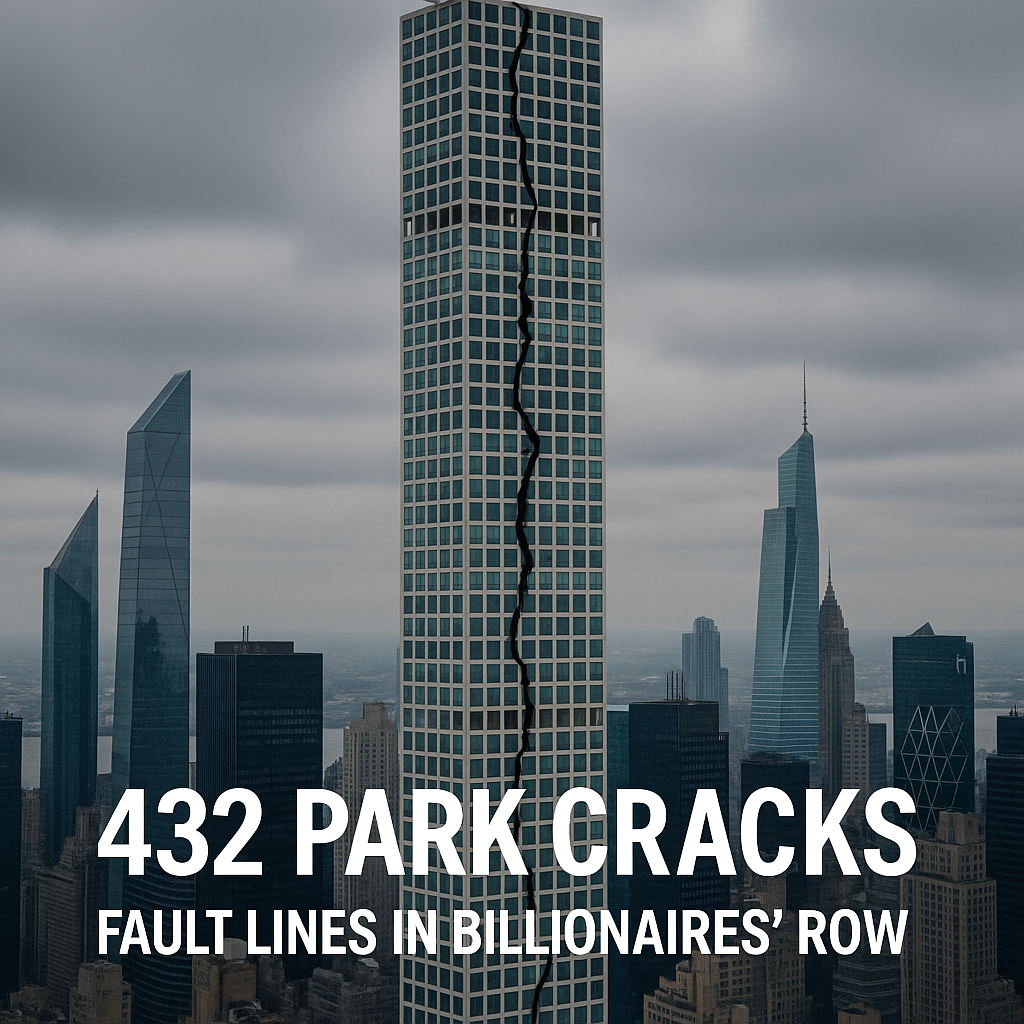
New York — A dramatic saga at 432 Park Avenue, the slender supertall that reshaped Manhattan’s Billionaires’ Row, has raised urgent questions about who is accountable when luxury towers crack. Residents have reported fissures, water intrusion and balky systems in a building that opened in 2015, and lawsuits, insurance claims and regulatory scrutiny have quickly followed.
At stake is more than a skyline blemish. The disputes highlight gaps in engineering, construction oversight and risk pricing — and they are accelerating interest in technology solutions from AI-driven monitoring to blockchain-based maintenance records.
What happened
432 Park Avenue, designed by Rafael Viñoly and completed in 2015, was built as an architectural statement: an ultra-slim, supertall residential tower with some of the city’s most expensive apartments. But over recent years residents and engineers documented cracking in walls and floors, noises attributed to structural movement, and instances of water penetration. Those conditions prompted resident complaints, litigation and inspections by city regulators.
Parties squarely in the crosshairs include those who designed and constructed the building, the condo board that manages it and insurers that underwrite construction and post-construction risk. Each contends with questions about design choices for such a slender tower, the quality of materials and workmanship, and the adequacy of ongoing maintenance and monitoring.
Who’s to blame — and why tech matters
Finding a single culprit is unlikely. Ultralight structural designs, tall slenderness ratios, wind-induced sway and complex mechanical systems all interact. In many cases, what looks like a cosmetic crack can signal differential settlement, concrete creep or failed joints — issues that require forensic engineering, not just patchwork repairs.
Technology is surfacing as part of the solution. Startups offering AI-powered structural-health monitoring, digital twins and sensor networks are pitching ways to continuously measure strain, moisture and vibration in real time. Those systems use machine learning to detect anomalous patterns earlier than periodic human inspections, and some investors see a potential regulatory tailwind that could drive adoption.
Blockchain proponents argue that immutable maintenance and inspection ledgers could prevent disputes about what was done and when. A tamper-resistant record of repairs, permits and inspections can help insurers and lenders assess risk more transparently, and could become a requirement in future condo sales or financing packages.
Financial and geopolitical ripple effects
The economics are material. Insurers are reassessing risk models for high-rise residential buildings, and lenders may demand more stringent inspections or reserve accounts before issuing loans. That could affect valuations and liquidity for ultra-luxury units, many of which were purchased with cross-border capital. Geopolitical shifts — including sanctions and capital controls in some markets — already affected flows into global real estate and could compound market uncertainty.
For venture and proptech investors, the episode is a reminder of tail-risk opportunities. Funding into construction-technology, sensor firms and software for asset management has been growing as owners and managers look to mitigate the kind of reputational and capital risk now playing out at 432 Park Avenue.
Conclusion
The crisis at 432 Park is neither a single-point engineering failure nor purely a legal fight. It is a convergence of design ambition, aging materials, operational gaps and market incentives. Expect more scrutiny from regulators, greater appetite from insurers for data-driven proof of maintenance, and a wave of startups pitching AI, sensor networks and blockchain records as ways to reduce uncertainty. If those technologies deliver on their promise, the next generation of towers may be safer — and more transparently managed — but the economic reckoning for owners, insurers and lenders may be long-lasting.
About the Author