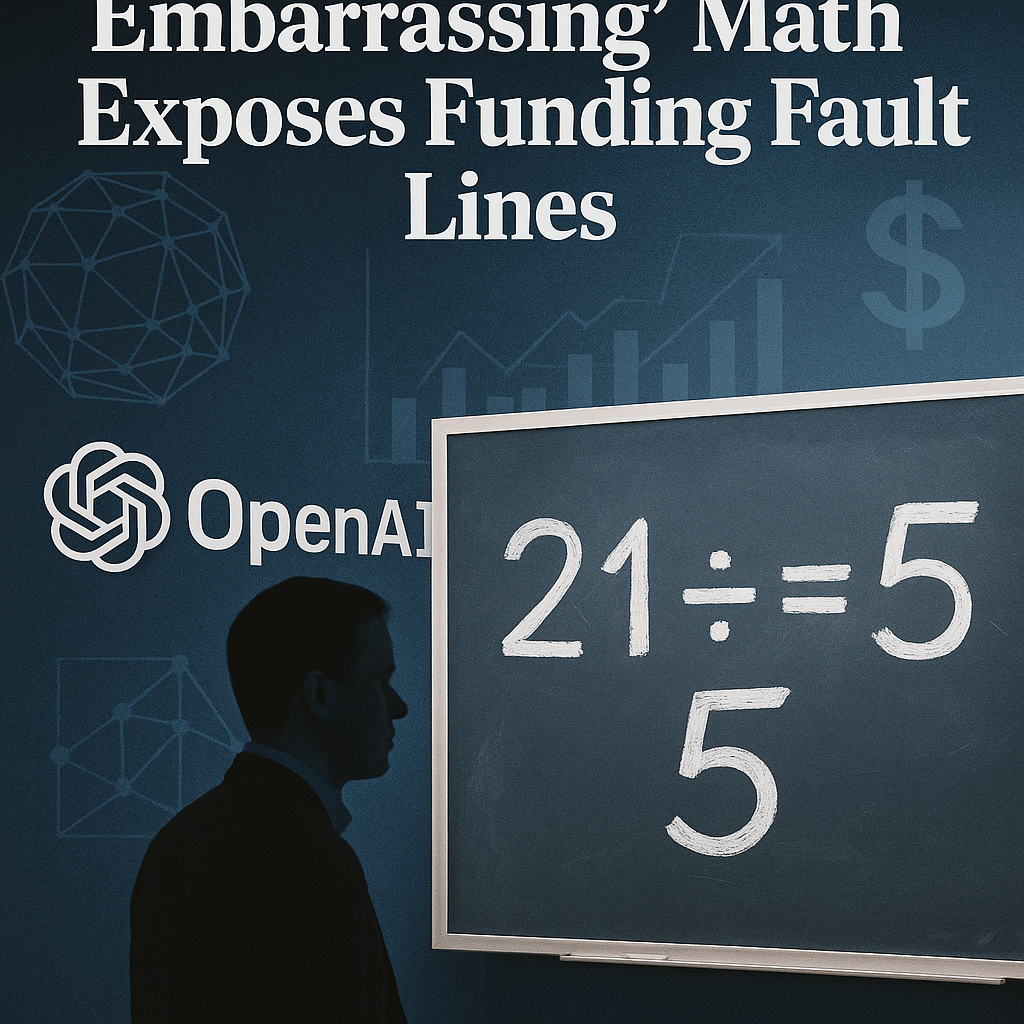
OpenAI has become the poster child for generative AI, but a recent debate over its public numbers — dismissed by some commentators as ’embarrassing’ math — has opened new questions about transparency, sustainability, and the financial underpinnings of the AI boom. The episode is a reminder that model performance alone won’t settle investor, regulatory, and geopolitical scrutiny: credible accounting will.
At issue is not a single smoking gun but a pattern critics say shows selective disclosure around revenue, costs, and compute economics. OpenAI, known for launching ChatGPT in late 2022 and monetizing through ChatGPT Plus subscriptions and API access, operates under a capped-profit model and has deep commercial ties to Microsoft, which publicly invested billions into the company. That relationship has allowed OpenAI access to Azure compute and enterprise distribution, but it has also made headlines as investors and regulators probe whether the company’s growth projections and unit economics add up.
Large language models are expensive to train and expensive to run in production. Publicly known facts — the multibillion-dollar Microsoft bet, the $20/month ChatGPT Plus tier, and heavy reliance on GPU-based data centers — underline why financial clarity matters. When stakeholders accuse an organization of sloppy arithmetic, it speaks to broader worries: how will startups that build on these models price services, how will VCs value companies whose primary costs are compute and talent, and how will sovereign actors react to concentrated compute capacity?
Startups across AI and adjacent sectors like blockchain are watching closely. Venture funding has cooled compared with the frenzy of 2021–22, pushing many startups to optimize for lower operating costs or to adopt open-source LLMs as cheaper backends. Blockchain projects tout decentralization as a hedge against concentrated infrastructure costs and control, though integrating on-chain primitives with low-latency, high-throughput AI inference remains technically and economically challenging.
Geopolitics intensifies the calculus. Export controls on advanced chips and lingering U.S.-China tensions raise compute pricing and supply risks. Companies that depend on centralized cloud providers face both higher bills and potential policy exposure. For a company like OpenAI, whose products are distributed globally and often embedded into mission-critical business workflows, demonstrating that its math is robust is as much about geopolitical risk management as it is about investor confidence.
Investors and enterprise customers are increasingly demanding verifiable metrics: churn, average revenue per user, API utilization, and real cost per token or inference. Transparency on these metrics can help startups benchmark and design profitable services, and it can discipline valuations in a sector prone to hype. At the same time, some opacity is structural — proprietary model architectures, negotiated cloud deals, and competitive positioning limit what companies can disclose without harming their edge.
What should founders, investors, and policymakers take away? First, unit economics matter. Knowing the true cost of delivering an LLM-powered service changes pricing, product design, and go-to-market strategy. Second, greater standardization of metrics would benefit the ecosystem: if cloud providers, model publishers, and integrators agree on basic cost and performance reporting, investors could underwrite risk more rationally. Third, geopolitical risk needs to be factored into capital plans: supply-chain fragility and export controls can transform marginal costs overnight.
Conclusion: the flap over OpenAI’s ’embarrassing’ math is less about public shaming and more a wake-up call. As AI embeds deeper into startups, enterprises, and national strategies, stakeholders will demand clearer numbers. Companies that meet that demand will win trust and capital; those that don’t may find valuations and partnerships harder to sustain. In an era where compute is currency, arithmetic is policy.
About the Author