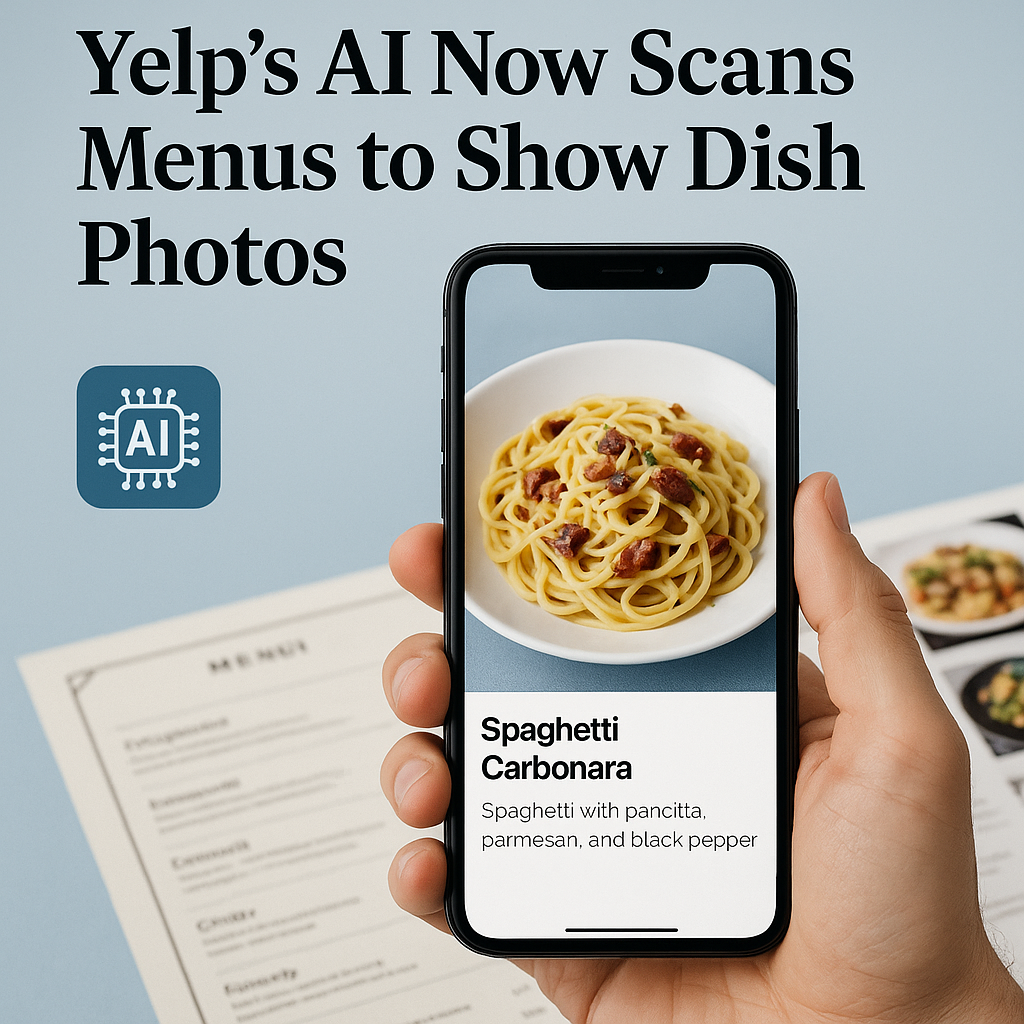
Yelp has rolled out an update to its AI assistant that lets users scan restaurant menus with their phone and see what listed dishes actually look like. The feature combines optical character recognition (OCR) with computer vision and multimodal AI to match menu items to user-submitted photos and generated imagery, promising a more visual and confident dining decision process for consumers.
At a technical level, the assistant parses the printed or digital menu, identifies dish names and descriptors, and then surfaces photos from Yelp’s extensive repository of user uploads. Where genuine photos are sparse, the system can use generative image models to create representative visuals that help set expectations. The pipeline marries OCR, natural language understanding, visual search and image-ranking models — an increasingly common stack for multimodal consumer AI.
For restaurants, the feature is a potential conversion amplifier. Visual confirmation of portion size, plating and ingredient presence can increase bookings and takeout orders. That raises business incentives for restaurants to encourage diners to upload high-quality images and to keep menus accurate — turning user photos into a form of low-cost marketing. For Yelp, richer visual experiences can boost engagement metrics and create new opportunities for promoted placement or premium listing features.
Startups and investors are watching closely. Visual AI for food discovery is a hot subsegment of consumer computer vision, and a number of well-funded startups have pursued automatic dish recognition, menu digitization and image-augmented ordering. Venture capital interest in generative and multimodal AI remains strong despite a recent recalibration in the broader funding environment; firms that can combine proprietary datasets (like aggregated restaurant photos) with efficient model deployment have clear commercialization pathways.
There are also adjacent plays. Blockchain proponents have argued for cryptographic provenance to verify where a photo came from and when it was taken. While Yelp is not announcing any blockchain integrations, the idea of verifiable media provenance resonates in a world worried about deepfakes and manipulated imagery. Supply-chain traceability projects using distributed ledgers could also intersect with food imagery in areas such as farm-to-table sourcing or premium ingredient verification, but those remain nascent and largely experimental.
Regulation and geopolitics are relevant too. The deployment of multimodal AI across borders faces differing legal frameworks: Europe’s AI Act and stringent privacy rules can limit data processing modalities and require transparency, while U.S. regulators have signaled interest in consumer protections around AI-generated content. Yelp will need to balance feature utility with compliance, especially when generated images are used as proxies for real photos — users and regulators may demand clear labeling and opt-outs.
Data quality is another practical challenge. Yelp’s advantage lies in its large base of user photographs and reviews, but crowdsourced imagery can be inconsistent. Effective ranking, deduplication and moderation systems are necessary to prevent misleading visuals. That opens opportunities for startups offering content moderation, image verification, or specialized vision models tuned to culinary contexts.
In sum, Yelp’s menu-scanning AI is a logical extension of the broader move toward multimodal, visually rich search experiences. It offers upside for restaurants and for Yelp’s monetization pathways, while stimulating competition among startups and attracting continued VC attention in verticalized visual-AI. Still, the feature comes with trade-offs: regulatory scrutiny, the need for provenance and moderation, and the technological work of delivering reliable, trustworthy imagery. How Yelp and the ecosystem address those challenges will shape whether this becomes a standard expectation for diners or just another novelty.
Looking forward, the evolution of menu and dish visualization could tie into broader commerce features — contactless ordering, dynamic menus, and even verified sourcing — creating crossovers between AI, supply-chain transparency, and emerging technologies like blockchain. For now, consumers can expect a more picture-driven way to choose what—and where—to eat.
About the Author