Why the loop matters now
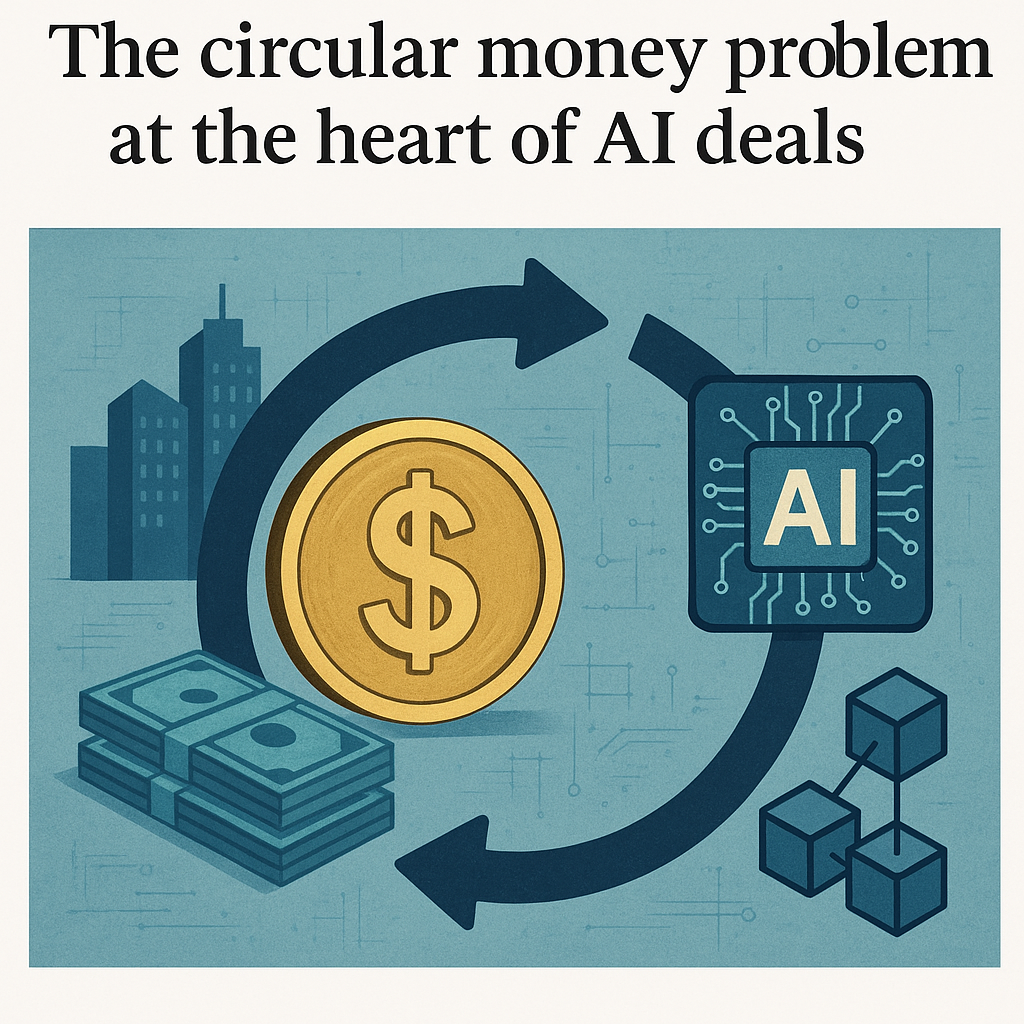
Big technology companies are not just funding the AI boom — they are often the recipients of the money those investments generate. That circular money problem, in which cash flows from investors into startups and then back into the coffers of the same investors via cloud contracts, chip purchases and services, is fast becoming a defining feature of the AI economy. The pattern has intensified since Microsoft’s 2019 $1 billion investment in OpenAI and accelerated through the multibillion-dollar partnerships and infrastructure deals that followed in 2023 and 2024.
Background: how the loop forms
The typical sequence is familiar by now. A hyperscaler or cloud vendor invests in an AI startup or inks an exclusivity deal. The startup trains and deploys large models that require vast amounts of GPU compute. Those GPUs are designed and sold largely by firms such as NVIDIA, while the compute is supplied through cloud platforms like Microsoft Azure, Amazon Web Services (AWS) or Google Cloud. In many cases, investment dollars and credits provided as part of partnerships flow directly or indirectly back to the investor via cloud bills, managed services and purchases of proprietary hardware.
This dynamic is visible in several headline relationships. Microsoft’s 2019 investment in OpenAI was followed by Azure becoming OpenAI’s primary cloud. NVIDIA’s meteoric rise — the company surpassed a $1 trillion market capitalization in 2023 amid surging datacenter sales — is tied to a global appetite for its GPUs. And cloud providers, which Synergy Research Group reports control roughly two-thirds of the global cloud infrastructure market, are the dominant venues where model training takes place. These interconnections concentrate economic value and raise questions about where profit really accrues in the AI value chain.
Why it’s a problem
There are three practical concerns. First, the loop concentrates economic rent in a small set of incumbent firms, potentially squeezing independent companies that lack access to preferential pricing or partnership terms. Second, it masks the true cost and profitability of AI services — headline investments can be recycled back into the investor through service revenues and hardware sales, creating an appearance of external growth while internal capture is the reality. Third, circular flows can amplify vendor lock-in, because startups that rely on an investor’s cloud or stack face high switching costs if they try to migrate.
Data points and market context
Exact numbers for compute spending remain opaque, but industry reporting has repeatedly shown that training and running large language models requires massive cloud budgets and specialized accelerators. Synergy Research’s analysis of cloud market share, NVIDIA’s public filings showing explosive datacenter revenue growth in 2023, and the handful of disclosed multibillion-dollar cloud and investment partnerships since 2023 together paint a picture of consolidated demand flowing to an equally concentrated set of suppliers.
Expert perspectives
Analysts and scholars caution that the circular money dynamic can distort incentives. Dan Ives of Wedbush has repeatedly argued that cloud and chip vendors are among the biggest beneficiaries of the AI wave because they capture much of the downstream spend. Kate Crawford, a long-time critic of tech concentration, has warned publicly about how infrastructure control concentrates power and shapes downstream research agendas and product behavior.
From a corporate perspective, the arrangement is logical: investors that provide capital, engineering support or credits also become trusted partners for mission-critical workloads. For a startup building at massive scale, tying with a hyperscaler can be the difference between survival and obsolescence. But that tension — between short-term scaling needs and long-term market health — is where regulators and competitors are starting to focus.
Implications for competition and policy
Regulators in the U.S., Europe and elsewhere are increasingly attuned to market concentration in digital infrastructure. While much of the regulatory conversation has centered on data privacy, misuse and the merits of the EU’s AI Act, competition authorities are also examining how exclusive partnerships and vertical ties might entrench incumbents. If investment dollars routinely return to investors via cloud bills and hardware sales, standard antitrust measures that focus only on market share or pricing may need to be updated to account for these circular flows.
Conclusion: what to watch next
Expect more scrutiny of disclosed partnership terms, cloud pricing, and the economics of model training. Watch for lawmakers to press cloud vendors and chipmakers on transparency around discounts, credits and bundled services. On the corporate side, startups will continue to face trade-offs: accept capital and privileged access from hyperscalers and risk lock-in, or stay independent and potentially struggle with costs at scale. Either way, the circular money problem is now central to understanding who really profits from AI’s biggest deals — and whether the rewards will diffuse across the economy or remain concentrated.
Related topics to explore: cloud consolidation, AI regulation, NVIDIA GPUs, Microsoft–OpenAI partnership, antitrust and digital infrastructure.
About the Author