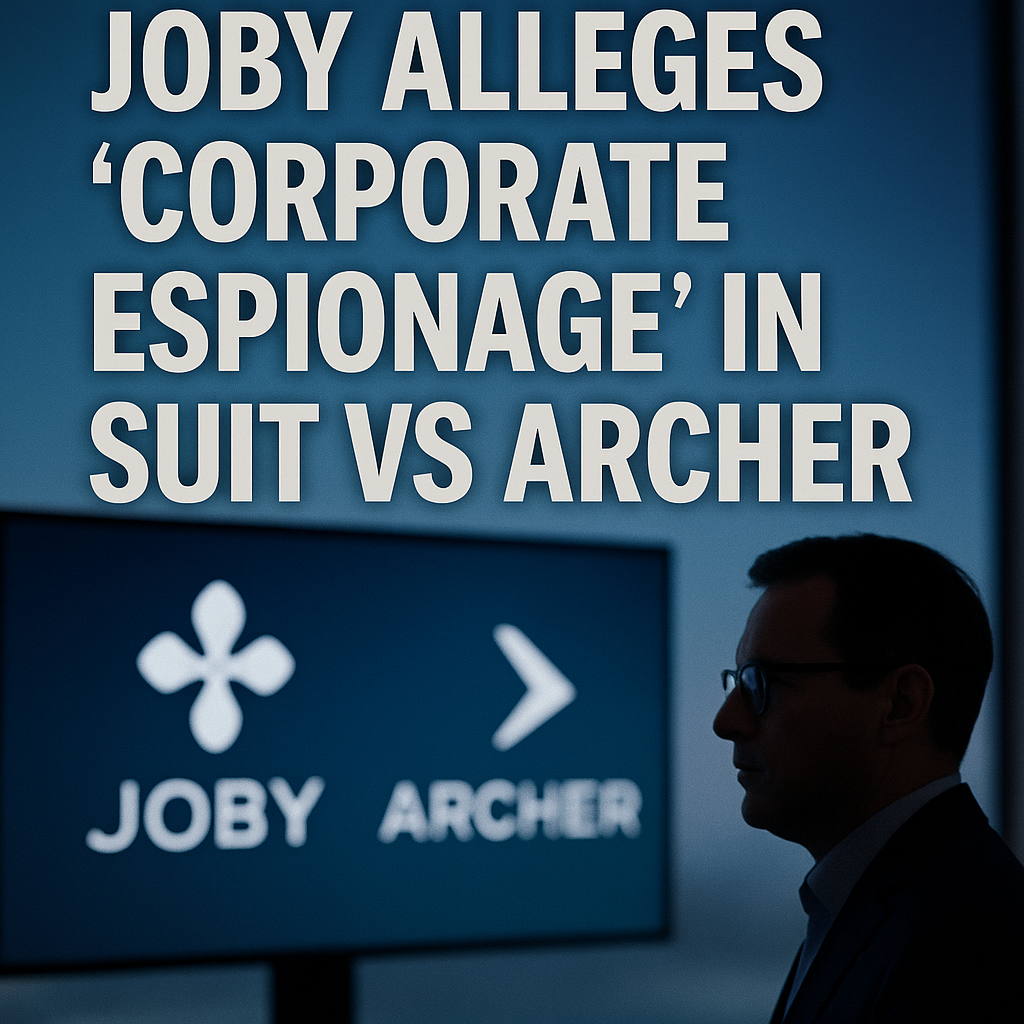
Joby Files Suit, Accuses Archer of ‘Corporate Espionage’
Joby Aviation, the California eVTOL developer led by founder and CEO JoeBen Bevirt, has lodged an aggressive legal complaint accusing rival Archer Aviation of “corporate espionage” and misappropriation of trade secrets. The lawsuit — filed in federal court — alleges that Archer recruited former Joby employees and obtained confidential designs, testing data and proprietary engineering know‑how that underpin Joby’s electric vertical takeoff and landing (eVTOL) work.
Background: Two Startups Racing to Certify eVTOLs
Joby and Archer are among the highest‑profile contenders in the nascent urban air mobility market. Both companies have moved from concept demonstrators into flight testing and manufacturing scale‑up as they pursue Federal Aviation Administration (FAA) certification and commercial services. Joby, which went public in 2021 under ticker JOBY, has focused on a piloted, five‑seat tilt‑rotor design. Archer, co‑founded by Brett Adcock and Adam Goldstein and also a public company, has developed a four‑seat Archer Maker/ Midnight family of aircraft aimed at short urban routes.
The lawsuit, which cites specific instances of alleged improper hiring and data transfer, escalates a rivalry that has already included patent skirmishes and aggressive hiring across the limited talent pool of electric‑aircraft engineers and software specialists. In the competitive eVTOL industry, trade secrets — from battery thermal management and propulsion control algorithms to composite manufacturing fixtures — are among the most valuable assets.
What the Complaint Says and Archer’s Response
In court papers, Joby accuses Archer of soliciting Joby engineers and gaining access to confidential Joby materials through both ex‑employees and third‑party consultants. Joby asks the court for injunctive relief and unspecified damages, arguing that the alleged conduct threatens Joby’s competitive position and jeopardizes the substantial regulatory investments both companies have made.
Archer has pushed back in a brief public statement, calling the allegations “without merit” and saying the company will “vigorously defend” itself. Archer characterized its hiring practices as consistent with industry norms and denied knowingly using proprietary Joby information. The company emphasized that innovation and talent acquisition are essential to the broader goal of making urban air mobility commercially viable.
Why This Matters: Legal, Regulatory and Commercial Stakes
The dispute has implications beyond the two startups. FAA certification processes demand rigorous and auditable engineering practices; if proprietary or improperly obtained materials have mixed into development workflows, regulators may scrutinize documentation and provenance more closely. Investors and commercial partners — including airlines, OEMs and suppliers — prize supply‑chain integrity and IP clearance when making long‑term commitments.
For both firms, the lawsuit risks distracting technical teams and creating friction during a critical phase of aircraft development. The eVTOL market is capital‑intensive and timeline‑sensitive: certification delays can cascade into lost contracts and higher capital consumption.
Expert Perspectives
Industry analysts and legal experts say the complaint highlights a recurring challenge in deep‑tech fields where a small pool of specialists and modular cloud collaboration tools can blur lines between legitimate hiring and illicit data transfer.
“When you combine proprietary flight‑control software, battery systems engineering and a competitive rush to certification, the temptation to hire for immediate knowledge is intense,” said an aerospace analyst familiar with the sector. “Courts will look closely at evidence of data exfiltration and whether confidential material was used to accelerate development.”
A legal expert in trade‑secret litigation noted that remedies can include preliminary injunctions, forced return of materials, and monetary damages — but that such claims are often fact‑specific and hinge on clear documentation showing ownership and misuse of the information.
Conclusion: What Comes Next
The case is likely to proceed through discovery, where both sides will exchange email chains, access logs and device images to substantiate their positions. If Joby wins an injunction, Archer could face limits on the use of contested technology or have to rework engineering elements. If the suit stalls or settles, the industry could see a confidential resolution with licensing terms or hiring protocols.
Regardless of outcome, the litigation underscores the fragile intersection of talent, IP and regulation in the race to commercialize eVTOL aircraft. For investors, regulators and potential airline customers, the episode will be a barometer of how well the industry can safeguard innovation while scaling a new class of aircraft.
About the Author