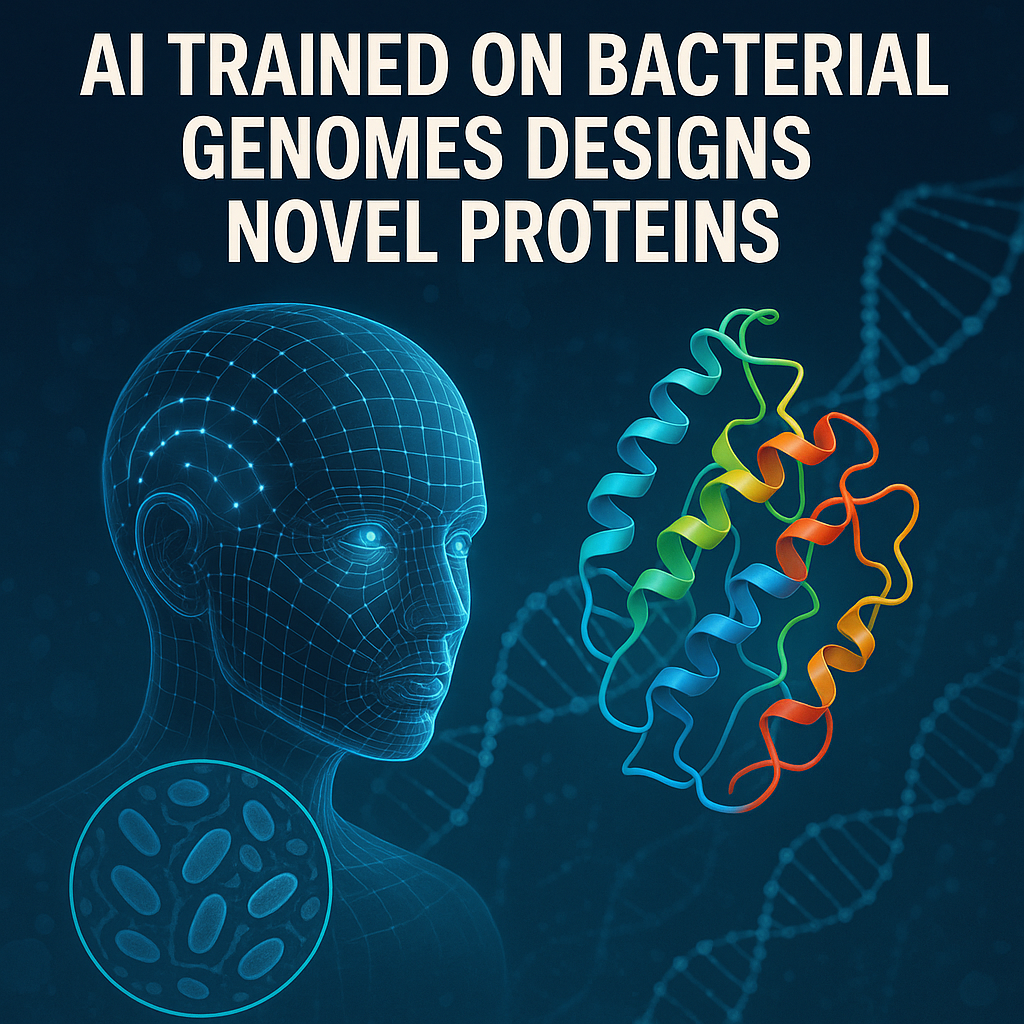
AI creates proteins no database has seen before
This week highlighted a growing trend in computational biology: large language models and generative systems trained on bacterial genome data are producing protein sequences that don’t match anything in existing databases. Researchers are combining bacterial sequence datasets with protein language models and modern structure predictors to generate, evaluate and — in some cases — synthesize entirely novel proteins with stable folds and predicted functions.
How models trained on bacterial genomes work
Protein language models borrow techniques from natural-language processing and are typically trained on millions of amino-acid sequences drawn from public repositories such as UniProt and UniRef, which contain large numbers of bacterial genes. Frameworks like Salesforce Research’s ProGen and Meta AI’s ESM family have shown that models exposed to the diversity of microbial genomes learn statistical relationships between residues, motifs and domains. Those learned patterns can be sampled to produce new sequences that respect evolutionary constraints but are not present in reference catalogs.
From sequence to structure to synthesis
Production of a candidate sequence is only step one. Tools such as DeepMind’s AlphaFold (whose global Protein Structure Database expansion in April 2022 made predicted structures widely accessible) and Meta’s ESMFold let researchers predict whether a generated sequence is likely to fold into a compact, stable three-dimensional structure. Labs then triage by predicted stability and potential function before synthesizing top candidates for wet-lab validation — the only definitive proof of activity.
Why bacterial data matters
Bacterial genomes are a rich training source: they contain enormous sequence diversity, compact operons, and a wide repertoire of enzymes evolved to function in diverse environments. That diversity helps models learn robust, generalizable patterns. Because many industrial enzymes and therapeutic lead candidates are derived from or inspired by bacterial proteins, models trained on microbial sequences are particularly valuable for enzyme engineering, novel antibiotic scaffolds and metabolic-pathway design.
Impacts and industry response
The implications span drug discovery, industrial biotech and synthetic biology. For pharmaceutical R&D, generative protein sequences could yield new scaffolds for binders, novel antimicrobial peptides or enzymes that degrade stubborn small molecules. For industrial labs, bespoke enzymes engineered by AI could speed up bio-manufacturing and reduce reliance on chemical catalysts.
Several companies and academic groups are racing to take generative outputs into the lab. DeepMind’s AlphaFold and Meta’s ESM projects are widely used for structure-first triage; startups like Ginkgo Bioworks and Benchling customers frequently pair DNA synthesis and high-throughput screening with in silico design to close the loop between computation and experiment. Meanwhile, synthetic-biology platforms and contract research organizations accelerate validation once a sequence shows promise.
Expert perspectives
Industry observers caution that computational novelty does not guarantee biological function. Protein design leaders have stressed that predicted folding is only an approximation: experimental biophysics remains the gold standard. At the same time, protein language modeling pioneers note that the fusion of generative models with high-quality bacterial training data and improved structure predictors has materially shortened the design–test cycle.
Biosecurity and ethics experts warn that easier generation of arbitrary protein sequences raises governance questions. Novel proteins could have unintended activities; the community is calling for rigorous screening, disclosure frameworks and collaboration between AI developers, biologists and regulators to manage dual-use risks while preserving scientific progress.
Analysis: strengths, limits and next steps
The marriage of bacterial-sequence-trained models and structure predictors is powerful because it leverages evolutionary diversity and modern predictive accuracy. Strengths include faster ideation, the ability to explore sequence space beyond natural evolution, and prioritization by predicted fold and stability. Key limits remain: in silico predictions struggle with dynamics, post-translational modifications, and cellular context. Wet-lab throughput is improving, but biochemical validation is still a bottleneck for moving candidates to therapeutics or industrial deployment.
Conclusion — what to watch next
Expect more papers and preprints showing experimental validation of AI-designed proteins, and growing collaboration between AI labs and wet labs. Regulators, funders and industry will need to accelerate best practices for validation and safety review as sequence-generation capabilities spread. For now, the combination of bacterial-genome-scale training data, generative protein models and structure prediction is moving from proof-of-concept to a practical engine for discovery — but turning computational novelty into reliable, scalable biology will require careful integration of modeling, synthesis and rigorous experimentation.
Related topics: AlphaFold, ESM models, protein language models, synthetic biology, biosecurity policy.
About the Author