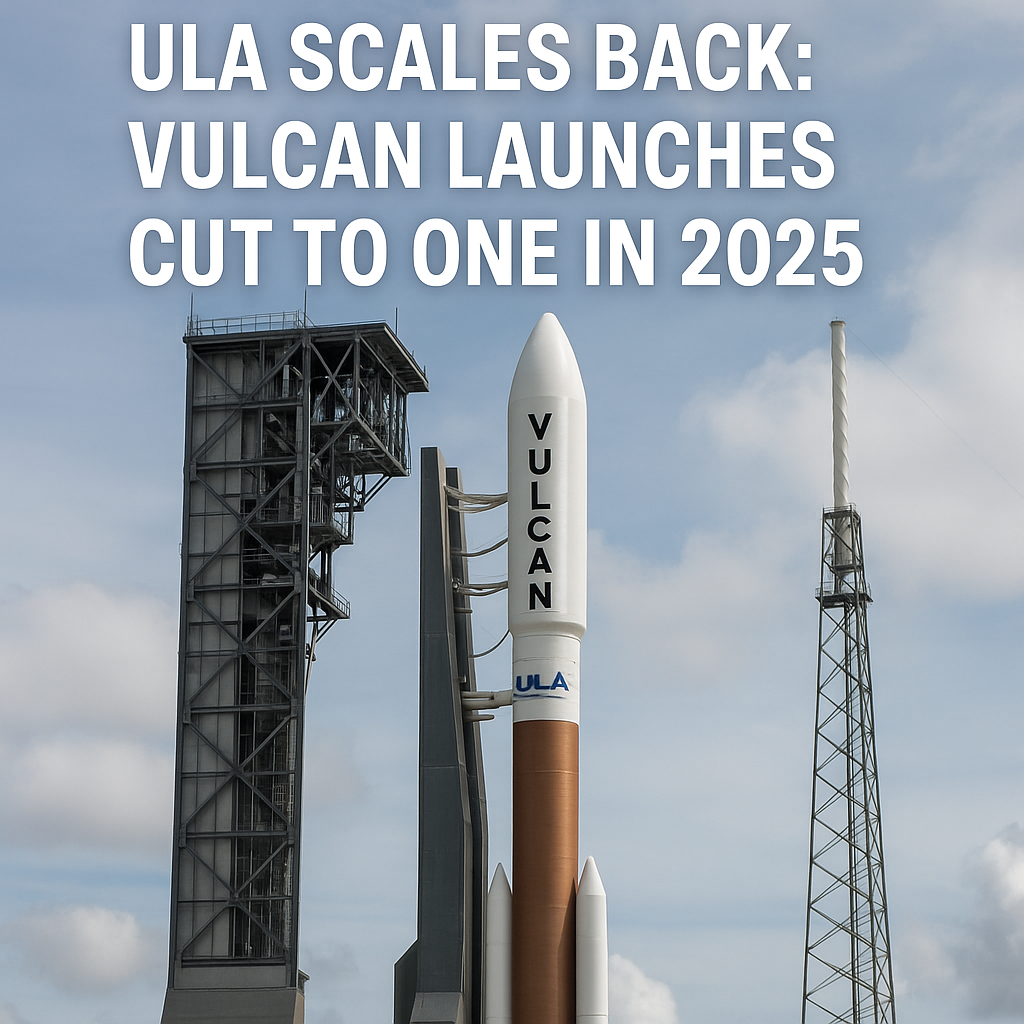
ULA’s ambitious cadence falls to a single Vulcan flight
United Launch Alliance (ULA) entered 2025 with plans to ramp up its Vulcan Centaur program — at one point indicating a goal of up to 10 Vulcan rocket launches this year. Instead, the company now expects to fly the new Vulcan vehicle just once this calendar year, a sharp pivot that underscores continuing supply-chain and integration challenges for the Boeing/Lockheed Martin joint venture.
Background: Vulcan, BE-4 and the NSSL stakes
Vulcan Centaur is ULA’s next-generation launcher, powered by Blue Origin’s BE-4 methane-fueled first-stage engines and a new Centaur V upper stage. The rocket is central to ULA’s strategy to replace the legacy Atlas V and Delta IV fleets, retain government launch business and compete for commercial missions. In 2020, the U.S. Department of Defense awarded ULA and SpaceX National Security Space Launch (NSSL) Phase 2 contracts — a decision that made a reliable Vulcan cadence a strategic priority for national security missions.
But BE-4 engine production and delivery schedules from Blue Origin, plus assembly and testing bottlenecks for the Centaur V upper stage at ULA’s Decatur, Alabama, facilities, have repeatedly slowed planned launches. Those technical and supply issues have ripple effects on manifest scheduling for both government and commercial payloads.
Details, causes and immediate impacts
Sources familiar with ULA’s production and integration timeline say the company has been forced to prioritize a carefully sequenced verification campaign for the early Vulcan flights. That means a much slower ramp than executives initially hoped. For ULA customers, the near-term consequence is a compressed manifest: satellite operators and defense customers will face delayed rides or rebooking choices, while subcontractors for avionics, fairings and propulsion see a temporary decline in throughput.
On the industrial side, the BE-4 engine — a critical long-lead item built by Blue Origin — remains the most frequently cited bottleneck. BE-4 development and qualification were complex, and serial production is only gradually reaching the levels needed for a high cadence. Centaur V assembly and hot-fire test campaigns also require careful sequencing to meet reliability requirements for national security missions.
Competitive and market implications
SpaceX, which dominates the commercial small- to medium-satellite market with Falcon 9 and has been pushing Starship development, stands to benefit from any sustained slowdown of Vulcan demand. Insurance rates, mission schedules and satellite constellation rollouts can be sensitive to launch availability; customers needing rapid replacement launches or flexible scheduling are likely to favor providers with demonstrable cadence.
Expert perspectives
Industry analysts note that a cautious initial cadence for a new vehicle is not unprecedented. “New rockets often take time to reach full-rate production,” said one independent launch-industry analyst. “But the difference is market dynamics: ULA is not just building a commercial product, it’s providing assured access for the U.S. government, which raises the stakes for schedule slips.”
Defense and procurement experts add that the Department of Defense and U.S. Space Force have contingency plans to preserve access to space — including flexible manifesting and contract options with other certified providers — but repeated delays could accelerate shifts in procurement behavior.
Wider context and what’s next
For ULA, the immediate objective will be to complete the single Vulcan flight planned for this year with full data capture and validation, then step up production throughput in 2026. That means resolving supply-chain constraints, increasing BE-4 deliveries, and optimizing Centaur V integration cycles. ULA CEO Tory Bruno has long emphasized reliability and mission assurance as priorities, and the company will likely stick to that script even if it delays a faster cadence.
For customers and the broader launch market, the outcome will be watched closely. A slow start for Vulcan could create opportunity for SpaceX and others to deepen commercial relationships, but it also reinforces the importance of diversified launch supply for national security. Related topics to follow include Blue Origin’s BE-4 production ramp, ULA’s Centaur V test program, and the evolving NSSL manifest distribution between providers.
Conclusion: cautious launch-up and strategic consequences
ULA’s shift from an early goal of up to 10 Vulcan launches to a single flight this year is a reminder that scaling a new, heavy-lift launch vehicle remains a complex industrial challenge. The immediate pain is operational and contractual; the strategic prize — guaranteed access to lucrative government and commercial payloads — depends on how quickly ULA can convert careful validation into steady cadence. For now, the industry will be watching that one Vulcan flight closely as a bellwether for the program’s trajectory.
About the Author