Federal Push Meets State Urgency
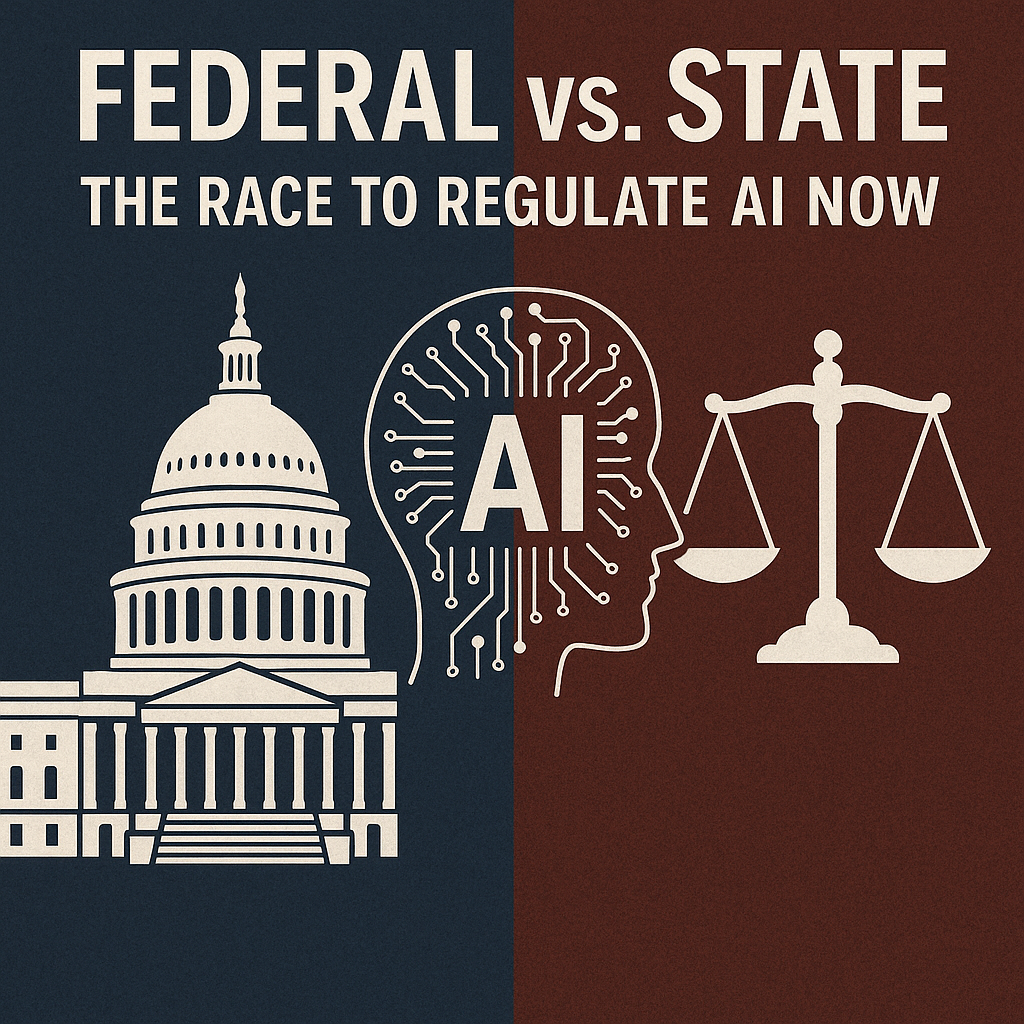
The race to regulate artificial intelligence has turned into a federal-versus-state showdown as Washington moves to impose baseline rules while states and cities push more specific restrictions. The White House’s October 30, 2023 Executive Order on AI laid out a federal framework for safety, security and civil rights oversight. But in the months since, dozens of state legislatures and municipal governments have proposed or enacted measures touching everything from biometric use to algorithmic hiring audits, creating a patchwork that could complicate compliance for companies such as OpenAI, Google, Microsoft and Amazon.
Background: Why Regulation Accelerated
AI surged into mainstream attention after the launch of ChatGPT on November 30, 2022 and subsequent models like GPT-4, released on March 14, 2023. The rapid commercial rollout of generative models, combined with high-profile accuracy failures, deepfake controversies and privacy lawsuits, prompted governments to act. Internationally, the EU achieved a provisional political agreement on the AI Act in December 2023, setting a near-term regulatory benchmark for high-risk AI systems.
In the U.S., federal agencies have signaled enforcement intentions. The Federal Trade Commission has repeatedly warned that companies are accountable for algorithmic harms and deceptive claims. Meanwhile, long-standing laws such as Illinois’ Biometric Information Privacy Act (BIPA, 2008) continue to underpin litigation against companies using facial recognition and other biometric-driven AI.
State and Local Action: Faster, Narrower, Fragmented
States and cities have pursued faster, more targeted rules. New York City’s Local Law 144, enacted in 2021, requires bias audits for automated employment decision tools used by employers — a leading example of municipal-level AI governance designed to protect workers. Beyond hiring, several state bills have tackled content labeling, consumer disclosures, and restrictions on law enforcement’s use of facial recognition.
That speed can create legal tensions. A company complying with a state requirement to disclose AI-generated content could still face different obligations under a future federal rule. Conversely, firms operating across multiple states must navigate differing thresholds for what counts as a “high-risk” system or when an independent algorithmic audit is required.
Practical Implications for Industry
For enterprises running large language models or deploying automated decision systems, the regulatory landscape raises technical and operational challenges: data governance, model cards and documentation, red-team testing, and the need to produce audit trails for decision-making pipelines. Cloud providers such as Microsoft (Azure OpenAI Service) and Google (Vertex AI / Gemini) also face the prospect of supporting customers who must comply with divergent state statutes while anticipating federal standards.
Expert Perspectives
Policy analysts and industry experts describe the clash as predictable but consequential. Analysts at the Brookings Institution have noted that federal rules can provide consistency and reduce compliance costs for national businesses, but warned that overly broad federal rules risk stifling innovation. Academia and civil-society groups have pushed for stronger civil-rights protections; researchers at the Center for Democracy & Technology argue states are filling gaps left by a slow-moving federal apparatus.
Legal scholars point to the power of existing statutes: BIPA litigation continues to affect facial-recognition vendors and downstream customers, while consumer-protection law is being used to challenge misleading claims about model capabilities. At the same time, corporate legal teams are preparing for overlapping jurisdiction: a company could face a state enforcement action, federal investigation, and private class-action suit all stemming from the same deployment.
Voices from Industry
Technology executives publicly urge harmonized rules. Major AI vendors have called for federal standards that establish base safety and transparency requirements while allowing state innovation. Meanwhile, investor and product leaders emphasize the business case for robust governance: poor compliance or high-profile regulatory losses can erode trust and market value.
Conclusion: What Comes Next
The near-term outlook is a multi-speed governance environment. Expect continued federal rulemaking and agency guidance over the next 12–24 months, alongside state-specific laws and local ordinances. For companies, the immediate challenge is operationalizing compliance: investing in documentation, risk assessments, model testing, and legal strategies that can adapt to a fragmented framework. For policymakers, the central question is balancing harmonized baseline rules with the ability for states to address localized harms — a debate that will shape how quickly and safely the U.S. adopts transformative AI technologies.
Related coverage: EU AI Act explained, White House Executive Order on AI, Local Law 144 and algorithmic hiring.
About the Author