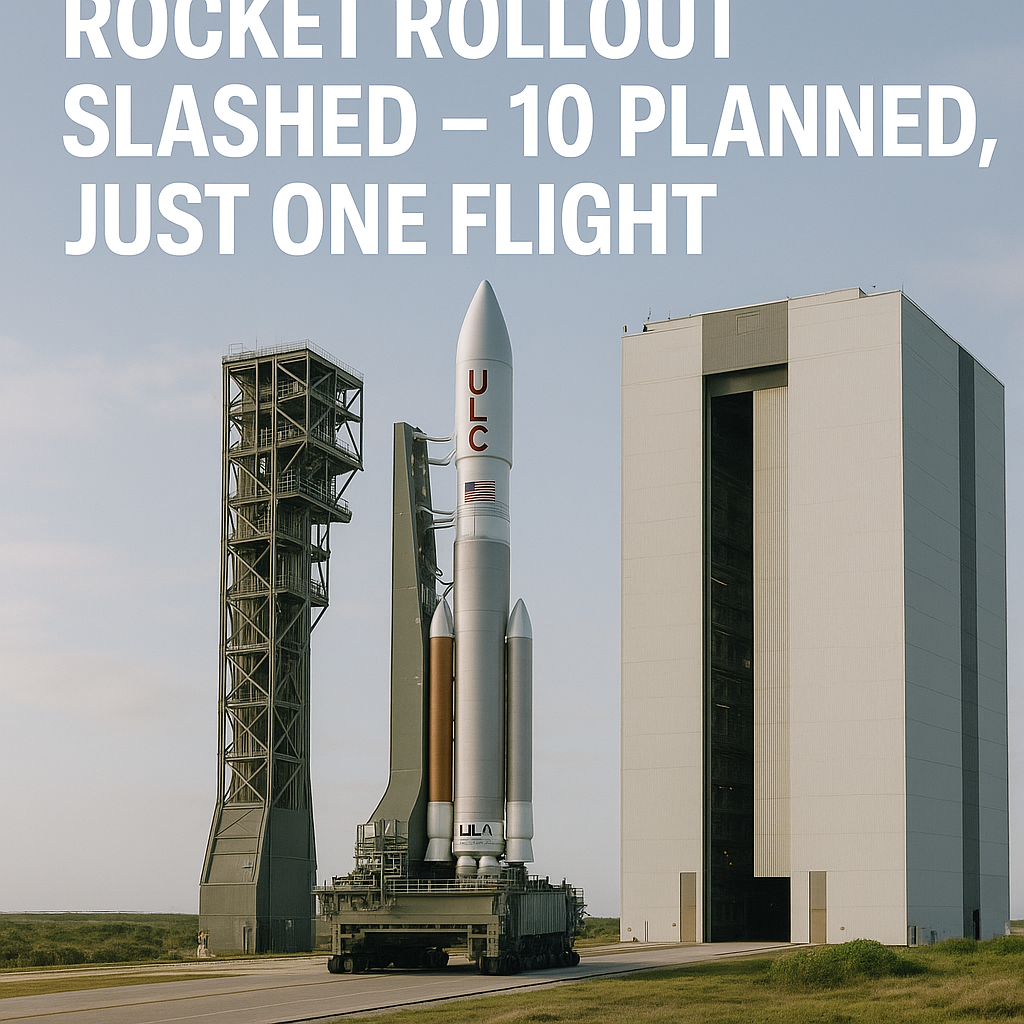
Vulcan rollout pared back: who, what and why
United Launch Alliance (ULA), the Boeing–Lockheed Martin joint venture, entered the year aiming to scale Vulcan Centaur launches sharply — as many as 10 in a single year — but the company now expects to fly the new Vulcan rocket just once this year. The dramatic pullback reflects continuing certification work, supply-chain bottlenecks and the long tail of engine development for key suppliers.
Vulcan Centaur is ULA’s next-generation orbital launcher intended to replace Atlas V and Delta IV variants. The vehicle uses two Blue Origin BE-4 methane engines on its first stage and a new Centaur V upper stage powered by Aerojet Rocketdyne RL10 engines. The architecture promises higher performance and the ability to serve national security, NASA and commercial customers, but the transition from legacy fleets to Vulcan has been bumpy.
Background: why ULA wanted a high cadence
ULA publicly positioned Vulcan as the backbone for its future manifest, citing customer commitments from the U.S. Department of Defense, NASA and commercial satellite operators. A cadence of up to 10 launches a year would allow ULA to close out Atlas V and Delta IV inherited commitments while ramping Vulcan production and lowering unit costs.
That ambition faces several practical hurdles: BE-4 engine availability and certification, Centaur V validation and regulatory clearances, and persistent supply-chain drag affecting complex suppliers like Aerojet Rocketdyne and component vendors across the industry. ULA’s planned ramp relied on predictable deliveries and rapid flight-proven iterations — conditions that have been elusive.
Details and technical constraints
At the heart of the problem are the propulsion and upper-stage certification tasks. The BE-4, developed by Blue Origin, is a new methane-oxygen engine and has faced a multi-year development arc for integration, test-firing and qualification. The Centaur V upper stage, a heavier, stretched evolution of the heritage Centaur family using RL10 engines, also requires rigorous hot-fire and flight-readiness verification before regular operational flights.
In the short term, the constrained engine throughput and the need for incremental flight testing mean ULA must balance safety, mission assurance and customer schedules. That tradeoff has tilted toward caution: more ground testing and fewer initial flights.
Impacts on customers and the broader launch market
For U.S. national security payloads, the change in cadence raises scheduling pressure. The Defense Department has long prioritized assured access to space, traditionally met through ULA but increasingly reliant on multiple providers. SpaceX’s Falcon 9 continues to demonstrate a higher flight cadence and lower cost per launch, and its manifest flexibility has become an important counterpoint to ULA’s slower burn.
Commercial satellite operators also face ripples: firm slotting on Falcon 9 or even waiting for later Vulcan flights affect insurance, orbital insertion timelines and constellation rollouts. For ULA, limited Vulcan flights this year will keep revenue and flight-proven statistics muted while the company leans on Atlas V and remaining Delta IV capability to meet near-term customer needs.
Expert perspectives and industry analysis
Industry analysts point out that the transition from legacy fleets to a new rocket is inherently risky. Analysts note that ULA’s emphasis on mission assurance — especially for Department of Defense and high-value NASA missions — makes a conservative cadence more likely than an aggressive one. The upshot: ULA trades short-term flight volume for long-term reliability and programmatic stability.
Observers also emphasize supplier dynamics. Blue Origin’s BE-4 and Aerojet Rocketdyne’s RL10 are central to Vulcan’s value proposition; delays or production shortfalls at either supplier directly throttle ULA’s ability to sustain multiple launches. Those same observers say that as suppliers mature production and as Centaur V completes certification flights, cadence can accelerate — but not before.
Conclusion: outlook and what to watch next
ULA’s decision to run a single Vulcan flight this year is a strategic retreat to prioritize validation and mission assurance over volume. The company’s longer-term goal of a steady-state cadence — perhaps 8–10 launches annually when fully ramped — remains plausible, but it will depend on BE-4 engine deliveries, Centaur V certification milestones and a smoother supplier pipeline.
Key milestones to watch: published BE-4 production rates from Blue Origin, Centaur V hot-fire and flight-test results from ULA, and any new customer manifests or DoD scheduling adjustments. Related topics for readers: Blue Origin BE-4 engine, Aerojet Rocketdyne RL10, SpaceX Falcon 9 cadence, Atlas V phase-out and Delta IV Heavy retirement. Editors can link to those pages for deeper technical and market context.
About the Author