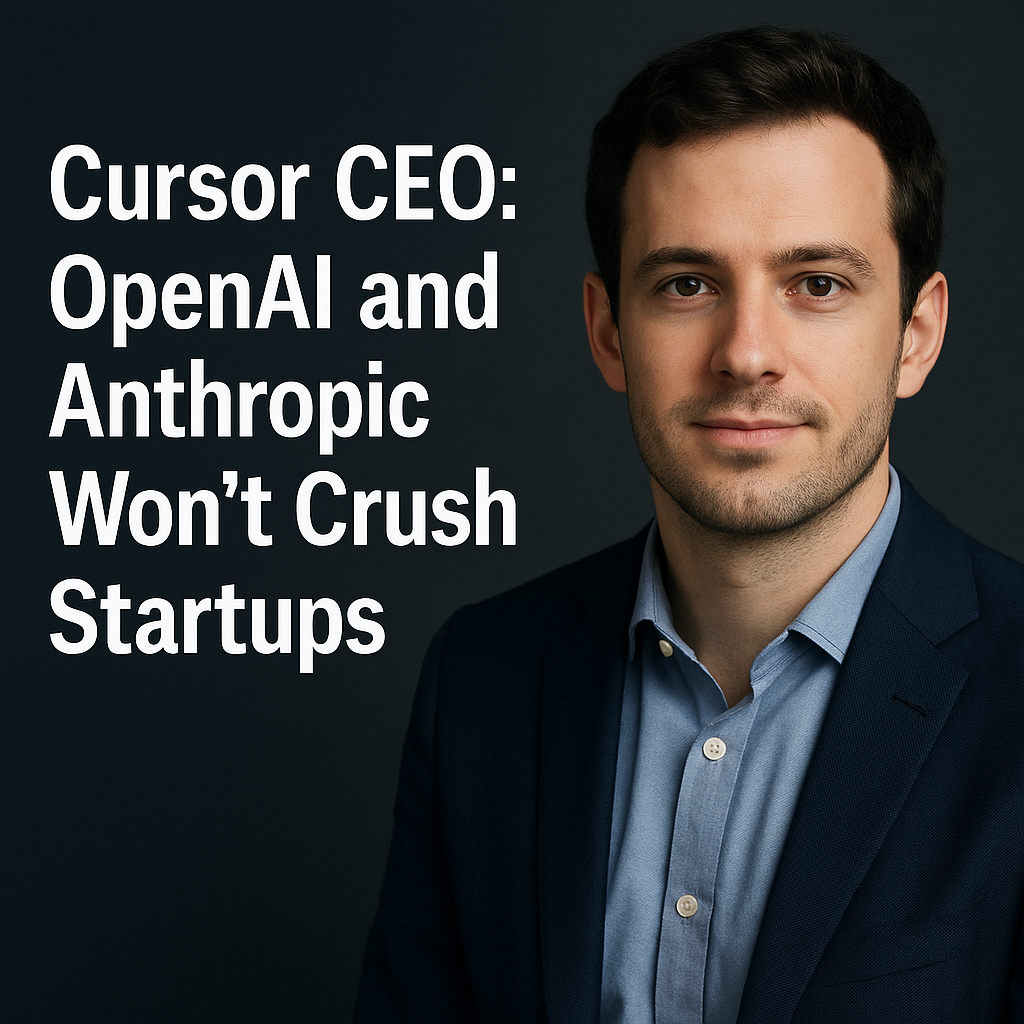
Why Cursor’s CEO isn’t worried about the big model arms race
Cursor, the startup building an AI-first code editor and developer environment, says it can thrive even as megacap AI labs like OpenAI and Anthropic race to build ever-larger models. The company’s CEO argues that timing, product focus, integrations and go-to-market matter as much as raw model scale — a view shaped by developments since OpenAI launched ChatGPT on Nov. 30, 2022 and the subsequent commercial rollout of GPT-4 in March 2023.
Context: a quickly consolidating but fragmented AI stack
OpenAI and Anthropic have dominated headlines with large language models (LLMs). OpenAI’s public releases and Microsoft’s multi-year partnership (an ongoing relationship that intensified after 2019) pushed LLMs into mainstream apps, while Anthropic — founded in 2021 by former OpenAI researchers — introduced the Claude family of assistants and positioned itself as a privacy- and safety-forward alternative. Meanwhile, tooling companies such as GitHub (Copilot has been broadly available since 2021) have shown that embedding AI into developer workflows can be a huge lever.
Yet despite apparent consolidation at the model layer, the market remains fragmented across hosting, latency, pricing, vertical customization and developer UX — factors Cursor’s leadership says are fertile ground for startups.
How Cursor differentiates: product, UX and integrations
Cursor’s strategy emphasizes product differentiation rather than chasing model scale. That means delivering a developer experience tailored to coding workflows: deep IDE integrations, context-aware prompts, low-latency interaction, and smart handling of private codebases. In practice this looks like integrating with GitHub repositories, CI/CD pipelines, and language-specific tooling so that AI suggestions are contextually relevant and safe to apply.
From a technical standpoint, startups can chain and orchestrate models from multiple providers — on-prem or cloud — while wrapping them in features that matter to developers: inferencing latency under 100ms for interactive suggestions, private fine-tuning on proprietary code, and tight editor integration that reduces friction. Those features are hard to replicate quickly at scale even for large labs because they require product design and deep integration work rather than just more parameters.
Business model and go-to-market advantages
Cursor also leans on a focused GTM (go-to-market) approach: targeting developer teams and enterprises that pay for productivity and compliance. Large labs sell models and APIs; startups can monetize through seat-based SaaS, enterprise contracts with SSO and DLP integrations, and value-added services like custom model tuning for codebases. That creates revenue predictability and sticky relationships that aren’t solely dependent on the underlying LLM provider.
Expert perspectives and industry implications
Industry observers note that the AI ecosystem is bifurcating into a commoditized model layer and a differentiated application layer. Analysts point to precedent: cloud infrastructure commoditized compute and storage, but companies that owned the developer experience and vertical integrations — think Datadog for observability, or HashiCorp for infra tooling — captured disproportionate value.
That suggests a roadmap for startups: specialize vertically, own customer workflows, and build for privacy and latency-sensitive use cases. For enterprises wary of sending proprietary code to public APIs, companies that offer hybrid deployment options or customer-managed inference become attractive. This is one of the reasons a startup like Cursor can find runway even as OpenAI and Anthropic expand their API businesses.
Risks and counterarguments
Counterpoints remain. Large AI labs can lower prices, absorb new features into their SDKs, or push platform-level integrations through cloud partners — moves that could erode startup margins. They also have scale for model R&D and could bundle developer tools into broader suites. Startups therefore must continuously innovate on UX and enterprise features, and cultivate distribution via developer communities and partnerships.
Conclusion: differentiation over raw scale
Cursor’s CEO frames competition with OpenAI and Anthropic not as a death sentence but as a market signal: models are table stakes, but product execution, integrations, data governance and go-to-market determine long-term success. If history is a guide, the winners in software infrastructure have been the companies that turned powerful primitives into workflows and developer habits. For Cursor and its peers, the next 12–24 months will test whether that playbook still holds in an era of ubiquitous LLMs.
Related topics to follow: GitHub Copilot, model fine-tuning, enterprise AI governance, hybrid inference, developer tooling.
About the Author