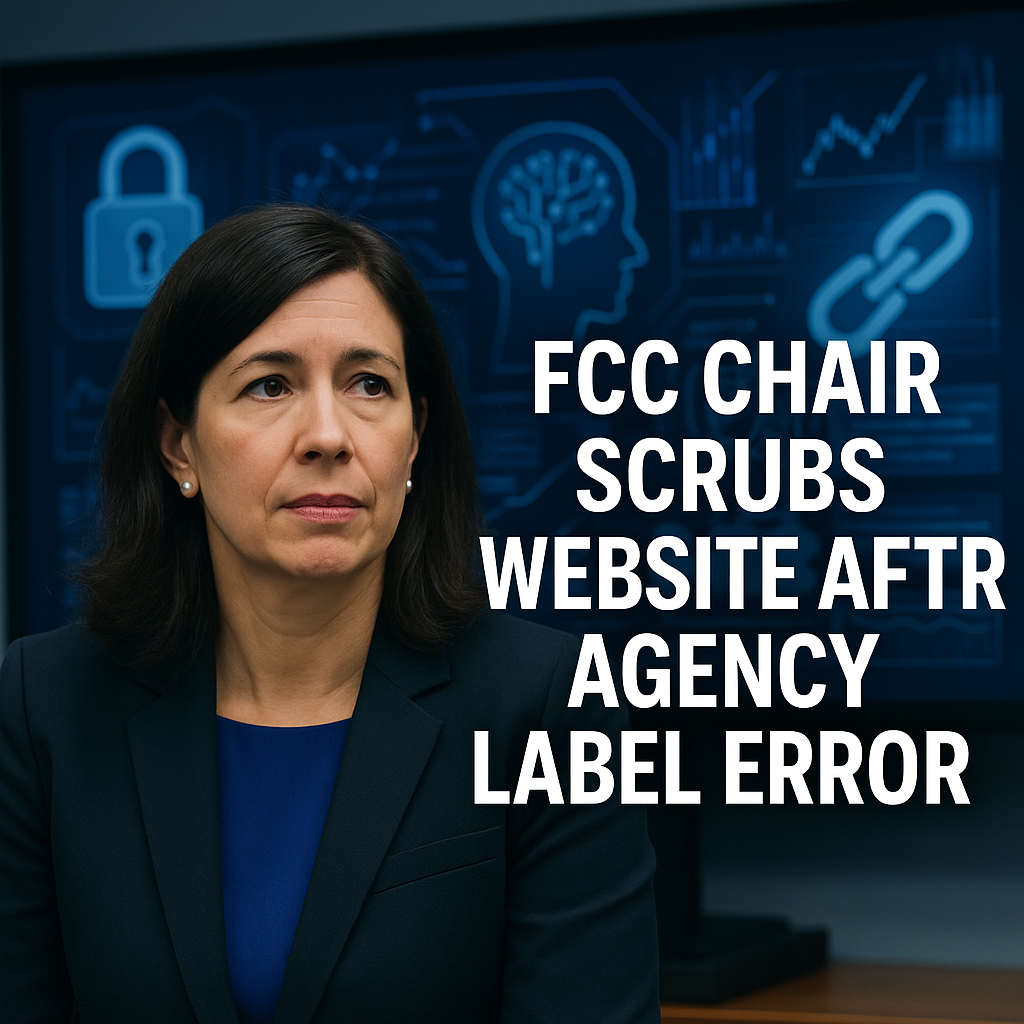
Chair Orders Website Change After Language Raises Eyebrows
The chair of the Federal Communications Commission instructed staff this week to remove wording from the agency’s public website after it referred to the FCC as an “independent agency.” The action, confirmed by multiple agency sources and visible to visitors before the text was altered, has prompted renewed discussion about how the regulator positions itself publicly and how that language shapes perceptions of its statutory independence.
Background: What ‘Independent Agency’ Means for the FCC
The FCC was created by the Communications Act of 1934 (signed June 19, 1934) and is structured as an independent federal agency, not part of a cabinet department. The commission has five commissioners appointed by the president and confirmed by the Senate, each serving staggered five-year terms. That statutory design is intended to insulate the agency from day-to-day political shifts—yet the practical balance between independence and presidential influence has long been a subject of debate across administrations.
In recent years the FCC has been at the center of high-profile policy battles—net neutrality (2015/2017), spectrum auctions, privacy rules for broadband providers, and the rollout of the Affordable Connectivity Program (ACP)—all of which make any public framing of the agency’s role politically and legally salient.
Why the Wording Change Matters
On the surface, altering a single descriptor on a government webpage might seem cosmetic. But in regulatory law and public administration, labels carry weight. Calling the FCC an “independent agency” on its outward-facing materials can reinforce legal arguments over the degree of executive influence permissible in setting regulatory priorities and supervising agency staff. Conversely, removing or softening that language can be interpreted as a signal—intentional or not—about shifting lines of control between the White House and the agency.
For telecom and tech companies—AT&T, Verizon, T-Mobile, Comcast, Google and Meta among them—those signals matter. They influence expectations around merger reviews, net neutrality enforcement, consumer privacy scrutiny, and spectrum policy. Investors and lawyers pay close attention to perceived shifts in regulatory posture because they affect transaction risk and litigation strategy.
Potential Legal and Political Implications
Legal scholars and practitioners watch agency communications for clues about agency intent and independence that could be consequential in court. The Supreme Court and federal appellate courts have used administrative record and public statements to interpret agency authority in cases involving rulemaking and adjudication. Any perceived change in how the FCC characterizes itself could become fodder in litigation challenging agency actions.
Expert Perspectives
Policy analysts say the website edit is likely more about optics than immediate legal effect. “Web copy doesn’t change the statute,” notes a former communications lawyer who has litigated before the FCC. “But it does affect narratives that courts and Congress can use to critique or defend agency action.” Independent think tanks and trade groups are already parsing the move for what it might mean during contested rulemakings and future appointments.
Industry watchers point out that the FCC’s practical independence has ebbed and flowed based on presidential priorities and the composition of the commission. For example, contentious decisions on net neutrality and broadband privacy in the mid-2010s were decided by slim commission majorities and led to extensive litigation and congressional oversight—illustrating how quickly questions of independence can become central to policy disputes.
What Comes Next
In the near term, stakeholders will be looking for clarifying statements from the FCC explaining the change and whether it reflects a broader communications strategy. Congressional oversight committees could seek briefings if lawmakers view the edit as consequential. Longer-term, the episode highlights the importance of precise language in agency communications—language that can influence public perception, enforcement posture, and judicial review.
As the FCC continues to work on high-stakes matters—spectrum allocations, robocall mitigation, broadband competition and merger reviews—attention to how the agency frames its own independence will remain part of the policy conversation. For readers tracking regulatory policy, related topics include net neutrality, spectrum auctions, merger enforcement, and the Affordable Connectivity Program (ACP).
Key Takeaways
The website edit is a reminder that even small changes in public communications can have outsized symbolic and legal resonance. Whether symbolic or substantive, the episode underscores the delicate balance between statutory independence and political oversight at the heart of modern telecom regulation.
About the Author