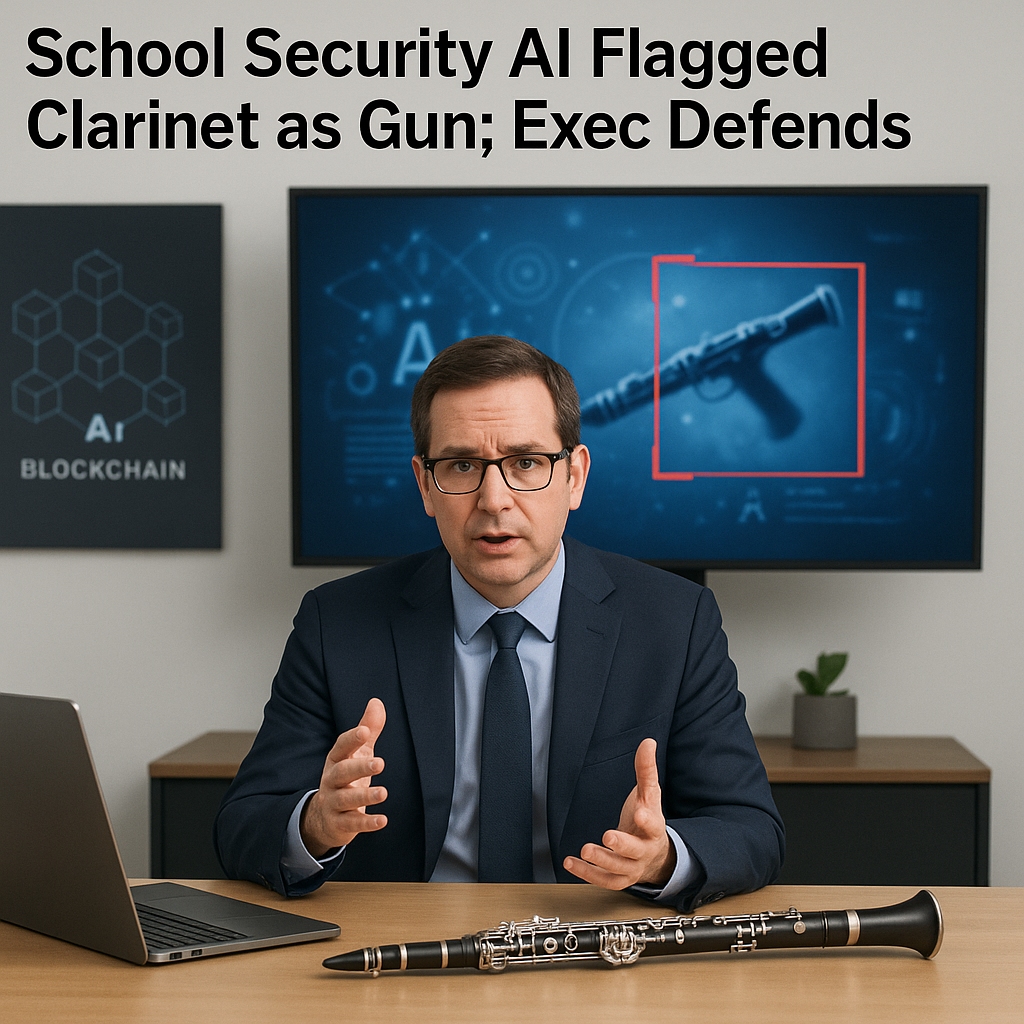
AI system flagged a clarinet during a school rehearsal
An AI-driven school safety system recently flagged a student’s clarinet as a firearm during a school music rehearsal, prompting renewed scrutiny of automated threat-detection tools used in K–12 settings. The incident, which circulated on social media this week, involved a vendor-supplied gun-detection model monitoring a public school campus. According to local reporting and parents who spoke to press, school administrators received an alert from the system indicating a potential firearm was present; the object turned out to be a clarinet. The vendor’s executive told reporters the alert was not an “error,” saying instead that the system had operated as designed.
Background: how gun-detection AI is deployed in schools
Over the past five years, districts nationwide have deployed AI-based camera analytics and sensor systems to detect weapons and active shooters in real time. Companies advertising automated gun-detection tech include ZeroEyes, Evolv, and commercial security platforms such as Avigilon (Motorola Solutions). These systems use computer vision models trained on image data to recognize shapes, silhouettes and contextual cues, then trigger alerts to school resource officers or monitoring centers.
Proponents argue these tools can shave seconds off response times in critical incidents; critics point to a patchy track record on accuracy, a potential for bias, and the risk of normalizing constant surveillance of students. A 2021 review by the Brookings Institution and subsequent academic studies highlighted that object-detection models can generate false positives when trained on limited datasets or when objects are seen in novel contexts — for example, musical instruments, backpacks, or sports equipment.
What the vendor said — and why it matters
The vendor executive’s statement — that the system wasn’t mistaken — suggests the alert reflected the model’s confidence threshold and internal logic. In practice, modern detection systems output confidence scores that are compared to preconfigured thresholds; if the score exceeds the threshold, an alert is sent. Vendors and integrators tune thresholds to balance false positives (nuisance alerts) against false negatives (missed detections).
Choosing a low threshold reduces the risk of missing a real weapon but increases false positives, which can trigger unnecessary lockdowns, law-enforcement responses, and anxiety among students and staff. Choosing a higher threshold reduces interruptions but raises the chance a weapon will be overlooked. The vendor’s defense points to this trade-off and to operational decisions that school districts themselves often make during system commissioning.
Technical factors that can lead to misclassification
Computer vision models can misclassify objects due to occlusion, lighting changes, camera angle, or limited training data diversity. Musical instruments such as clarinets have long, cylindrical shapes and tonal keys that, in low resolution or from certain angles, can be geometrically similar to the barrel and grip of some weapons. If a training dataset lacks sufficient examples of instruments in school environments, the model may overfit to weapon-like shapes and emit false positives when encountering uncommon but benign objects.
Expert perspectives and policy implications
Security and privacy experts say the incident underscores larger governance questions. Bruce Schneier, a security technologist and author, has routinely cautioned about overreliance on automated systems without robust human oversight; while he did not comment on this specific case, his published work recommends multi-layered verification and human-in-the-loop review to mitigate false alarms.
Education policy analysts emphasize the psychological and civil-liberty costs. Research from the American Civil Liberties Union and the RAND Corporation suggests frequent false alarms can erode trust and disproportionately affect marginalized students. Latanya Sweeney and other academics have documented how biased datasets can translate into unequal outcomes when AI is used for surveillance and enforcement.
Operational and procurement lessons for districts
Districts that purchase AI security systems should demand transparency around training data, access to model performance metrics (precision, recall, false-positive rate), and clear SLAs for incident response. Independent third-party audits and red-team testing — stress tests in which systems are probed with atypical objects — are recommended best practices in the industry.
Schools should also craft policies about alert escalation: who receives an automated alert, what verification steps are required before a lockdown, and how parents and students are notified after a false alarm. The International Association of Chiefs of Police and the U.S. Department of Education have both advised caution and oversight for surveillance tech in schools.
Conclusion: balancing safety, accuracy and trust
The clarinet-as-gun episode is the latest reminder that AI is not infallible, and that the stakes are high when automated systems are deployed where children are present. Vendors point to technical trade-offs and operational settings; district leaders face decisions about acceptable risk, transparency, and the social cost of surveillance. As gun-detection and other safety AIs proliferate, robust auditing, informed procurement, and meaningful human oversight will be essential to avoid harm while protecting school communities.
About the Author