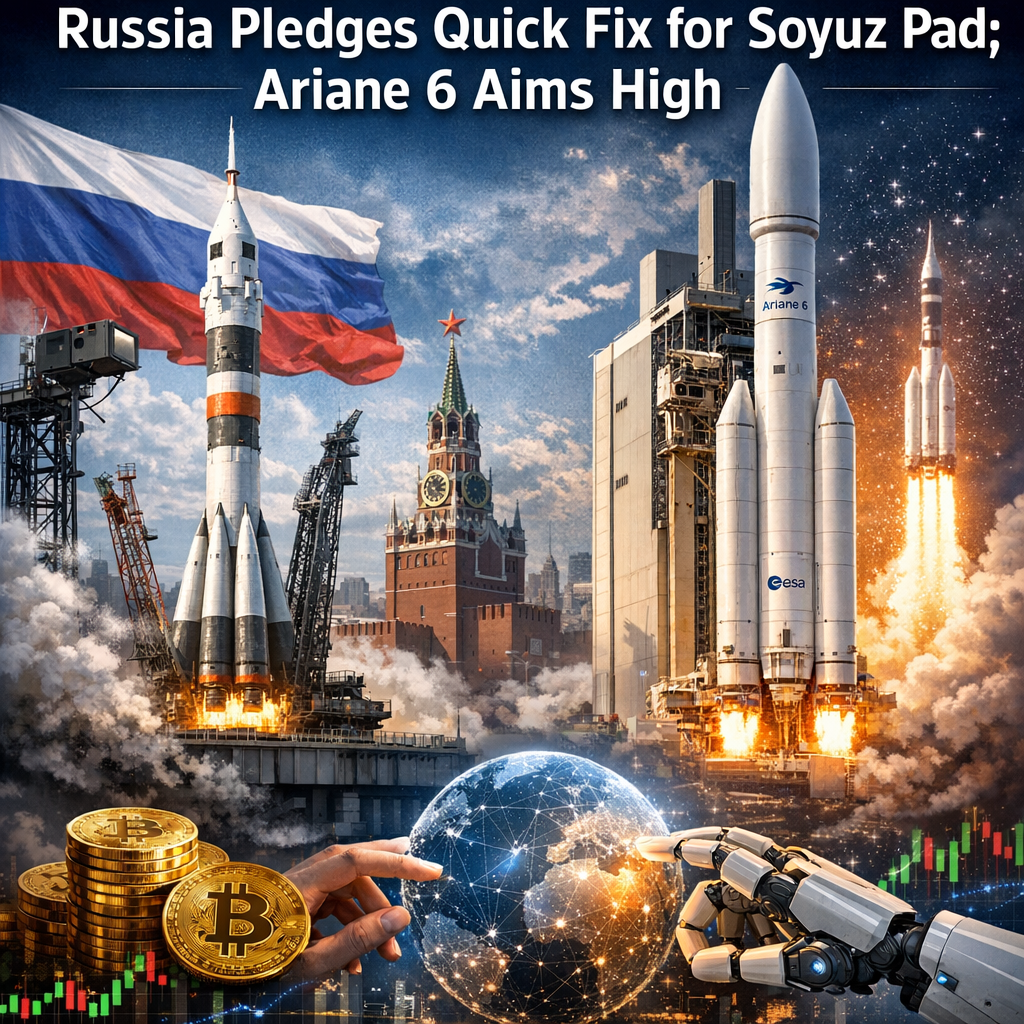
Roscosmos promises rapid repairs after Soyuz pad damage
Russia’s state space corporation Roscosmos has pledged a rapid repair effort after a recent incident that damaged a Soyuz launch pad at the Baikonur Cosmodrome in Kazakhstan. The agency said it will prioritize bringing the pad back online to minimize disruption to the Soyuz launch cadence, which remains a workhorse for a range of government and commercial missions.
The Soyuz family — in its modern Soyuz‑2 variant — still conducts launches from Baikonur as well as Plesetsk and the newer Vostochny Cosmodrome. Roscosmos did not specify a detailed timetable for repairs in its initial public comments, but emphasized that structural and propellant‑support systems will be the focus. Restoring pad infrastructure quickly matters not only to Russia’s manifest but also to international customers that continue to use Soyuz-derived services for satellites and crewed missions in some contexts.
Why the pad repair matters
Launch pad damage, even when localized, reverberates across schedules. Pads are complex facilities: flame trenches, umbilicals, fueling lines and telemetry hookups are engineered as an integrated system around each vehicle. A prolonged outage can force a reshuffle of launches, require cross‑manifesting to alternate pads or providers, and increase insurance and operations costs for satellite operators.
For Russia, which has leaned on Soyuz derivatives for medium‑lift missions for decades, maintaining steady throughput is crucial for contracts with commercial satellite firms and for preserving export revenue. The incident comes at a time when the global commercial launch market is intensely competitive; customers increasingly ask for predictable timelines and rapid turnaround.
Operational context and background
The Soyuz design dates back to the Soviet era but has been continuously upgraded; the Soyuz‑2 introduced modernized digital flight control, upgraded engines and improved payload fairings. Launch sites such as Baikonur are aging facilities that nonetheless host a dense mix of military, civil and commercial launches. Roscosmos has a long history of field repairs and pad refurbishments, but each repair is an engineering challenge dependent on parts, specialist crews and quality assurance testing.
Ariane 6: Europe’s answer to a changing market
Meanwhile, Europe is pressing ahead with Ariane 6, the next‑generation rocket developed by ArianeGroup under contract to the European Space Agency (ESA) and managed commercially by Arianespace. Ariane 6 is offered in two primary configurations — the two‑strap‑on booster Ariane 62 and the four‑strap‑on Ariane 64 — to span medium and heavy payload classes and to be more cost‑competitive than its Ariane 5 predecessor.
After multiple schedule adjustments during development, Ariane 6 is being positioned as Europe’s effort to restore competitiveness in the global heavy‑lift sector and to better serve the emergent market for large constellations and institutional missions. Key selling points are a simplified production line, modularity, and lower recurring costs per flight.
Technical and market implications
Technically, Ariane 6 retains a staged‑combustion first stage for efficiency and uses relatively mature technologies to reduce development risk. Operationally, ESA and Arianespace emphasize higher launch cadence and lower marginal cost as advantages. But the launcher will enter service in a market shaped by SpaceX’s Falcon 9 and Falcon Heavy — vehicles that have pushed down price points with reusability and high flight tempo.
For satellite operators, the choice of launcher increasingly balances price, schedule certainty and orbital delivery capability. Ariane 6’s ability to capture business will depend on competitive pricing, launch reliability and the agility of the European supply chain to meet constellation customers’ cadence requirements.
Expert perspectives and industry analysis
Industry observers note that short‑term facility outages such as the Soyuz pad incident can accelerate customer diversification. Operators that historically used Soyuz may accelerate commitments to other providers such as SpaceX, Arianespace, or emerging vehicles from Blue Origin and others. At the same time, analysts stress that no single provider currently meets every customer need: payload mass, orbital plane, price and schedule all factor into procurement decisions.
For Europe, Ariane 6 represents a strategic bet. If it can deliver reliable flights at competitive prices, it could win institutional missions from ESA member states and a share of commercial constellation launches. If not, incumbents that prioritized rapid innovation and operational scale will keep exerting downward pressure on price.
Outlook: resilience and competition
Roscosmos’s pledge to repair the Soyuz pad quickly will be judged by how soon launches can resume without compromising safety. For operators, the immediate concern is schedule certainty; for Roscosmos, it is preserving launch revenue and operational momentum. For Europe, Ariane 6’s entry is a pivotal moment: success would strengthen a diversified global launch market, while setbacks would leave the field more concentrated.
In short, the next several months will test both operational resilience in Russia’s legacy infrastructure and the commercial viability of Europe’s next‑generation launcher amid one of the most competitive eras in orbital launch history.
About the Author