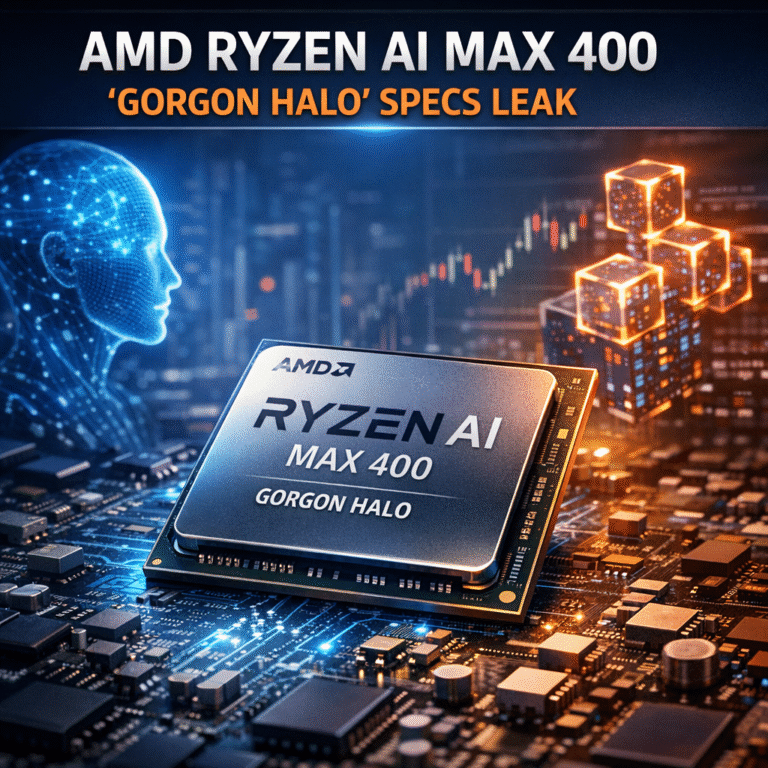
AMD announces AI-focused PC processors at CES
At the annual CES show in Las Vegas, AMD this week revealed a new family of PC processors that integrate dedicated AI acceleration for both general-purpose laptops and gaming systems. The company framed the chips as a response to rising demand for on-device AI features—from faster app-level image and language processing to smarter in-game systems—while stressing power efficiency and compatibility with existing x86 software ecosystems.
What AMD showed and why it matters
AMD positioned the launch around two use cases: everyday consumer machines that will run productivity and generative AI tasks locally, and higher‑performance gaming platforms where AI can enhance graphics, streaming and gameplay. The company highlighted hardware-level neural engines alongside its established CPU cores and Radeon graphics, aiming for a heterogeneous architecture that routes workloads to the most appropriate silicon block.
The move follows a broader industry push to embed AI accelerators directly into client devices. Intel introduced neural processing units in recent Core generations, Apple has long integrated a Neural Engine in its M-series chips, and GPUs from NVIDIA continue to power heavy model training and inference in the cloud. AMD’s entry accelerates competition in the PC market and gives OEMs more choices for building laptops and desktops with native AI capabilities.
Technical direction and software support
AMD emphasized software partnerships and developer tooling as critical to adoption. Executives said the company will provide drivers and SDKs so developers can target the on-chip AI engines, and that it is working with major OS and application vendors to optimize common frameworks. That approach aims to avoid the fragmentation that can slow uptake of new silicon capabilities.
On the hardware side, AMD described a balancing act between delivering meaningful inference performance and maintaining thermal and battery characteristics that OEMs and consumers expect. For mainstream laptops, that means enabling light-weight generative and assistive workloads locally; for gaming rigs, the priority is accelerating tasks like AI-based upscaling, NPC behavior and real-time capture/streaming enhancements without penalizing frame rates.
Context and market implications
Embedding AI accelerators in client processors is increasingly seen as necessary as generative and real-time AI features become standard in consumer apps and games. Local inference reduces latency, lowers recurring cloud costs, and offers privacy benefits by keeping sensitive data on-device. For AMD, which has historically competed on CPU performance and discrete GPU value, the new chips represent a strategic push to be a full-stack supplier of compute for the PC.
For OEMs and gamers, the announcement could spur refreshed product lines later this year. Laptops that pair traditional CPU cores with neural engines can advertise practical benefits—faster photo edits, improved video conferencing backgrounds, and AI-assisted content creation—while gaming hardware can tout AI-enhanced visuals and streaming tools. The key commercial question will be how much of the AI workload is run locally versus offloaded to cloud services, and how software publishers make use of on-device APIs.
Expert perspectives
Industry observers view AMD’s announcement as a logical but necessary step. Analysts note that adding dedicated AI units to client silicon is now table stakes if vendors want to support emerging app experiences without relying solely on the cloud. They also flag potential challenges: ensuring robust developer support, creating transparent performance metrics for buyers, and managing the increased complexity of validating heterogeneous platforms.
From a competitive standpoint, the move tightens AMD’s feature parity with rivals that have already introduced client NPUs. The company will need to demonstrate that its combination of CPU, GPU and neural acceleration provides measurable advantages in everyday tasks and across popular gaming titles.
Takeaways and outlook
AMD’s CES reveal signals the mainstreaming of on-device AI in the PC market. For consumers, the immediate benefits will come down to which devices ship with the new processors and how software makers tap into their capabilities. For developers and OEMs, the challenge is to integrate these hardware features into compelling user experiences while maintaining performance and battery life.
Looking ahead, expect more detailed benchmarks, OEM design wins and developer tooling announcements in the coming months as AMD and its partners move from CES demos to shipping products. The broader implication is clear: AI acceleration is no longer confined to data centers or high-end GPUs—it’s becoming a baseline feature of the next generation of PCs.
About the Author