Who, What, When and Why
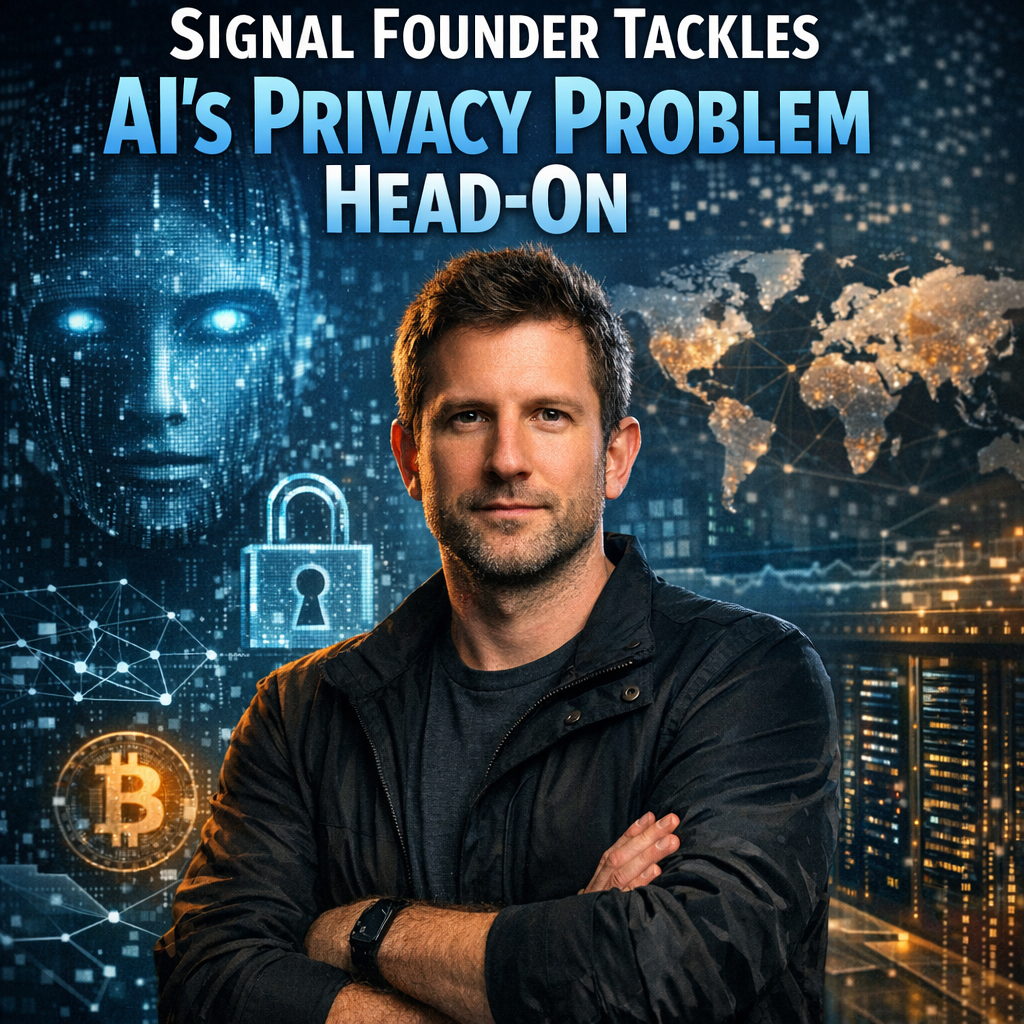
Moxie Marlinspike, the cryptographer best known as a founder of Signal and a co-founder of the Signal Foundation, has turned his attention to what many technologists now call AI’s privacy problem: the risk that large language models (LLMs) and other machine learning systems will memorize, leak or otherwise misuse personal and proprietary data. The Signal Foundation, created in February 2018 with support from Brian Acton, helped popularize end-to-end encryption for messaging; Marlinspike’s new focus applies the same adversarial mindset to the data flows behind today’s generative AI systems.
What’s at Stake: Technical Risks and Real-World Consequences
Modern AI models are typically trained on massive scrapes of public and private text, images and code. Researchers have demonstrated model inversion and extraction attacks that can recover training examples; prompt engineering and jailbreaks can coax models into revealing sensitive data. These technical phenomena — memorization, data poisoning and model inversion — translate into concrete privacy failures when models expose medical records, proprietary source code or personal identifiers.
The implications extend beyond the research lab. Companies deploying LLMs — from OpenAI and Google to Meta and Anthropic — must weigh legal obligations under frameworks such as the EU’s General Data Protection Regulation (GDPR) and California’s CCPA, while enterprises demand contractual guarantees that proprietary data submitted to models won’t leak or be used to retrain public models.
Technical Remedies in Play
There is no single fix. Industry and academia are advancing a toolkit that includes differential privacy, which injects calibrated noise to limit memorization; federated learning and on-device inference, which keep raw data local; secure enclaves and cryptographic techniques such as homomorphic encryption and multi-party computation for private model evaluation; and robust auditing and provenance systems to track data lineage. Each approach carries trade-offs in accuracy, cost and complexity.
Marlinspike’s Angle: Applying Cryptographic Rigor to AI
Marlinspike’s reputation rests on building practical, well-audited cryptographic systems for messaging. The central idea behind his new work is to apply similarly rigorous threat modeling and engineering discipline to AI pipelines: identify where sensitive data enters training corpora, impose strong controls on data ingestion, and design systems that limit what a trained model can reveal even if adversaries probe it aggressively.
That approach mirrors ongoing shifts in the industry: privacy engineering teams are expanding beyond compliance into design — embedding data minimization, purpose limitation and robust logging into ML pipelines. For vendors and customers, the hard questions are implementation details: how to certify that a model hasn’t absorbed a customer’s private data, and how to remediate exposures if they occur.
Expert Perspectives and Industry Response
Privacy researchers and security engineers broadly welcome attention from leaders like Marlinspike because the problems are both technical and socio-legal. Experts note that differential privacy provides provable bounds but degrades model utility at strong settings, while federated approaches reduce central risk but complicate updates and auditing. Legal scholars emphasize that regulation will increasingly demand demonstrable safeguards for training data provenance and retention.
Enterprise security officers are now adding contractual terms and technical attestations to cloud AI agreements, demanding transparent data-handling practices and the right to opt out of model training. At the same time, AI vendors cite trade-offs around model performance, latency and cost when resisting broad adoption of the strongest privacy primitives.
Broader Implications for Platforms and Policymakers
Marlinspike’s pivot highlights a broader tension: the economic value of ever-larger models versus the privacy rights of individuals and organizations whose data may have been ingested without clear consent. Policymakers are paying attention. The EU’s AI Act and ongoing rulemaking in the U.S. touch on transparency and risk management, and could force providers to implement stronger technical protections or disclose training data sources.
Conclusion: What Comes Next
Expect intensified collaboration between privacy-minded cryptographers, ML researchers and regulators. Practical progress will likely be incremental: improved tooling for data provenance, broader use of privacy guarantees where they fit, and stronger contractual and regulatory controls where technical solutions remain immature. Marlinspike’s involvement adds credibility and urgency; whether that accelerates the adoption of provable privacy techniques at scale will depend on commercial incentives, regulatory pressure and the continued maturation of privacy-preserving machine learning.
About the Author