U.S. levies 25% tariff on Nvidia H200 shipments to China
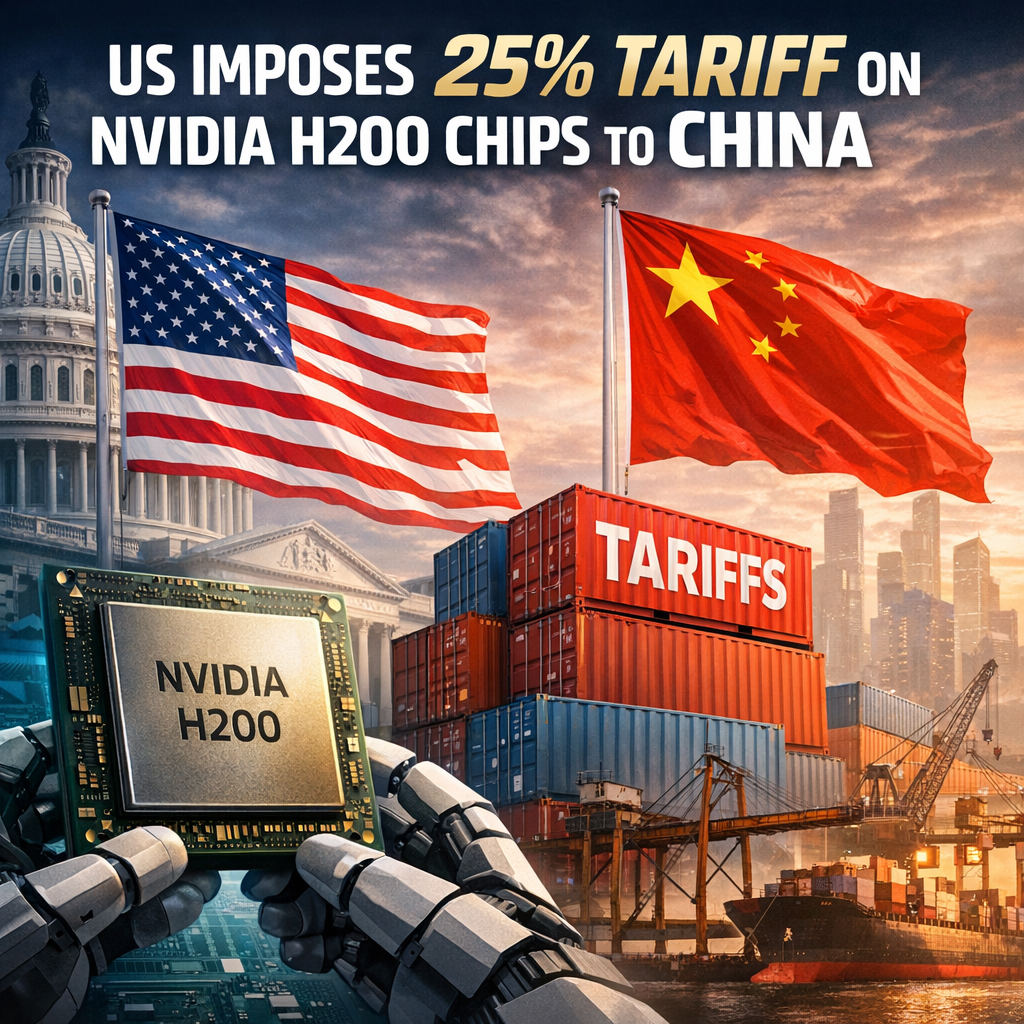
The U.S. government this week announced a 25% tariff on imports of Nvidia’s H200 data‑center AI accelerators destined for China, citing concerns about balancing economic competitiveness and national security. The move targets shipments of Nvidia’s latest Hopper‑architecture product — the H200 — which is used in large‑scale machine learning training and inference in datacenters.
What the measure covers and why it matters
The tariff is aimed specifically at H200‑class accelerators and applies to products declared as being shipped to mainland China. The U.S. measure differs from export controls in that it raises the cost of legally importable goods rather than outright prohibiting transfers. Trade officials said the levy is intended to slow the unregulated transfer of cutting‑edge compute capacity while preserving commercial channels that can be monitored.
For Nvidia, the H200 is a follow‑on to the H100 and represents one of the most advanced GPUs for generative AI workloads. The chip’s combination of high FLOPS, new memory subsystems and software stack integration has made it a key component for cloud providers, hyperscalers and chipset resellers. A 25% tariff would substantially raise the landed cost of these accelerators for Chinese customers and could alter purchasing decisions and deployment timelines.
Background: tariffs, export controls and tech rivalry
Tariffs are an older trade instrument that governments have used to protect domestic industry or to exert leverage. In recent years the U.S. has relied more on export controls and licensing rules to limit the transfer of advanced semiconductors and related tools. This tariff action sits alongside those controls and signals a calibrated approach: limit access by raising costs without fully closing commercial channels.
The U.S. and allied governments have previously restricted the sale of specialised AI chips, EUV lithography equipment and other advanced semiconductor manufacturing tools to certain Chinese entities. This latest measure reflects concern in Washington that high‑end accelerators materially advance capabilities for large‑scale model training, which has strategic and economic consequences.
Industry reaction and immediate impacts
Cloud providers and system integrators that buy Nvidia accelerators for resale will face higher import costs if they continue to supply Chinese customers. That could push some demand toward domestic Chinese GPU alternatives or to older-generation chips that are not targeted by the tariff. It may also spur attempts to reclassify shipments or alter supply chains to avoid the levy — outcomes that trade enforcement officials will likely monitor closely.
For Nvidia, the tariff raises near‑term revenue uncertainty in China, one of its largest markets for datacenter GPUs. While Nvidia’s sales are diversified across cloud operators, enterprise buyers and government customers, the company could see a slowdown in replacement cycles and new cluster builds in China if buyers delay purchases or pass higher costs on to customers.
Expert perspectives and analysis
Trade and technology analysts say the tariff will change commercial calculus but is unlikely to fully choke off China’s access to high‑performance AI compute. Experts note that tariffs increase economic friction and can incentivize both sides to find workarounds, including using third‑country intermediaries or shifting to alternative suppliers.
Policy analysts emphasize the difference between tariffs and export bans: tariffs retain legal trade flows but penalize them economically, which may be easier to defend under World Trade Organization rules than blanket prohibitions. Some analysts argue the measure buys time for the U.S. to accelerate domestic investment in advanced chip design and manufacturing, while others warn it could accelerate China’s push for indigenous accelerators and software stacks.
Conclusion: implications and what to watch next
The 25% tariff on Nvidia’s H200 chips headed for China represents a new lever in Washington’s approach to controlling advanced compute. Near term, expect slower procurement cycles among Chinese hyperscalers and greater scrutiny of supply chains. Over the medium term, the measure may accelerate Chinese investment in domestic GPU designs and foster greater diversification of global AI‑compute suppliers.
Observers will be watching how Nvidia responds — whether via pricing, product reclassification, or legal challenges — and how Chinese customers adapt. Regulators on both sides will also face pressure to tighten enforcement or negotiate carve‑outs. The tariff is a notable escalation in the technology competition between the U.S. and China, and it will shape market dynamics for high‑end AI hardware in the months ahead.
About the Author