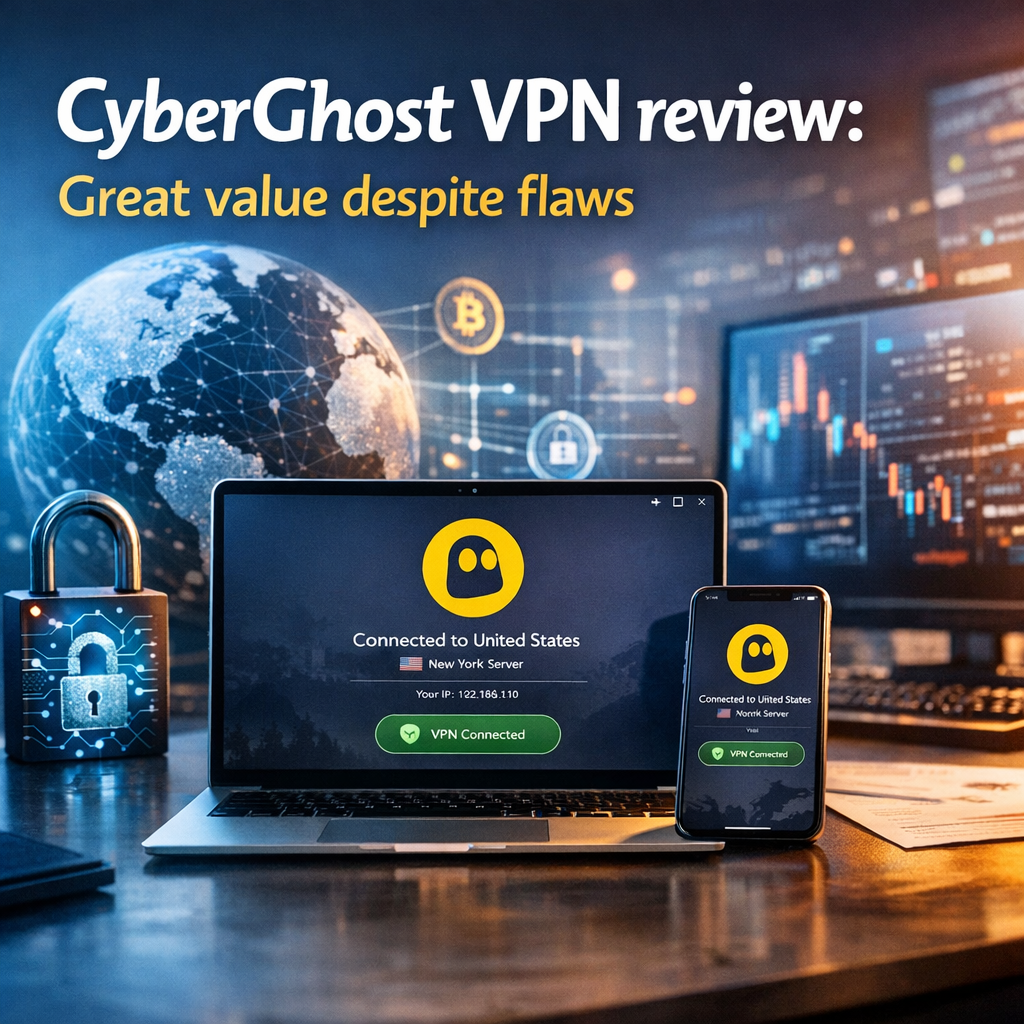
What is CyberGhost and why it matters
CyberGhost is a consumer VPN service launched in 2011 and headquartered in Romania. As of January 2026 the product remains positioned as a budget-friendly option for mainstream users who want to unblock streaming services, protect their Wi‑Fi connections and download files via P2P. The company was acquired by Kape Technologies in 2017 and today competes with larger names such as NordVPN, Surfshark and Private Internet Access in a crowded market.
Features, performance and real-world use
CyberGhost offers the modern protocol mix most users expect: WireGuard for fast, low-overhead connections, plus OpenVPN and IKEv2 for compatibility. It includes a kill switch, DNS/leak protection, and client-side features such as ad‑blocking and split tunneling on some platforms. The provider also markets dedicated streaming and P2P servers and a “NoSpy” server cluster maintained in Romania.
On speed, results are mixed. In short sessions CyberGhost’s WireGuard servers typically deliver strong throughput for HD and 4K streaming, but performance can vary by region and server load. Users trying to squeeze maximum latency-sensitive performance (competitive gaming or large simultaneous uploads) may see better consistency from higher‑end rivals. For geo-unblocking, CyberGhost reliably reaches popular services including Netflix, Disney+ and BBC iPlayer in many regions, thanks to its dedicated streaming endpoints.
Privacy, jurisdiction and transparency
Romania as a base of operations is a practical advantage: it is not part of the Five Eyes or Fourteen Eyes surveillance alliances and generally has stronger privacy protections than some hosting jurisdictions. CyberGhost maintains a no-logs policy and publishes a transparency-oriented set of claims about how it operates.
Nonetheless, ownership by Kape Technologies — a company with a background in adtech and a string of VPN acquisitions — complicates trust calculus for some customers and privacy advocates. Kape is a publicly listed company and that commercial context introduces different incentives than a small, independent privacy-focused startup. CyberGhost has sought to address skepticism through selective independent testing and public-facing documentation, but transparency gaps remain when compared with providers that release full, multi-stage audits and ongoing third-party verification.
Price and value proposition
CyberGhost’s long-term subscription plans are aggressively priced, making it an easy recommendation for cost-conscious buyers who need a general-purpose VPN for streaming, basic privacy and casual torrenting. The client software is polished and user-friendly across Windows, macOS, Android and iOS, and onboarding is straightforward for non-technical customers.
Where the service shines is in the price-to-features ratio: you get modern protocols, a kill switch, dedicated streaming servers and a suite of convenience tools at a monthly cost that undercuts many rivals. Power users who demand enterprise-grade audit practices, the fastest consistent global speeds, or an ownership structure with no ties to adtech may prefer different brands.
Expert perspectives and implications
Industry observers note two practical takeaways. First, for average consumers seeking to secure public Wi‑Fi, access geo-restricted content, and add a layer of privacy without spending heavily, CyberGhost represents a strong value play. Second, for privacy purists and those in high-risk threat environments the ownership history and partial transparency are meaningful considerations; such users should seek providers with sustained, public third-party audits and a demonstrable track record of legal independence.
For businesses and compliance-heavy contexts, VPN choice should be driven by contractual SLA commitments and independently verifiable security controls — areas where CyberGhost’s consumer-focused product may not be the best fit.
Conclusion: who should buy CyberGhost?
CyberGhost remains an attractive option in 2026 for mainstream users who prioritize price and ease of use. Its feature set—including WireGuard support, dedicated streaming servers and Romania-based NoSpy infrastructure—covers most everyday use cases. But the service is not flawless: variable performance in some regions, limited public audit granularity and a corporate owner with a complicated past mean the product is not the default pick for threat-model‑sensitive users.
Bottom line: if your priority is cost-effective protection and reliable streaming, CyberGhost delivers high value. If your risk model demands the highest assurances of independence and auditability, compare alternatives and seek providers with deeper public verification.
About the Author