Razer CEO: Gamers love AI even if they don’t notice
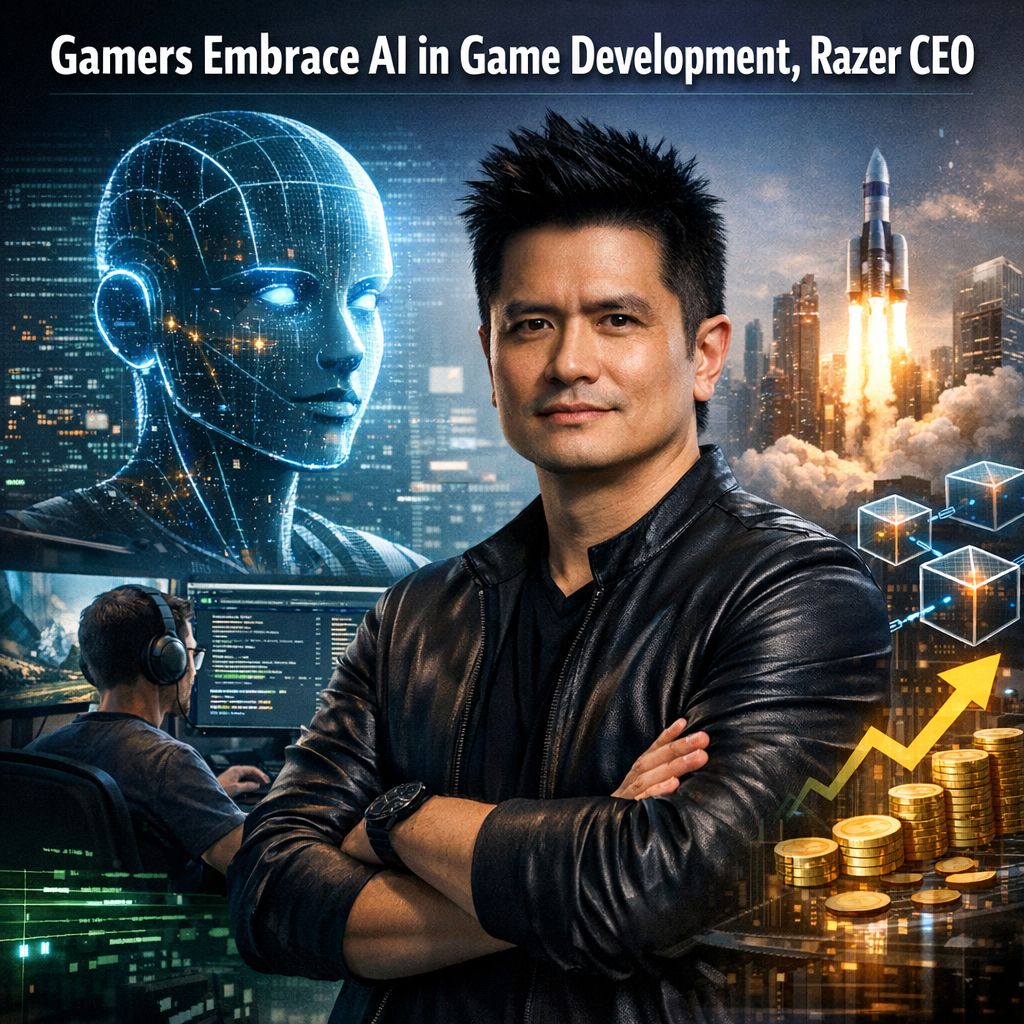
Razer co‑founder and CEO Min‑Liang Tan has been making the case that players are already consumers of AI-driven game development workflows, even when they don’t realize it. In recent public remarks he framed AI as a pervasive, behind‑the‑scenes force — powering everything from performance upscaling to procedural assets and automated quality assurance — that improves player experience without asking for explicit buy‑in.
Where AI is already shaping games
The presence of machine learning and generative systems in games is no longer theoretical. NVIDIA’s DLSS frame‑generation and upscaling technologies, first introduced in consumer products in 2020 and expanded in subsequent RTX generations, use deep learning to boost performance while preserving visual fidelity. Studios large and small have adopted AI for tasks such as procedural level generation, animation interpolation, voice synthesis for NPCs, texture and asset creation, and automated bug detection during QA.
Razer itself sits at the intersection of hardware and software: products such as Razer Synapse (device configuration) and Razer Chroma (peripheral lighting SDK) provide hooks that developers and middleware vendors can use to integrate smart, data‑driven behaviors at the player‑facing layer. Tan argues that these integrations — whether a mouse macro that adapts to playstyle or a lighting profile that reacts to in‑game events — are subtle AI experiences that many players take for granted.
Background and industry context
Generative AI’s rapid consumer advance in 2023–2024 accelerated studios’ interest in incorporating models into pipelines. Major engines and middleware vendors have started shipping tools and SDKs that enable developer access to ML inference, and cloud providers have commodified the GPU capacity needed for training and running models at scale. Meanwhile, game studios such as Ubisoft have publicly experimented with internal AI research groups and tools to accelerate content creation and testing workflows.
The net effect is a shift in the toolchain: artists, level designers and testers are increasingly working with AI‑assisted workflows, which can reduce repetitive tasks and let teams focus on higher‑level design. For players, the tangible benefits often present as higher frame rates, faster patch cycles, richer procedural worlds and more responsive NPC behaviors — outcomes that may not carry an obvious ‘AI’ label in marketing materials.
Expert perspectives and industry reaction
Industry analysts contacted for this story say Tan’s framing is useful for separating the public debate around AI’s risks from its quieter adoption in engineering pipelines. Analysts note that many players’ first interaction with game-related AI today is through performance features such as upscalers, matchmaking algorithms, netcode optimization or cloud‑based anti‑cheat telemetry — systems that optimize experience rather than create new content.
Developers, meanwhile, express both enthusiasm and caution. Smaller studios see AI as a democratizing force: generative tools can lower the barrier to producing high‑quality art or iterating levels quickly. Larger publishers focus on operational gains, using models to triage bugs, synthesize speech or generate animation alternatives that speed production. Common concerns raised internally include model bias, copyright provenance for AI‑generated assets, and the potential for gameplay automation that undermines competitive integrity.
Implications for players, studios and the ecosystem
If Tan is right that players ‘love’ AI without noticing, there are several implications. First, studios and platform holders will increasingly hide complexity behind UX improvements rather than sell AI as a feature. Second, legal and ethical questions about data provenance and intellectual property will come into sharper focus as AI becomes embedded in content creation. Third, peripheral and platform companies such as Razer can monetize AI‑enabled experiences through SDKs, cloud services or developer partnerships.
For modders and indie developers, AI tools offer enormous productivity gains but also raise debates over originality and ownership. For esports and competitive titles, AI‑driven gameplay assistance or advanced matchmaking could reshape fairness unless governed by transparent rules and anti‑cheat mechanisms.
Conclusion: a pragmatic outlook
Razer’s CEO frames AI in games as a largely invisible utility that elevates player experience through better performance, smarter systems and faster production cycles. The near term will likely see broader adoption of AI in pipelines and more player‑facing benefits that don’t explicitly carry an AI label. At the same time, the industry must confront legal, ethical and competitive questions that come with deeper reliance on models and automated systems. How studios, platform holders and hardware vendors address provenance, transparency and gameplay integrity will determine whether that quiet embrace becomes a durable advantage for players and developers alike.
About the Author