What happened, who and why it matters
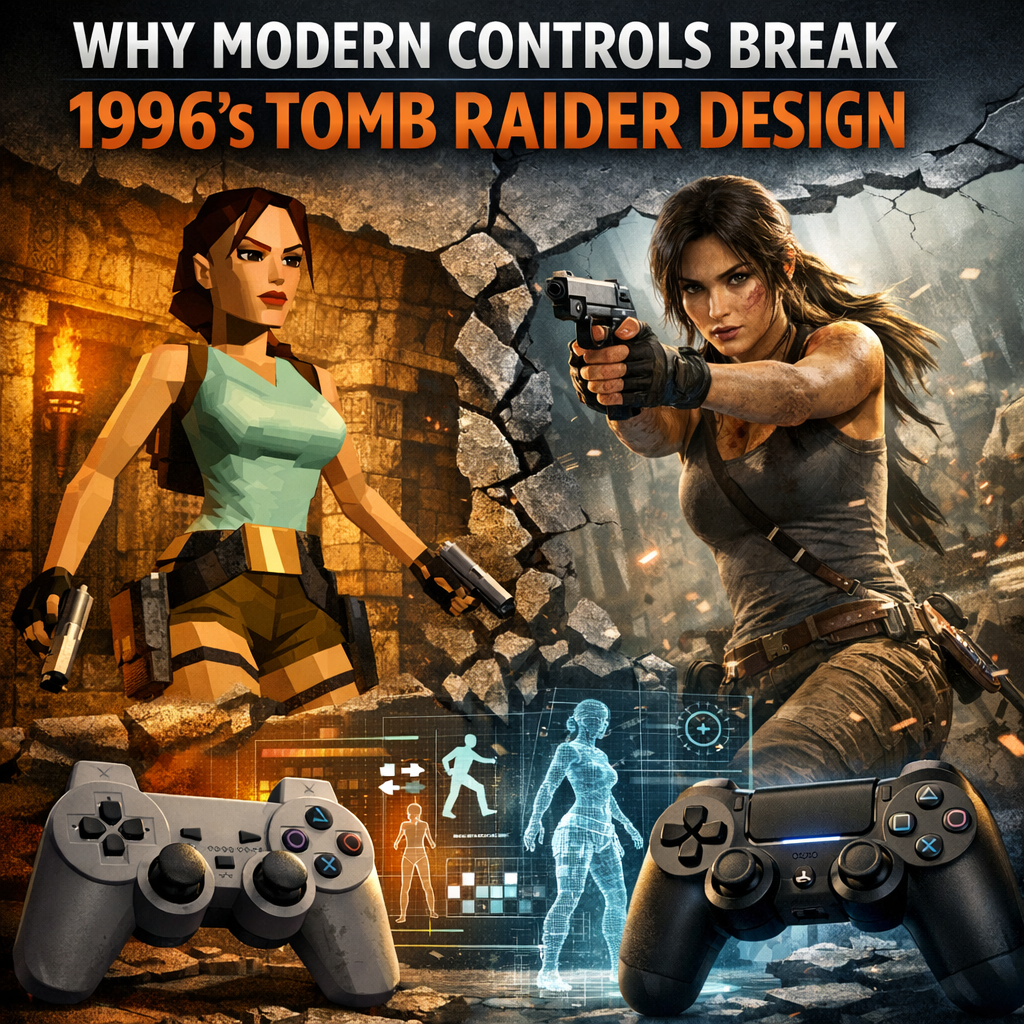
Tomb Raider launched in 1996, developed by Core Design and published by Eidos Interactive. Its protagonist, Lara Croft, explored fixed-camera, polygonal levels built around what today we’d call tank controls and discrete input states. That original control model was never an arbitrary quirk — it was a core design decision. When contemporary players or developers try to graft modern analog sticks, free camera systems and aim-relative movement onto that 1996 architecture, the result is often frustrating rather than refreshing.
How controls, camera and level design are inseparable
The original Tomb Raider levels were engineered for a particular set of constraints: fixed or scripted cameras, large collision boxes, frame-perfect platforming and puzzles that relied on predictable, discrete moves. Tank controls and fixed camera angles give designers certainty about the player vector, jump arcs and where a player will be standing when a camera switches. Swap in an over-the-shoulder or twin-stick scheme and you change the variables designers assumed during level creation. Jumps that were once pixel-perfect become either trivial or impossible; enemy encounters shift in difficulty because players can aim and strafe in ways the AI was not tuned to handle.
Technically, problems arise because of animation timing, bounding volumes and collision detection. The original code treats movement as state changes tied to animation frames. Modern engines use blended animations, root motion and continuous analog input. That mismatch alters hitboxes and the timing windows for climbs, grabs and ledge interactions. In short, the controls do not just change player comfort — they change the geometry of play.
Past attempts and what they reveal
There have been multiple attempts to modernize Tomb Raider over the years. Crystal Dynamics remade the original as Tomb Raider: Anniversary in 2007 and later rebooted the franchise with Tomb Raider in 2013, shifting to modern third-person controls and a tighter camera. Those were not simple control swaps; they were full remakes that rebuilt levels, adjusted puzzles and retuned combat around new movement and camera systems. Community projects such as OpenLara and other engine recreations on GitHub have shown how much of the original game logic is entangled with control code: providing analog support or a free camera often requires rewriting collision, animation and enemy AI behavior.
Why quick fixes rarely work
Modders and preservationists who add controller support to the original executable frequently encounter edge cases: clipping through geometry, unintended deaths during platforming, or trivialized puzzle solutions. These are not cosmetic bugs. They are symptoms of a deeper mismatch between input model and level intent. To make the game feel right with modern controls often means reworking level flow, re-scripting camera transitions and rebalancing combat — essentially creating a different game.
Expert perspectives and industry insight
Designers and historians of game development often emphasize that controls are a design tool as much as a convenience. Veteran level designers point out that what reads as ‘clunky’ today was frequently a deliberate difficulty curve, a way to choreograph tension and movement with limited resources. Preservationists add that faithful emulation of the original experience is itself a choice: some players want the purity of 1996 controls, others want a reimagined Lara with contemporary sensibilities. Both outcomes require conscious design trade-offs, and one cannot be achieved only by swapping input mappings.
Conclusion and outlook
Adding modern controls to the original Tomb Raider is seductive — it promises improved accessibility and a familiar control scheme for new players — but practical reality shows the approach rarely produces a satisfying play experience without deeper intervention. The successful route has been full remakes and reboots that rebuild levels, AI and pacing around new control metaphors. For preservationists, the takeaway is clear: respect the original input model, or be prepared to redesign the game around new mechanics. For developers and players seeking the best of both worlds, the path forward is explicit remakes or parallel versions rather than grafted control patches.
About the Author