Why companies are going all-in — and doing it human-first
The generative AI era has shifted boardroom conversations from “if” to “how fast.” ChatGPT’s public debut on November 30, 2022, and the release of GPT-4 on March 14, 2023, crystallized the commercial potential of large language models (LLMs), prompting multibillion-dollar bets and fast-moving product roadmaps. Microsoft’s reported roughly $10 billion investment in OpenAI in 2023, Google’s push with Bard and PaLM, and Anthropic’s Claude are emblematic of a market sprint to ship and integrate foundation models across software, cloud and vertical applications.
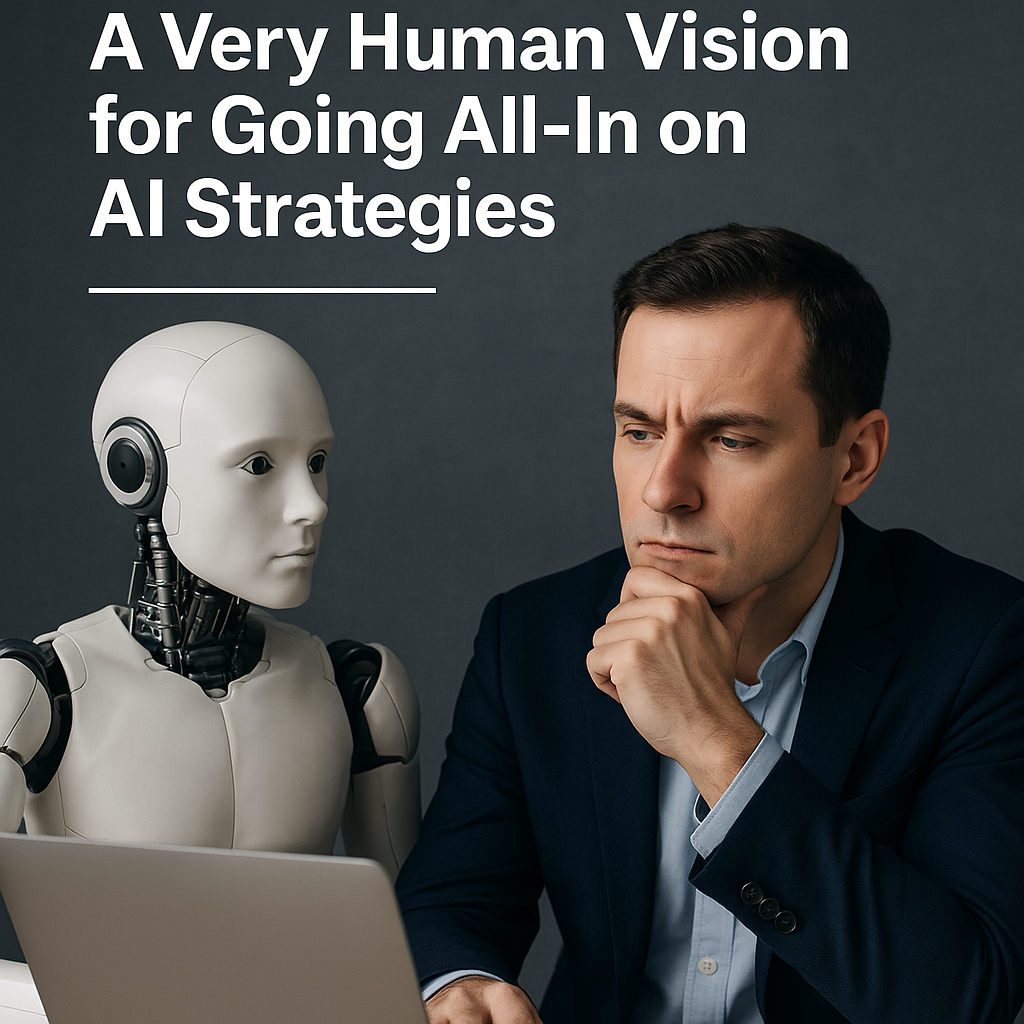
But a growing chorus of executives and technologists is arguing that “going all-in on AI” must center people. A human-first approach emphasizes human-in-the-loop (HITL) workflows, explainability (XAI), rigorous model governance, and reskilling — not blind automation. Firms from incumbent enterprises to startups are blending LLM-driven automation with human oversight to maintain trust, safety and measurable ROI.
Background: technology, timelines and the regulatory backdrop
The pace since late 2022 has been extraordinary. Beyond the headline GPT releases, the ecosystem matured through cloud-native products (AWS’s generative AI services, Google Cloud’s Vertex AI enhancements, Microsoft’s Azure AI stack) and specialized vendor offerings such as Anthropic, Cohere, and smaller vertical AI vendors. Enterprises are experimenting with prompt engineering, fine-tuning, retrieval-augmented generation (RAG), and MLOps pipelines to operationalize models in production.
Regulation and governance are catching up: the European Union reached a provisional agreement on the AI Act in December 2023, setting risk-based rules that will affect high-risk AI deployments. In parallel, guidance from bodies such as NIST and industry consortia is nudging companies toward documented model cards, versioning, and audit trails. These legal and compliance signals are a key reason human-centered controls have moved from a nice-to-have to a board-level requirement.
Business implications: ROI, workforce and product strategy
Adopting AI at scale changes product roadmaps and go-to-market strategies. For software vendors and platforms, adding generative features can drive stickiness — Salesforce and other SaaS firms have integrated AI assistants and automation into CRM and workflow tooling. For enterprises, the economics are more nuanced: price/latency trade-offs between running expensive foundation models in the cloud versus deploying distilled models at the edge; cost of human review; and the need for domain-specific fine-tuning.
Workforce impact is a central tension. Leaders are investing in reskilling programs and redesigning jobs around AI-augmented workflows rather than wholesale replacement. That approach can preserve institutional knowledge and reduce operational risk, but it requires investment in internal tooling (MLOps, data labeling, monitoring) and cultural change.
Technology terms to know
Key industry terms in this shift include LLMs, prompt engineering, fine-tuning, RAG, MLOps, HITL (human-in-the-loop), XAI (explainable AI), model governance and federation. Understanding how these pieces interact is critical for implementing a human-first AI strategy.
Expert perspectives
Andrew Ng, founder of Deeplearning.ai, has long argued that “AI is the new electricity,” emphasizing broad, cross-industry impact — a useful framing for why firms prioritize AI. At the same time, scholars such as Kate Crawford (co-founder of the AI Now Institute) have warned about the societal and power asymmetries that can arise when models are deployed without adequate oversight.
Industry analysts note a pragmatic duality: “Successful enterprises combine fast experimentation with rigorous governance,” says a senior analyst at a major research firm. That playbook blends agile pilot programs with model risk assessments, change management and measurable KPIs tied to customer outcomes.
Conclusion: a human-centered path forward
Going all-in on AI no longer means an unchecked race to automate. The most durable strategies intertwine powerful foundation models with human judgment, governance scaffolding and investments in people. Over the next 12–36 months, expect to see three trends accelerate: tighter regulatory compliance tied to the EU AI Act and national frameworks, proliferation of HITL and XAI tooling in production stacks, and sustained investment in workforce reskilling. For practitioners and executives, the imperative is clear: deploy AI to amplify human capabilities, not to sideline them.
Related topics: enterprise AI adoption, LLMs and model governance, AI ethics and regulation, MLOps and human-in-the-loop systems (see our coverage of LLMs, AI ethics, and enterprise AI adoption for deeper reads).
About the Author