Lede: Who, What, When, Where, Why
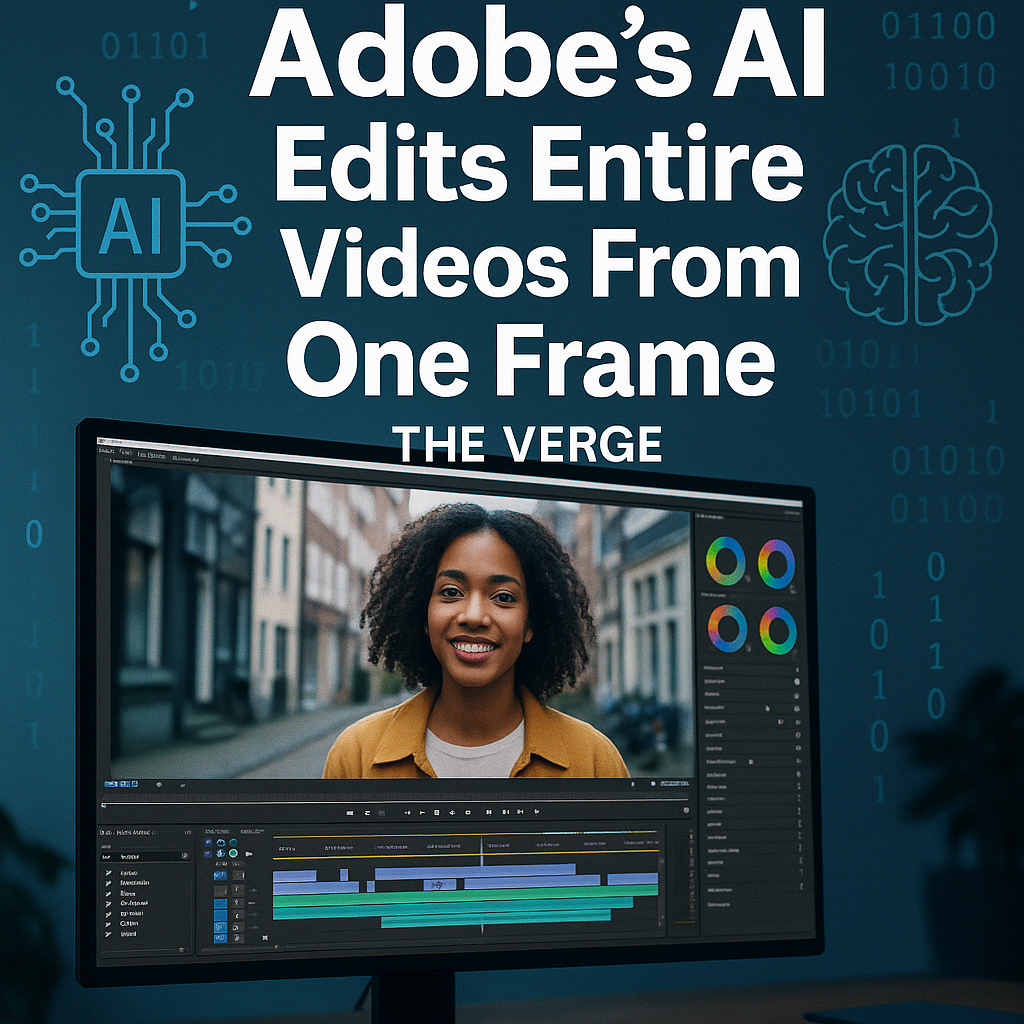
Adobe this week is at the center of renewed debate over generative AI after The Verge detailed an experimental tool from Adobe Research that can propagate a single-frame edit across a whole video. The development, reported by The Verge, aims to reduce hours of manual rotoscoping and frame-by-frame adjustments to seconds of computation — a change that could reshape video post-production workflows for studios and creators worldwide.
What Adobe showed and how it matters
The Verge’s article describes an experimental workflow in which an edit applied to one frame — for example, changing an actor’s shirt color, removing an object, or altering a reflection — is automatically extended to subsequent and previous frames with minimal user intervention. Adobe calls the work experimental research; the company has not announced a product release date. The approach promises to cut repetitive editing tasks and accelerate turnaround time for short-form and long-form video projects.
How the “one-frame” edit works (in plain terms)
Adobe’s method, as summarized by The Verge, combines motion estimation, scene parsing, and learned image priors to track and translate a pixel-level change through time. Instead of forcing editors to paint out an element on every frame, the system leverages temporal consistency and scene understanding to infer how that edit should look across different viewpoints and lighting conditions. Conceptually this blends classic computer-vision tools — optical flow and segmentation — with modern generative models trained on large image and video datasets.
Context: Why this is coming now
Video already dominates internet bandwidth: Cisco’s Visual Networking Index projected that video would represent roughly 82 percent of consumer internet traffic by 2022. As creators face demand for more frequent, higher-quality output, automation that reduces manual labor becomes commercially attractive. Adobe has invested heavily in generative AI across Photoshop, Premiere Pro, and After Effects, positioning itself to bring research prototypes into pro workflows if they prove robust and safe for production use.
Implications for creators, studios, and platforms
For freelance editors and small studios, the promise of automating repetitive frame-by-frame fixes could increase throughput and reduce costs. For large post-production houses, tools that propagate edits reliably could shift the balance from manual compositing toward verification and creative direction. However, the technology also raises concerns: automated edits can introduce subtle artifacts, and failures at scale in high-resolution footage could require significant human oversight.
Legal and ethical questions
One-frame editing accelerates the ability to manipulate video content, which heightens risks around misinformation, deepfakes, and unauthorized alterations of likenesses. Content platforms and rights holders will need clearer provenance, watermarking, and verification tools. Adobe has previously rolled out metadata and content credentials across its apps; any production deployment would likely include similar safeguards to maintain creator trust and compliance with platform policies.
Industry reaction and expert takeaway
Industry researchers and practitioners see one-frame propagation as a natural evolution in video tooling. The core value is not merely speed but shifting the editor’s role from painstaking pixel work to higher-level creative decisions. That said, adoption hinges on reliability: production environments demand near-perfect consistency, especially in feature film and broadcast contexts.
Outlook: What to watch next
Adobe’s project remains experimental, but it signals where the market is headed. Expect incremental rollouts into Creative Cloud betas or research previews, accompanied by technical papers and demo videos. Watch for three measurable milestones before broad adoption: (1) percent reductions in manual frame edits in real workflows, (2) robust artifact detection and rollback tools, and (3) industry-standard provenance features for safety and rights management.
As automated video editing advances, creators, platforms, and policymakers will need to balance productivity gains with accuracy, transparency, and ethical use. The Verge’s report highlights a technical leap that could alter video production economics — but the path from lab demo to trusted studio tool will be governed by quality, controls, and real-world testing.
About the Author