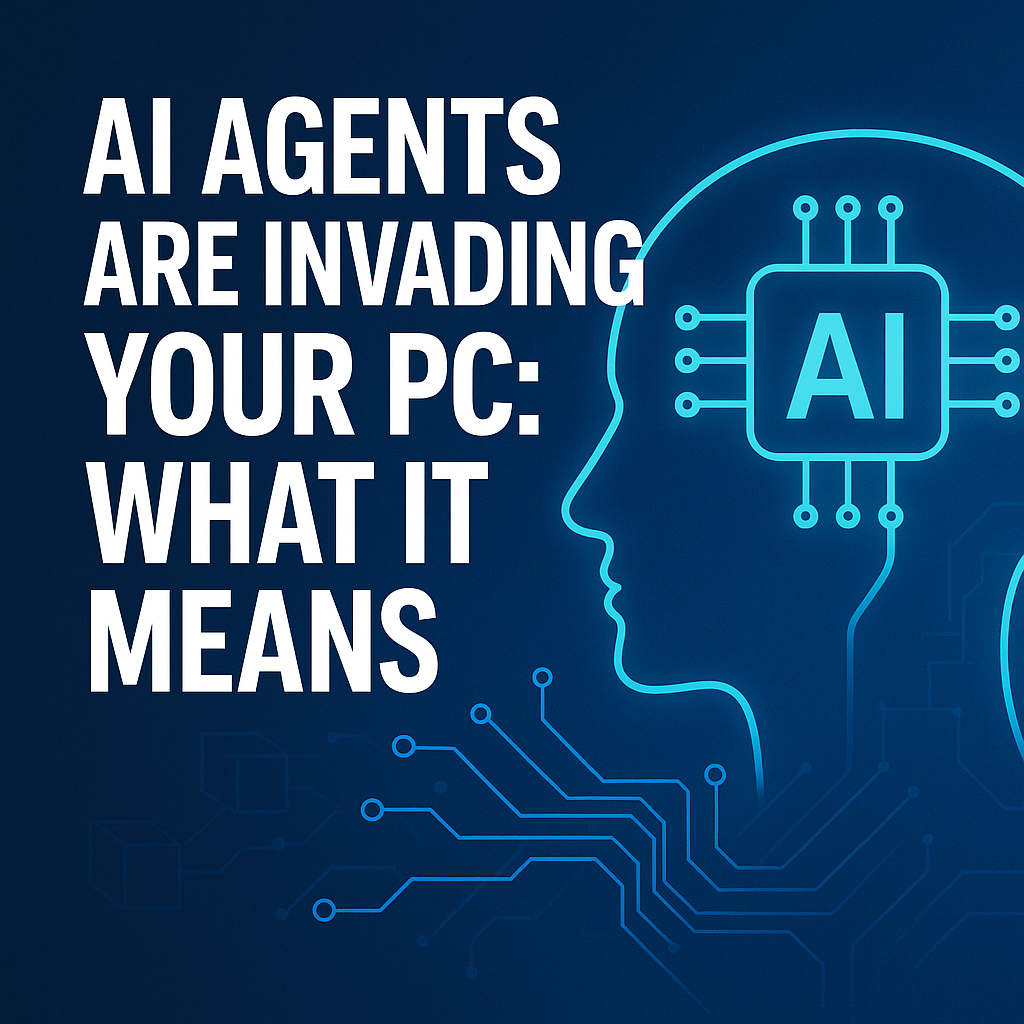
AI agents are showing up on everyday PCs
From background helpers that summarize email to autonomous ‘agent’ scripts that can fetch files, update spreadsheets and push code, AI agents are migrating from cloud experiments to your laptop and desktop. The trend accelerated after major vendors began embedding agent-style assistants across their products in 2023 and 2024: Microsoft with Copilot across Microsoft 365 and Windows, Google with Duet AI in Workspace, Adobe’s Firefly family inside Creative Cloud apps, and a long tail of startups and open-source projects like Auto-GPT that let hobbyists run agents locally or via API.
Why now: compute, models and integration
Several technical shifts have converged to put AI agents on the desktop. Low-latency APIs and faster transformers make multi-step, goal-oriented agents practical; local ML runtimes, Apple’s M-series Neural Engine and Intel/AMD hardware changes give vendors a path to run models or acceleration on-device; and product teams are building tighter integrations between generative models and desktop workflows—email, file managers, IDEs and browsers.
That combination turns generative models from reactive copilots (answer this prompt) into agents that can take a sequence of actions: open documents, run a search, extract data and return a consolidated result. Open-source agent frameworks—popularized in 2023 by projects such as Auto-GPT and BabyAGI—helped spread the idea that an AI could be given a goal and permitted to act autonomously.
How the big vendors are embedding agents
Microsoft has stamped “Copilot” across Office and Windows, focusing on contextual assistance tightly integrated with file and app access. Google’s Duet AI brings similar capabilities to Gmail, Docs and Google Drive, designed for collaborative workplaces. Adobe’s Firefly models extend generative tools into Photoshop and Illustrator to automate creative tasks. Meanwhile, OpenAI’s ChatGPT ecosystem—including the GPTs and plugins introduced since 2023—lets third parties build agents that connect to cloud services and desktop bridges.
Practical examples
Use cases are emerging fast: an agent that triages and drafts responses to your inbox, one that prepares a slide deck from a set of documents, or an engineering agent that opens a repo, runs tests and files GitHub issues. Enterprises can chain agents to automate HR onboarding, invoice processing and cross-system reporting, turning repetitive workflows into mostly automated sequences.
Security, privacy and governance implications
But autonomy creates new attack surfaces. An agent granted too-broad permissions could exfiltrate files, modify documents, or interact with cloud services in unsafe ways. Endpoint security vendors and IT teams are racing to add agent-aware controls—permission scoping, audit trails and policy enforcement—while compliance teams worry about data residency and recordkeeping when agents access sensitive systems.
Privacy advocates note that even agent actions that appear local can leak data to third-party LLM providers when APIs are involved. That has prompted enterprises to consider hybrid architectures—local model inference for sensitive tasks and cloud models for heavy-lift reasoning—or to demand contractual guarantees about data use from vendors.
Expert perspectives
Industry analysts characterize this shift as the next wave of software automation: rather than isolated features, agents are being treated as programmable, composable services that sit between users and their apps. Security practitioners advise treating agents like any third-party app—apply the principle of least privilege, maintain logs, and use orchestration policies to limit autonomy. Product leaders see major productivity gains but warn that governance must keep pace with capability.
What this means for users and IT teams
For consumers, desktop agents will make everyday tasks faster but also more opaque: an agent’s multi-step process might be hard to audit after the fact. For IT and security teams, the immediate work is policy definition—who can run agents, what data they may access and how results are validated. Expect endpoint management vendors and SIEM platforms to add agent-detection and behavior analysis over the next 12–18 months.
Conclusion: a powerful tool that needs guardrails
AI agents promise real productivity gains by automating multi-step workflows, but they also change the security and governance calculus for desktop computing. Companies such as Microsoft, Google and Adobe are already shipping agent-enabled features; open-source communities and startups are democratizing agent creation. The key takeaway: treat agents as first-class software actors—powerful, useful and in need of careful controls—because as they invade the PC, they’ll alter how work gets done and who gets to control it.
Related topics: Windows Copilot, Google Duet AI, Adobe Firefly, Auto-GPT, endpoint security, enterprise AI governance.
About the Author