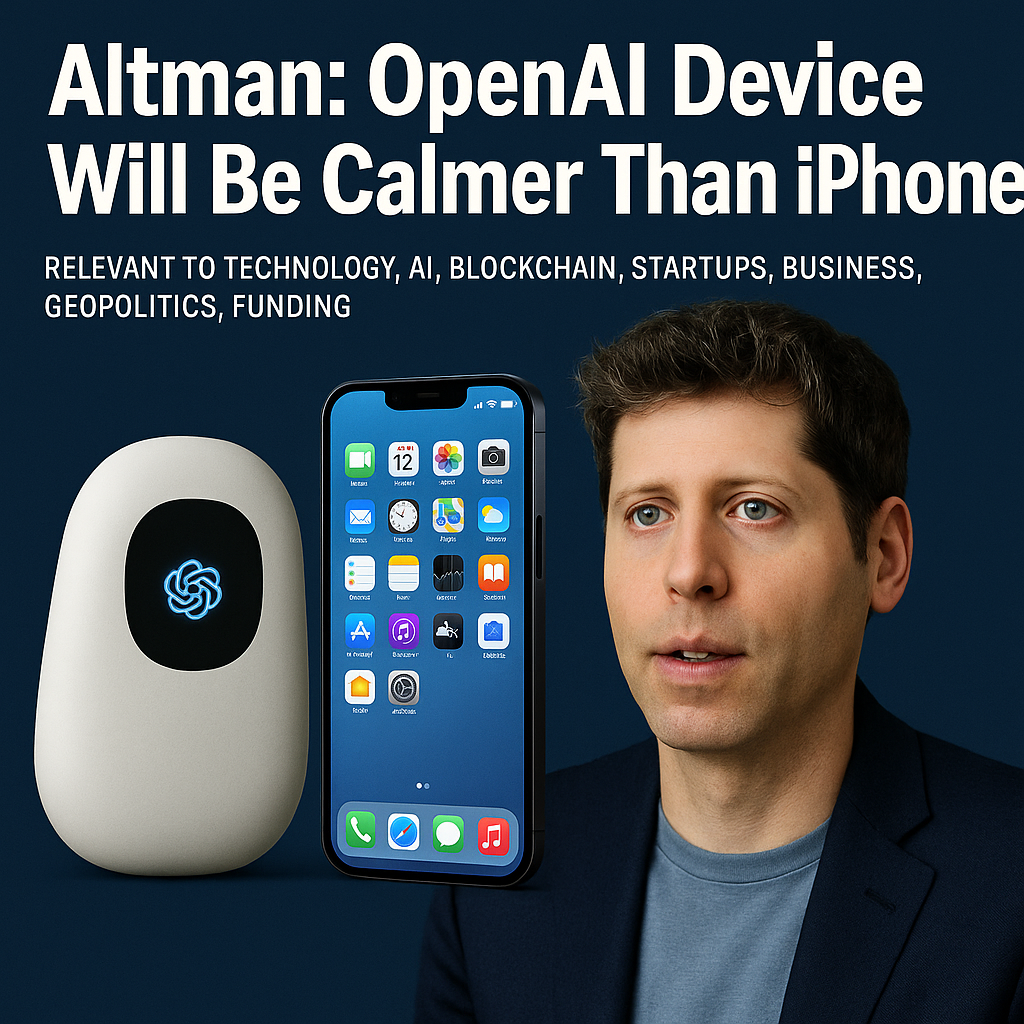
Altman frames OpenAI’s hardware as a calmer alternative to phones
Sam Altman, CEO of OpenAI, has described the company’s forthcoming consumer AI device as intentionally “more peaceful and calm” than the iPhone, signaling a design philosophy that prioritizes quieter, lower-friction interactions over attention-grabbing notifications. The comment comes as OpenAI — the San Francisco startup founded in 2015 that popularized ChatGPT (launched Nov. 30, 2022) — moves from cloud-first models toward more integrated consumer hardware and user experience experiments.
Why OpenAI is eyeing hardware
OpenAI’s pivot toward a physical device reflects broader industry dynamics: from the rise of voice-first assistants (Amazon Echo, 2014) to recent efforts by Big Tech to embed AI at the device level for latency, privacy and continuous services. The company’s work on models such as GPT-4 (announced March 14, 2023) and the proliferation of custom AI assistants have created demand for new interaction surfaces. Altman’s comments suggest OpenAI wants to avoid the smartphone’s reputation as an attention economy engine — a point that matters to regulators and consumers alike.
Smartphone adoption is deeply entrenched: Pew Research found in 2021 that about 85% of U.S. adults owned a smartphone. The open question for OpenAI and rivals is whether consumers will buy a dedicated AI device rather than relying on iPhone, Android phones, or smart speakers. Apple has tied device-level AI evolution to iOS, hardware chips (Apple’s A-series and M-series silicon) and ecosystem control; OpenAI’s approach will have to address manufacturing, distribution and app ecosystems if it hopes to compete.
Design goals: calmer notifications and conversational UX
Altman’s emphasis on being “calmer” implies prioritizing notification filtering, multimodal conversation continuity, and perhaps a different monetization model than the ad-driven services that incentivize constant engagement. That design stance aligns with growing interest in digital wellbeing: policymakers, advocacy groups and users have criticized attention-maximizing interfaces for their mental health impacts. A device that reduces interruptive alerts in favor of asynchronous, context-aware AI assistance would be materially different from the iPhone’s current UX model.
Implications for Apple, Google and the attention economy
If OpenAI ships hardware that meaningfully alters how users are interrupted or engaged, it could pressure Apple and Google to refine their UX and notification strategies. Apple sells iPhones and services tied to an App Store ecosystem that depends on developer distribution and clear platform policies. Google similarly integrates AI into Android and Pixel hardware. A successful OpenAI device would likely push the industry to rethink how on-device models, background processing, and privacy-preserving personalization are engineered.
There are supply-chain and business-model hurdles: manufacturing partnerships, silicon choices (ARM-based chips vs. custom accelerators), carrier relationships for cellular connectivity, and an app/API ecosystem that incentivizes third-party developers. OpenAI will also face scrutiny over data handling and moderation; regulators in the EU and U.S. have already signaled interest in controlling powerful AI deployments.
Expert perspectives
Observers say the framing matters. Tristan Harris, founder of the nonprofit Center for Humane Technology, has long argued that product design should prioritize human attention and wellbeing; a device intentionally designed to be less interruptive would be “aligned with calls for more humane attention design,” Harris has suggested in public commentary on attention economy issues. Independent analysts note that hardware alone won’t change user behavior unless paired with a compelling ecosystem and clear incentives for developers.
Industry analysts also point out execution risks: building a new consumer device is expensive and time-consuming. Many ambitious hardware projects fail not for lack of software vision but because of logistics — sourcing components, certification, global distribution and customer support. OpenAI will need to show both a differentiated user experience and a realistic path to scale.
Conclusion: A calm product vision, with hard practical tests ahead
Altman’s description of a more “peaceful and calm” OpenAI device sets a high-level design bar that appeals to growing concerns about attention and screen time. But transforming that aspiration into a commercially viable product will force OpenAI to contend with manufacturing, regulatory, and ecosystem realities — and to prove that consumers will buy a dedicated AI surface rather than using AI on existing iPhones and Android devices. For coverage continuity, see our reporting on ChatGPT, GPT-4, and Apple iPhone design evolutions for how software and hardware are reshaping the attention economy.
About the Author