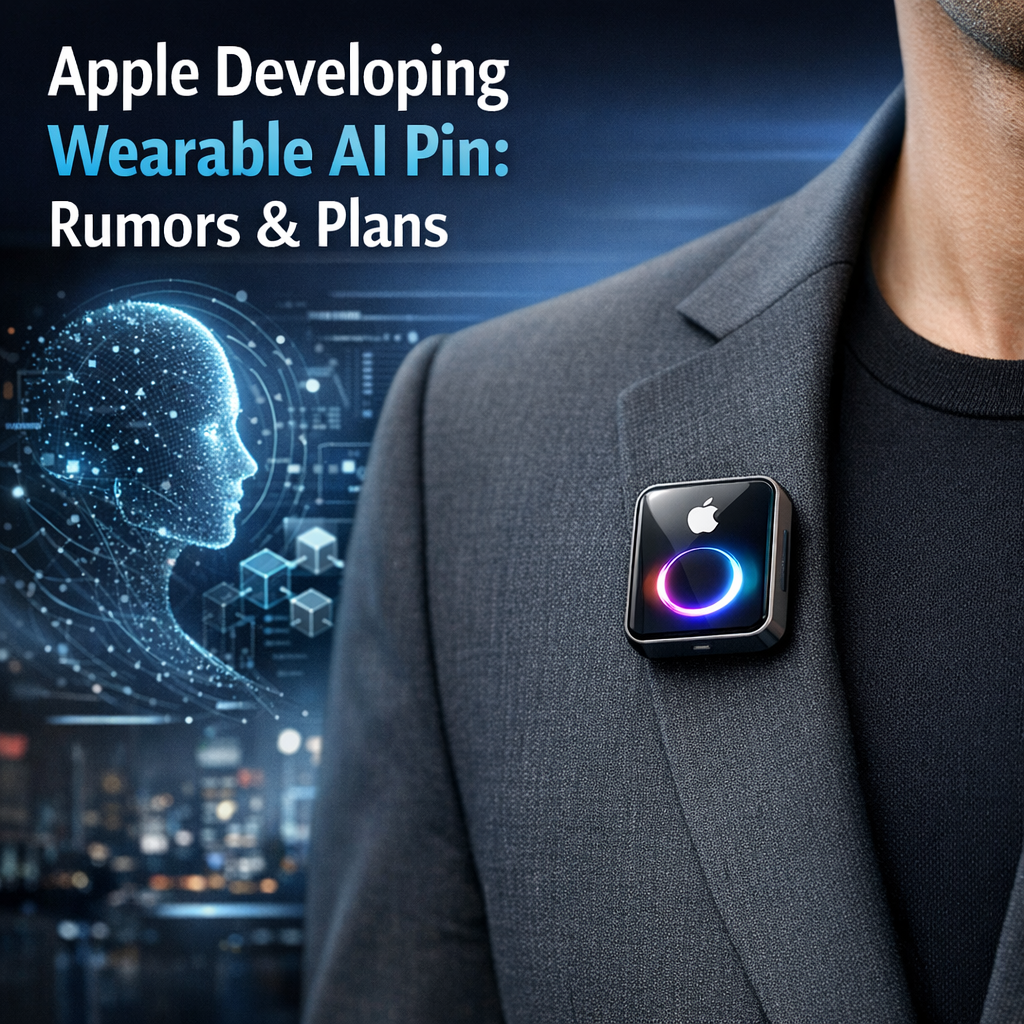
Apple reportedly building a wearable AI pin — who, what, when
Apple is reportedly developing a small wearable device — widely described in industry coverage as an “AI pin” — that would bring voice-driven, on-device artificial intelligence to users without a new smartphone form factor. Reports about the project began circulating in early 2024 and have continued as Apple invests heavily in machine learning, custom silicon and ambient computing. The company has not confirmed a product name, official launch date or pricing.
What the device is expected to do
Details remain sketchy and stem largely from people familiar with the matter and supply-chain reporting. The concept resembles other tiny, clip-on wearables introduced by startups: a hands-free interface that surfaces contextual AI assistance, voice queries and notifications using a combination of onboard sensors, microphones and local compute. Key reported features include natural-language interactions, short-form visual or audio summaries, and deep integration with an iPhone and Apple services.
Central to the idea is on-device processing. Apple has long emphasized neural network acceleration with its Neural Engine in A- and M-series chips, and the pin concept would likely leverage similar silicon to run models locally rather than relying solely on cloud servers. That design approach aligns with Apple’s focus on privacy and low-latency interactions, but it also raises engineering trade-offs around battery life, thermal limits and miniaturization.
How it compares to competitors
Apple would be entering a market that already includes niche entrants such as Humane, which introduced an AI pin product that experiments with ambient AI and a screen-less experience. Large competitors including Google and Meta have also signaled ambitions in ambient computing, smart glasses and voice agents. Apple’s advantage would be its ecosystem: tight hardware-software integration, iPhone pairing, the App Store and services such as Siri, iCloud and Apple Music.
Background: why Apple is pursuing wearable AI
Apple’s work on an AI pin follows a broader industry shift toward on-device and conversational AI. The company has expanded machine-learning investments across hardware, frameworks like Core ML, and developer tooling. On the user side, demand for always-available assistants and eyes-free interfaces has grown, but mainstream consumers remain wary of devices that constantly listen or send data to the cloud.
From a strategic standpoint, a small wearable lets Apple extend its ecosystem beyond the iPhone and Watch, offering new touchpoints for services and subscriptions. It also positions the company to compete on ambient and personal AI experiences without committing to full augmented-reality glasses or a bulky headset.
Analysis: technical and business challenges
Packing meaningful AI into a coin-sized device presents difficult engineering problems. Battery capacity is the most obvious constraint: sustained voice processing and wireless connectivity drain power quickly, forcing either frequent charging or aggressive on-device model compression. Thermal management and microphone array performance in a tiny housing are additional hardware hurdles. On the software side, Apple will need to optimize models for its silicon and design a privacy-preserving data flow that reassures users.
Commercially, Apple must decide how to position such a device. Will it be a premium accessory tied to high-margin services, or a mass-market gateway for new subscription revenue? Pricing and developer support will influence adoption and third-party integrations.
Expert perspectives and industry reaction
Industry analysts note that an Apple-branded AI pin would be consequential precisely because of the company’s scale and ecosystem control. Analysts point out that Apple can drive rapid adoption if the device integrates seamlessly with iOS and third-party apps while maintaining familiar privacy controls.
Privacy and security experts caution that any always-available listening device changes the threat model. Even if much processing happens locally, metadata and selective cloud fallbacks can create new vectors for data exposure. For many privacy advocates, the hallmark questions will be what data is stored, how long it is retained, and whether users can meaningfully control or audit those flows.
Conclusion: outlook and what to watch
At this stage, the AI pin remains a reported project rather than a confirmed product. Watch for supply-chain indicators, patent filings, Apple job listings for small-form-factor audio and ML engineers, and comments at major company events such as WWDC for clearer signals. If Apple moves forward, the device could accelerate a new class of ambient interfaces while renewing debates over battery, form factor and privacy. For consumers and developers, the key takeaway is to expect incremental deployments: Apple typically introduces new hardware with tight software integration and a measured rollout that emphasizes user experience and privacy controls.
About the Author