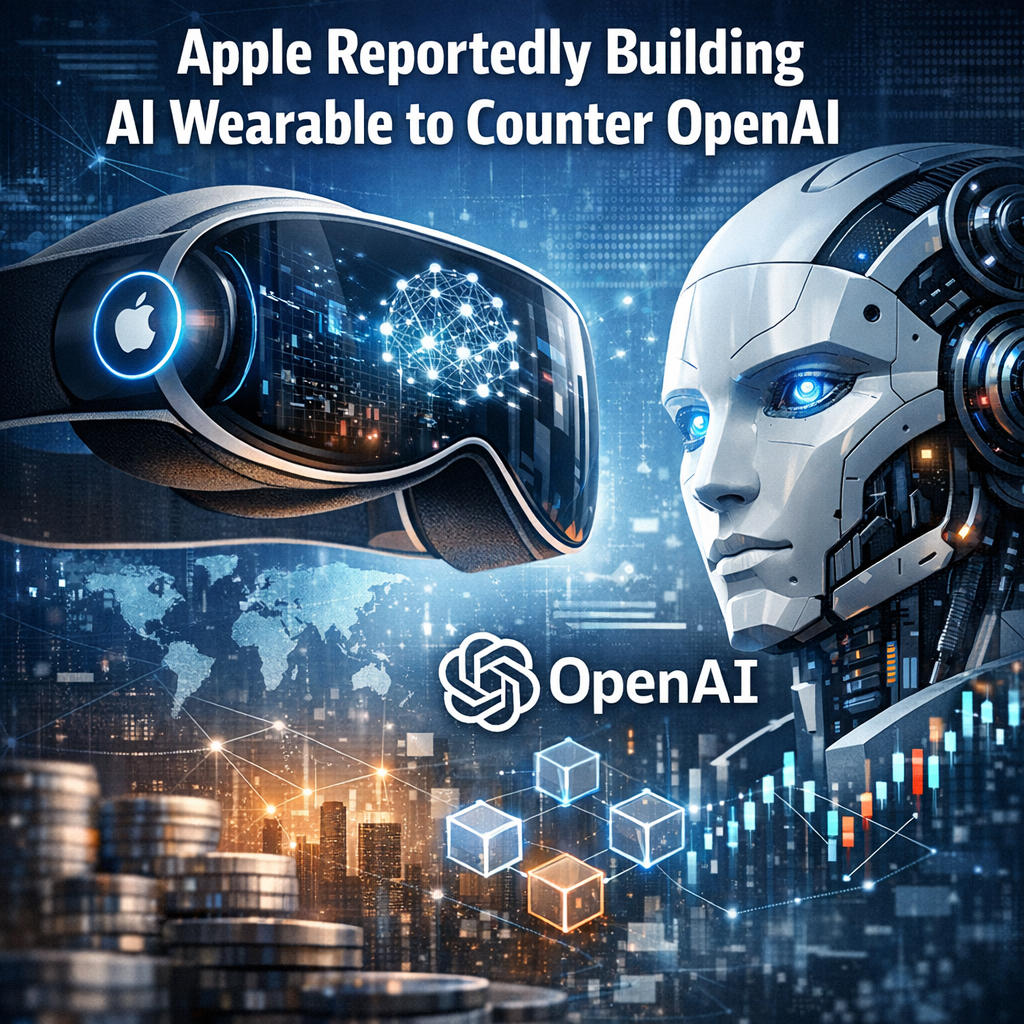
Apple moves into AI wearables as competition intensifies
TechCrunch reported this month that Apple is developing an AI-focused wearable, an apparent bid to keep pace with the surge of consumer AI products from companies such as OpenAI. The report, citing people familiar with the matter, suggests Apple is exploring a form factor that leverages its silicon and services ecosystem to deliver low-latency, on-device AI features.
The move underscores a broader industry trend: Big Tech is translating the rapid advances in generative AI and large language models into hardware that can deliver continuous, context-aware assistance. For Apple, historically cautious on new product categories, an AI wearable would represent both a technical and strategic pivot aimed at extending Siri and device continuity into more ambient, always-available experiences.
What the device could look like and how it might work
Details about the wearable’s form factor are limited. TechCrunch’s reporting did not confirm a product name or a launch timeline, and Apple declined to comment. Analysts and industry observers say the device could take several shapes — from earbuds with expanded sensor arrays to a glasses-like headset — but any Apple wearable would likely lean on the company’s existing strengths: tight hardware-software integration, custom silicon with Neural Engine capabilities, and a robust developer platform.
On the technical side, the device would probably use a hybrid model: on-device inference for latency-sensitive tasks and privacy-preserving features, with cloud-based models for heavier generative workloads. That architecture mirrors Apple’s approach in recent years, where the A- and M-series chips include dedicated neural accelerators to handle machine learning tasks locally, reducing the need to stream every request to remote servers.
Sensors, context and integration
Sensors and context-awareness are likely to be central. Apple’s existing wearables and accessories — the Apple Watch, AirPods, and Vision Pro headset — show the company’s emphasis on sensor fusion, motion tracking, and health telemetry. An AI wearable could combine audio, motion, and environmental data with on-device models to offer proactive assistance, contextual summaries, real-time language translation, or hands-free productivity functions tied into Apple’s ecosystem: Messages, Mail, Calendar and Health data.
Why Apple is acting now: strategic rationale
Apple faces a competitive landscape reshaped by OpenAI, Google, and Microsoft, all pushing consumer-facing AI experiences into apps and devices. OpenAI’s ChatGPT and associated integrations accelerated mainstream expectations for conversational AI; Google and Microsoft have embedded generative models across search, Office apps and Android devices. For Apple, an AI wearable is a way to retain control of the user experience while differentiating on privacy and tight integration rather than raw model scale.
Apple has repeatedly framed privacy as a market differentiator. By prioritizing on-device processing and differential privacy techniques, Apple can offer powerful AI features without funneling all user data to third-party clouds. That trade-off, however, poses engineering challenges: delivering sophisticated generative capabilities within tight power and thermal envelopes requires new model compression techniques, efficient neural accelerators and smart offloading strategies to cloud resources.
Expert perspectives and market implications
Industry observers note that Apple’s success will hinge on three factors: developer adoption, battery life, and perceived value versus existing devices. A compelling SDK and APIs that let third-party developers extend the wearable’s capabilities would be critical. Equally important will be delivering multi-hour battery life while running continuous sensor processing and local inference.
From a market perspective, a well-executed AI wearable could expand Apple’s services revenue by creating new subscription and in-app ecosystems tied to premium AI features. It would also pressure competitors to accelerate hardware-software co-design for AI. For regulators and privacy advocates, however, a new class of ambient AI devices raises fresh questions about consent, data minimization and adversarial use cases.
Risks and regulatory scrutiny
Regulators around the world are already scrutinizing AI applications in areas such as advertising, health and public safety. A sensor-rich wearable that interprets speech and context in real time would invite careful review, particularly in Europe where AI and data protection rules are tightening. For Apple, navigating that landscape will require robust transparency, clear on-device privacy controls and careful partnerships with developers and health providers.
Conclusion: long game, not a quick reaction
Apple’s reported work on an AI wearable is consistent with its long-term approach: iterate on hardware and services together, prioritize user privacy, and introduce new categories when the company believes the user experience is ready. Whether the result will be a category-defining product or a niche accessory depends on technical execution, ecosystem support and regulatory outcomes. For consumers and competitors alike, the prospect of an Apple AI wearable signals that the next phase of AI will be increasingly personal and ambient, much closer to the body and daily life than the smartphone alone.
About the Author