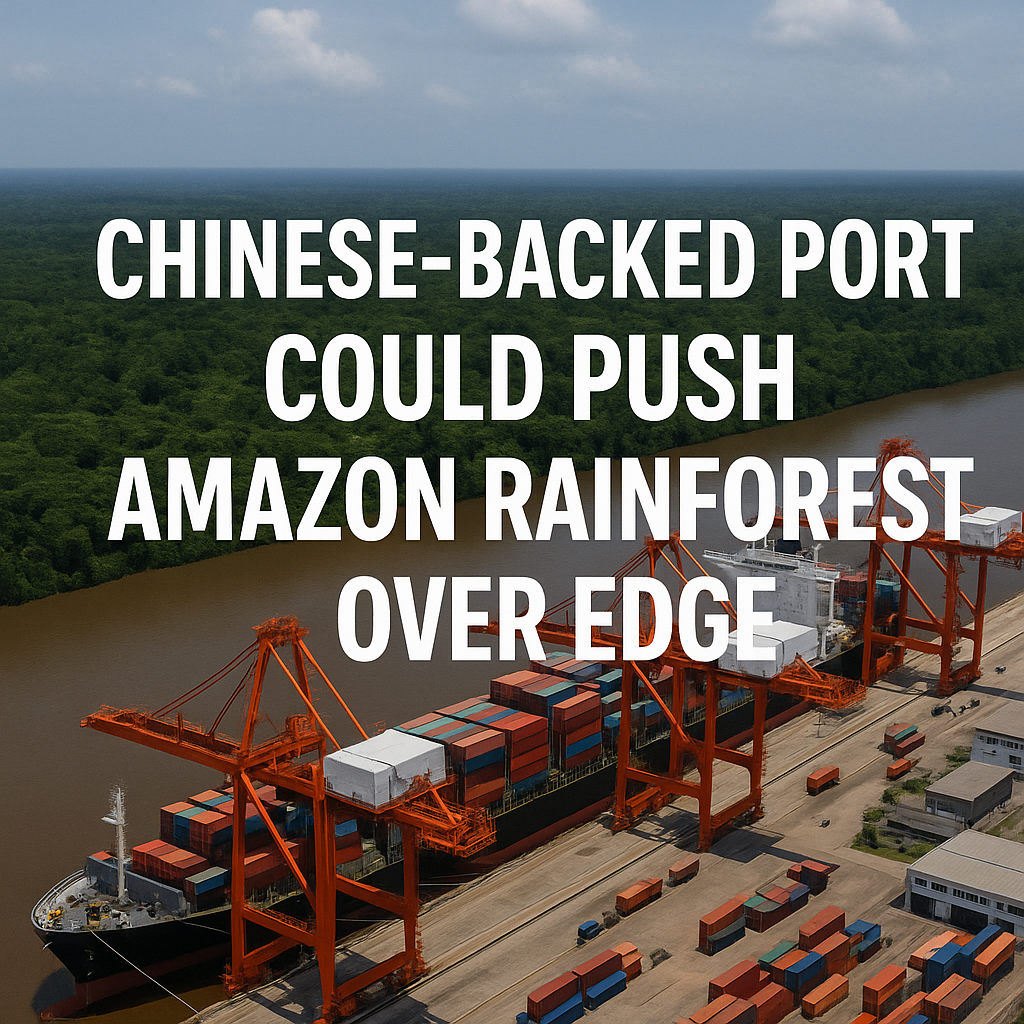
Big infrastructure, bigger risks: who, what, when, where, why
Plans for a massive, Chinese-backed port complex in the Brazilian Amazon — tied into the proposed Ferrogrão rail corridor and river export hubs such as Miritituba on the Tapajós — have reignited fears that new logistics capacity will accelerate deforestation and push fragile ecosystems “over the edge.” The proposals, which have gained traction with interest from Chinese investors and shippers in the past several years, would dramatically lower transport costs for soy, beef and timber bound for global markets, particularly China, Brazil’s largest commodity customer.
Background: Ferrogrão, Miritituba and the export squeeze
The Ferrogrão railway (often referred to as EF-170) is a planned north–south grain corridor to move produce from Mato Grosso — Brazil’s soybean- and cattle-producing heartland — to ports on the Tapajós River. The roughly 1,000-kilometer rail project has been discussed in Brasília and international markets for much of the 2010s and into the 2020s. Its goal: shorten transit time to northern ports like Miritituba and downstream terminals, shaving freight costs and increasing export capacity.
Chinese shipping and infrastructure firms, including state-backed financiers and global port operators such as China Communications Construction Company (CCCC) and COSCO, have a long history in port concessions worldwide and have expressed commercial interest in faster, cheaper South American routes. That commercial logic is straightforward: China imports vast quantities of soy and meat, and better access to Amazon-adjacent ports expedites shipments and reduces handling bottlenecks at southern terminals.
Why environmentalists are alarmed
Researchers and NGOs say new corridors and deepwater terminals are classic catalysts for frontier deforestation. Data from Brazil’s National Institute for Space Research (INPE) show forest loss climbed in recent years, with annual clearings in the Brazilian Amazon well into the tens of thousands of hectares in the early 2020s. Studies published in peer-reviewed journals and analyses by organizations such as the World Resources Institute (WRI) and the Amazon Environmental Research Institute (IPAM) link transport infrastructure to rapid agricultural expansion, land-grabbing and illegal logging.
In practical terms, paved roads, rail spurs and port terminals lower the cost of converting rainforest to pasture or cropland. Local land values rise, lending and speculative activity increase, and rural properties that were previously uneconomic to clear become ripe for large-scale soy and cattle operations. Indigenous territories and protected areas in Pará and neighboring states could face greater incursions if large export nodes scale up.
Economic trade-offs and industry perspective
Proponents argue that better logistics will boost Brazil’s export competitiveness and create jobs in port construction, operations, and logistics. Agribusiness groups in Mato Grosso have long championed Ferrogrão, arguing Brazil needs efficient routes to remain competitive with North American and Argentine supply chains. Chinese importers, too, benefit from more reliable, lower-cost cargo flows.
But those economic gains come with externalities: increased carbon emissions from land-use change, biodiversity loss in one of the planet’s most important carbon sinks, and legal and reputational risks for companies in global supply chains as consumers and regulators demand deforestation-free sourcing.
Expert perspectives and policy levers
Analysts at environmental think tanks warn that without strict environmental safeguards, new ports and rail corridors will be a deforestation accelerant. Researchers advising policy-makers recommend binding, traceable supply-chain commitments, accelerated land titling and monitoring, and conditional financing that ties Chinese and international loans to robust environmental impact assessments and Indigenous consultation.
Public-interest groups in Brazil have urged the Ministry of Infrastructure and IBAMA (the federal environmental agency) to require comprehensive Environmental Impact Assessments (EIAs), banca de mitigação measures and enforcement plans before concessions proceed. International lenders and export credit agencies have a role too: conditioned finance — requiring verifiable anti-deforestation controls — can blunt worst-case outcomes.
Conclusion: stakes and what comes next
The tradeoff at the center of the debate is stark: faster, cheaper exports versus an increased risk of large-scale ecological tipping points in the Amazon. With Chinese commercial interest and the Ferrogrão corridor still advancing in fits and starts through the mid-2020s, the immediate future will be determined by regulatory rigor, corporate sourcing policies, and whether finance partners insist on enforceable environmental safeguards. For Brazil, China and commodity buyers worldwide, the choice is no longer abstract: the infrastructure decisions made today will shape the Amazon’s fate and global climate outcomes for decades.
Related topics for further reading: Ferrogrão railway developments, INPE deforestation data, Brazil-China trade relations, sustainable supply-chain certification, Indigenous land rights.
About the Author