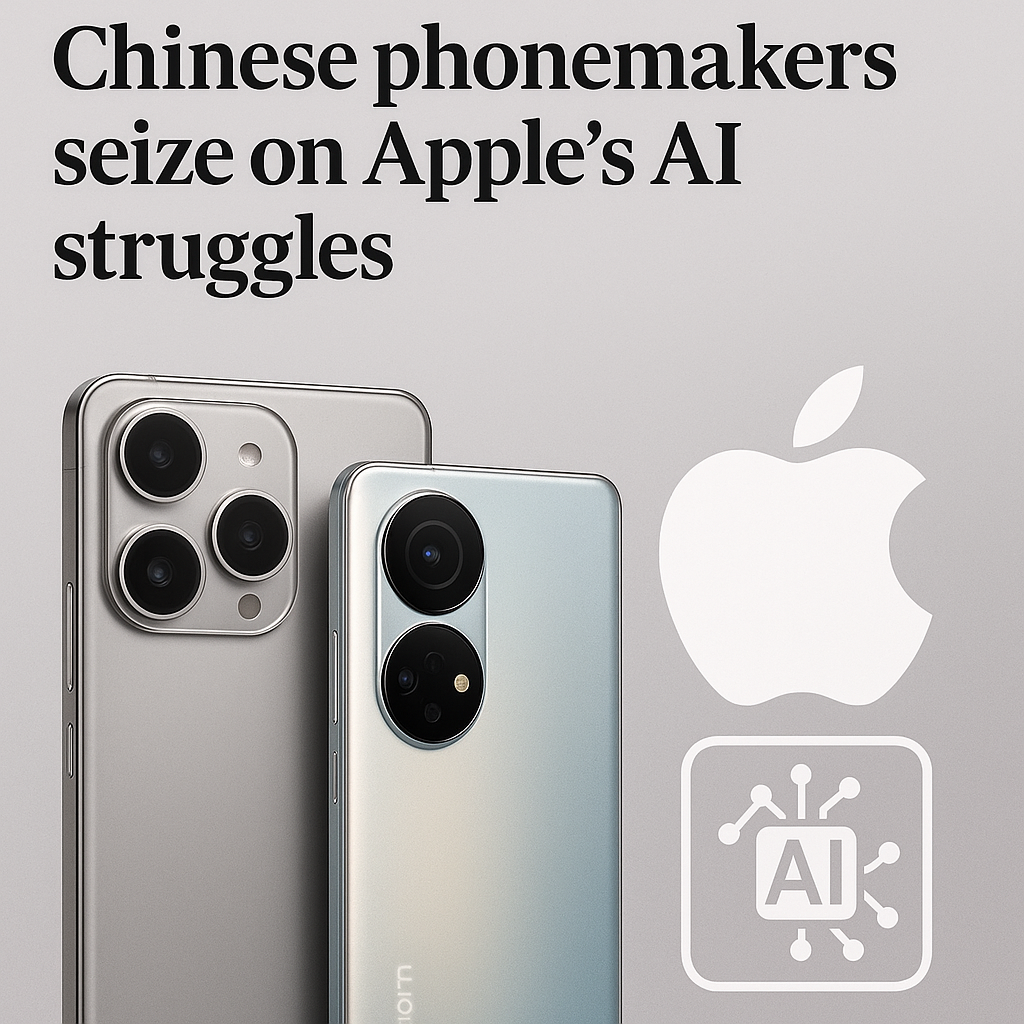
Chinese phone makers pounce as Apple falters on AI
Chinese smartphone makers including Xiaomi, Huawei, Oppo and Vivo are accelerating rollouts of on-device AI features and partnerships with domestic large language models (LLMs) to capitalize on what the Financial Times describes as Apple’s AI struggles. The move follows Apple’s high-profile AI push at WWDC in June 2024 — where the company unveiled “Apple Intelligence” — but has exposed gaps that rivals are exploiting in China’s fiercely competitive handset market.
Background: a fast-moving AI battleground
At WWDC on June 10, 2024, Apple presented a suite of generative-AI features that lean heavily on on-device processing using the Neural Engine in iPhones, iPads and Macs. While the presentation laid out Apple’s roadmap, the company faces challenges around feature parity, regulatory limits in China and a slower rollout of some headline capabilities compared with rivals.
That has opened a window for local manufacturers. Xiaomi has been promoting advanced camera AI and conversational assistants integrated into HyperOS; Huawei has bundled its Pangu models and Pangu-powered services into flagship devices following the company’s broader AI work; Oppo and Vivo have pushed similar features in ColorOS and OriginOS, advertising real-time generative photo, video and voice functions. These manufacturers are pairing device-level neural processing units (NPUs) with tie‑ins to Chinese cloud and AI firms such as Baidu (ERNIE), Alibaba (Tongyi Qianwen) and Tencent (Hunyuan).
Why Chinese OEMs have an edge
Several structural factors are helping Chinese OEMs move faster in the local market. First, tighter integration with Chinese LLM providers avoids the cross-border data and regulatory hurdles Apple faces when attempting to rely on third-party models in China. Second, many vendors are optimizing software to run on NPUs or on Qualcomm and MediaTek silicon tuned for local inference workloads. Third, marketing cycles and pricing strategies allow them to rapidly ship AI features even at lower price tiers, pushing the technology beyond Apple’s premium-only positioning.
Market dynamics and data points
China’s smartphone sector remains intensely competitive, with local brands collectively holding a dominant share of shipments in 2024. While Apple remains the main premium player, domestic brands have regained momentum by tying device upgrades to novel AI features rather than only specs like camera megapixels or chip clock speeds. Analysts at Canalys and Counterpoint Research have noted increased promotional activity and OS-level AI hooks among Chinese OEMs during the second half of 2024 and into 2025.
Expert perspectives
Industry observers say the contest is about more than flashy demos. “On-device AI that respects latency and privacy — and that integrates seamlessly with local services — resonates strongly with Chinese consumers,” said an independent mobile analyst who asked not to be named. “That’s a space Apple wants to own, but local constraints and the need to partner with domestic LLMs slow it down.”
Other analysts emphasize Apple’s strengths. “Apple’s ecosystem, hardware-software co-design and large installed base are formidable advantages,” said a senior analyst at a global consultancy. “But if Chinese OEMs can deliver genuinely useful AI experiences at a wider range of price points, Apple will face pressure, particularly in Greater China and emerging markets.”
Implications for Apple, OEMs and the supply chain
If Chinese phonemakers keep shipping perceptible AI improvements faster than Apple, the result could be market share erosion for iPhone in China and faster feature-led upgrades across the Android ecosystem. For suppliers, this could mean renewed demand for AI-capable chips from MediaTek and Qualcomm, and investment in NPUs and specialized accelerators.
On the regulatory front, reliance on domestic LLMs helps Chinese OEMs avoid data residency and censorship hurdles that complicate Apple’s deployments in China. Conversely, Apple’s insistence on tight control over its AI stack could limit its ability to localize as quickly as rivals that can plug into regional AI clouds.
Conclusion: a race defined by integration and experience
The Financial Times’ reporting underscores a simple dynamic: the AI era in smartphones favors speed and local integration as much as silicon prowess. Apple’s methodical, privacy-first approach to AI is strategically coherent but may leave short-term openings that Chinese manufacturers are eager to exploit. For consumers, that promises faster innovation — and for Apple, it poses a clear challenge to sharpen execution and regional partnerships as the AI arms race in mobile intensifies.
Related topics: Apple Intelligence (WWDC 2024), Baidu ERNIE, Huawei Pangu, smartphone market share, on-device AI integration.
About the Author