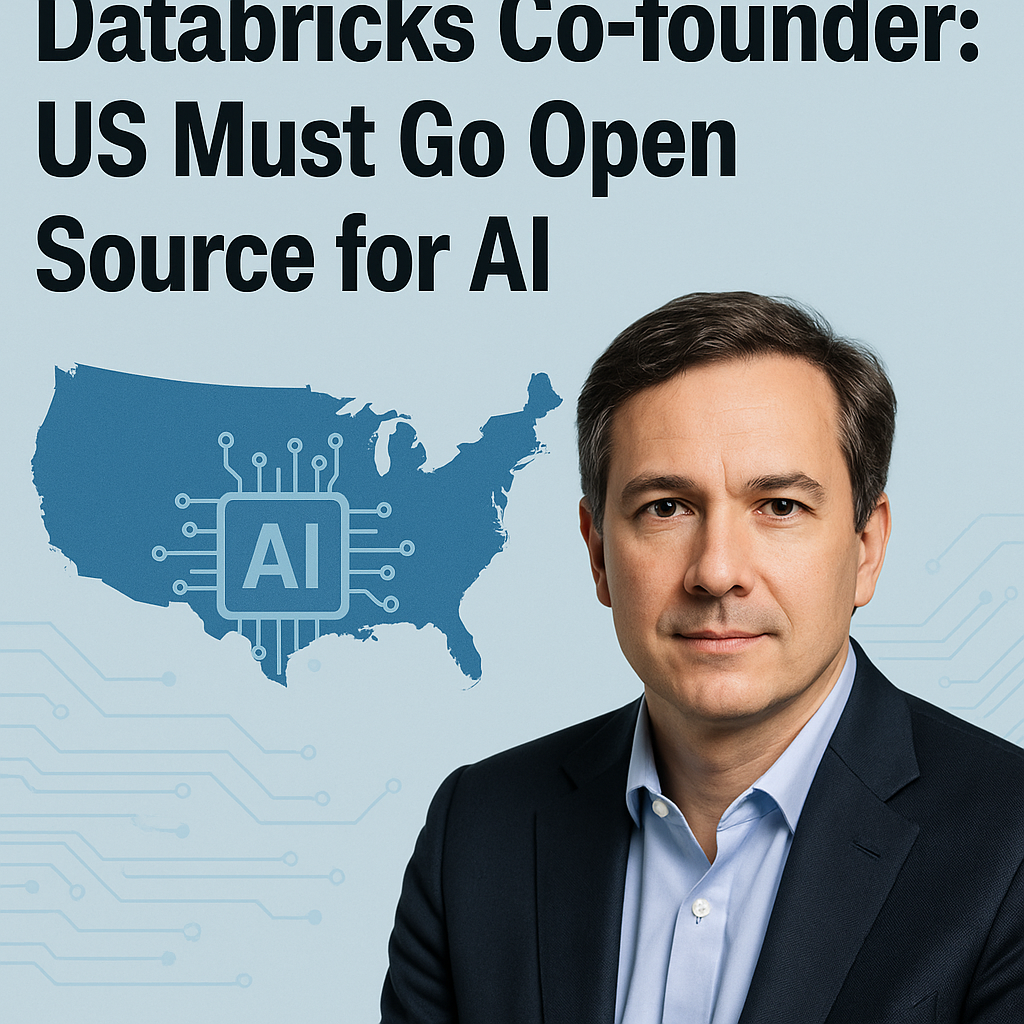
Databricks co-founder urges open-source strategy to counter China
Ali Ghodsi, co-founder and CEO of Databricks, has argued that the United States should pivot toward an open-source approach to artificial intelligence if it wants to remain competitive with China’s state-backed AI ecosystem. The call adds urgency to an ongoing policy debate about how best to preserve U.S. leadership in model development, data infrastructure and compute while managing national security and safety risks.
Background: Databricks, Dolly and the rise of open models
Databricks, founded in 2013 by the creators of Apache Spark, has grown into a major cloud data and AI company, known for its Lakehouse architecture that combines data engineering and machine learning workloads. In 2023 Databricks released Dolly, an open-source instruction-following language model, signaling the company’s commitment to community-driven model development alongside commercial offerings such as Databricks Workspace and Photon.
Open-source AI has accelerated in recent years: Stability AI’s release of Stable Diffusion in 2022 democratized image generative models, while the open weights movement for large language models (LLMs) — from Llama (Meta) forks to community projects hosted on Hugging Face — has expanded access to powerful AI tools outside of a handful of big cloud providers.
Why open source? Speed, transparency and ecosystem growth
Proponents say open-source AI lowers barriers to entry, fosters rapid iteration, and creates a diverse ecosystem of tooling that benefits startups, universities and government labs. For the U.S., an open-source-first stance could mean more actors contributing to model safety, auditing and benchmarks — accelerating innovation in areas from healthcare and biotech to climate modeling.
Ali Ghodsi’s argument rests on these dynamics: broad distribution of model weights, training recipes and reproducible benchmarks can create an R&D multiplier effect, making it harder for any single adversary to dominate innovation. Open-source projects also generate a talent pipeline; Apache Spark, first open-sourced in 2009 and later commercialized by Databricks, is a familiar example of an open project spawning an industry.
Trade-offs: Security, IP and misuse
Open source is not a panacea. Releasing powerful model weights can increase risks of misuse, state-level exploitation and intellectual-property leakage. That concern is front and center for U.S. policymakers: the National Institute of Standards and Technology (NIST) published the AI Risk Management Framework in 2023 to help organizations identify and manage AI risks, and the Biden administration has pursued executive actions and international dialogues aiming to balance innovation with safety.
Industry and analyst perspectives
Stability AI CEO Emad Mostaque has been a visible proponent of open modeling, arguing that democratized access spurs creativity and competition. At the same time, researchers and institutional leaders have warned that unfettered releases require stronger guardrails. Fei-Fei Li, director of Stanford’s Human-Centered AI Institute, has emphasized the need to pair openness with robust governance and public-interest safeguards to protect civil liberties and safety.
Analysts see genuine strategic trade-offs. Some consultancy reports and market trackers note that China’s model of coordinated state and corporate investment—exemplified by Baidu, Alibaba, Tencent and startups like SenseTime—creates a different risk profile: China can direct capital and talent toward prioritized projects, while the U.S. advantages lie in its diverse private sector and academic base. Open-source adoption could play to the U.S. strength of distributed innovation, but it will require policy calibration on export controls, research funding and procurement strategies.
Implications for policy, industry and competition
If the U.S. formally leans into open-source AI, expect changes across procurement, grant funding and public data initiatives. Federal research programs—already considering the National AI Research Resource concept—might prioritize open datasets, reproducible training pipelines and shared evaluation platforms. For industry, greater openness could lower switching costs between cloud providers and spur competition among model-hosting services, model governance platforms and security tooling.
However, political and commercial realities complicate the picture. Major model creators such as OpenAI, Google DeepMind and Anthropic currently balance proprietary deployments with research releases; their business models and investor expectations may resist full openness. Meanwhile, export-control regimes and national-security reviews could slow or constrain cross-border collaboration.
Conclusion: A pragmatic path forward
Ghodsi’s plea for open-source AI reframes the U.S.–China competition as one not only of chips and capital but of software architecture and community norms. Embracing openness could amplify American advantages in research and entrepreneurship—but only if paired with investment in safety standards, compute access, workforce development and international coordination. For policymakers and industry leaders, the question is not whether to open up, but how to do so safely and strategically.
Internal linking opportunities: see our coverage of Apache Spark, Databricks’ Lakehouse, OpenAI and NIST’s AI Risk Management Framework for related reporting and analysis.
About the Author