Lede: Who, What, When, Where, Why
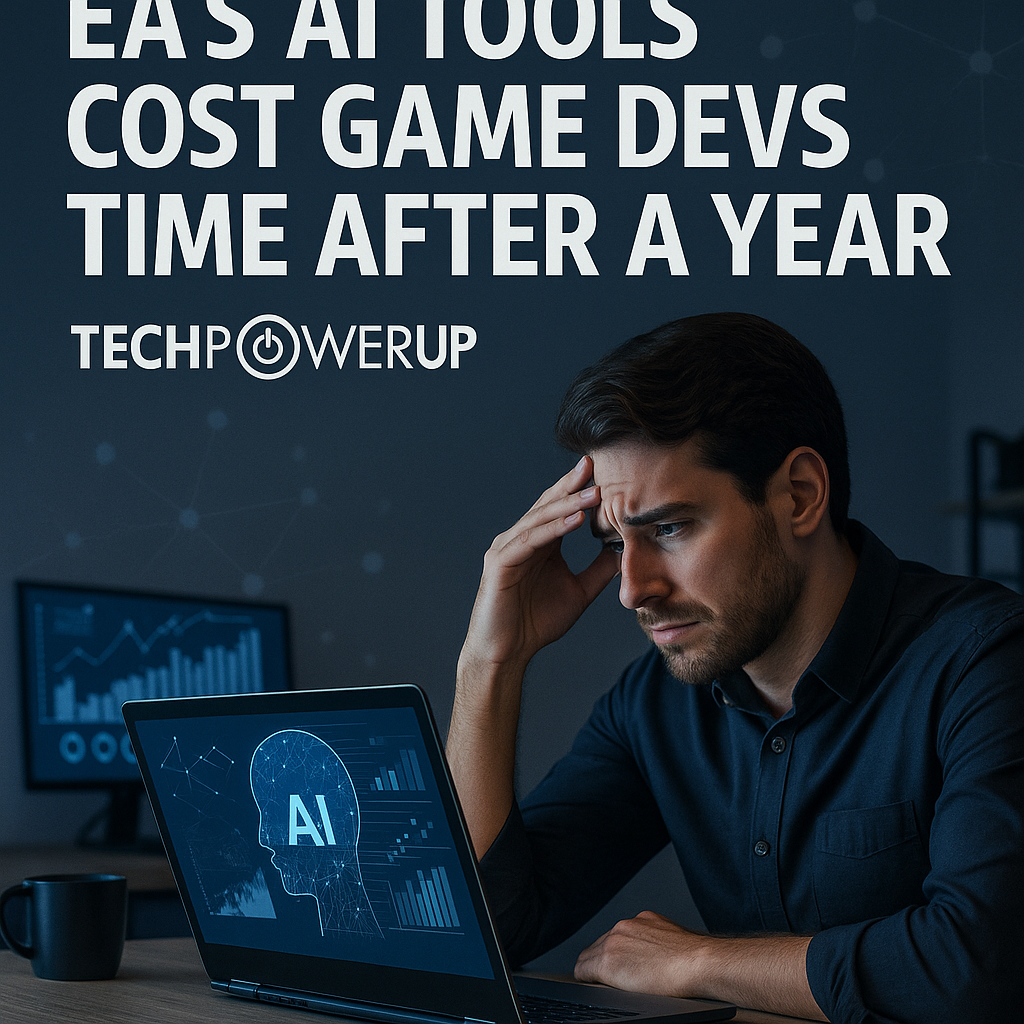
Electronic Arts’ (EA) AI-assisted development tools, introduced internally to accelerate asset creation and iteration, have reportedly cost game developers time even after roughly a year of use, a TechPowerUp investigation finds. The report — based on developer interviews and internal workflow audits — says initial time savings were eroded by compatibility problems, quality-control overhead and unanticipated rework across EA studios.
What TechPowerUp Reported
TechPowerUp’s coverage centers on multiple development teams inside EA that adopted AI features for tasks like texture generation, animation clean-up and dialogue iteration. While the tools reduced manual effort on discrete tasks, the outlet documents how downstream integration into existing pipelines created new bottlenecks. Developers told TechPowerUp that fixing edge-case failures, reconciling AI outputs with engine constraints and addressing subtle visual or gameplay regressions consumed additional staff time.
Technical Friction and Pipeline Costs
Game development pipelines are tightly coupled systems: art, animation, audio and code must align to ship a stable build. The report highlights that AI outputs often required format translation, manual verification and bespoke scripts to avoid breaking the build. That translation layer — and the QA required to certify AI-generated assets — became recurring work, reducing the net productivity gains teams expected after the first months of adoption.
Integration vs. Coverage
Industry practitioners say integration costs frequently appear only after teams scale usage. Early prototypes can look promising in isolation, but once AI tools are fed real project data, gaps emerge. TechPowerUp’s reporting suggests that many of the issues were not failures of the AI models themselves, but of integration design and change-management: updates to the AI toolchain required coordinating across multiple teams and bespoke tooling.
EA’s Response and Broader Industry Context
EA has previously discussed AI experimentation publicly in corporate filings and developer talks, emphasizing research into both generative content and automation. TechPowerUp notes that these efforts are part of broader industry moves toward AI-assisted workflows, which major publishers and studios have piloted in recent years. The story underscores a recurring dilemma: AI can cut unit work, but enterprise-level gains depend on integration, standards and verification.
Implications for Studios and Publishers
The TechPowerUp findings carry three practical implications for studios considering AI adoption. First, expect a non-trivial integration tax: pipelines, QA processes and build systems must be adapted. Second, set measurement frameworks beyond task time saved — include downstream QA hours, bug-fix rates and artistic review time. Third, prioritize tooling that fits existing format standards to reduce translation overhead.
Analysis: Where Time Savings Vanish
The experience described in TechPowerUp is not unique to games. In enterprise software and media production, early AI pilots often deliver headline speedups but shift effort to edge-case handling and oversight. For game development, where small asset differences can cascade into gameplay and performance issues, the oversight cost is amplified. That means studios aiming for net productivity gains must budget for sustained engineering support and robust QA processes, not just one-off pilot success.
Expert Insights and Future Outlook
Industry analysts and senior engineers contacted by outlets covering similar stories emphasize governance and standards as solutions: clear acceptance criteria for AI outputs, automated validation suites and incremental rollout plans. Looking ahead, vendors and platform teams at large publishers are likely to invest more in interoperability layers, authoring standards and explainability features to reduce the rework tax.
For EA, the TechPowerUp report is a reminder that AI is a systems problem. Achieving durable productivity gains will require sustained engineering investment, cross-discipline coordination and transparent measurement of both savings and new costs. Studios that treat AI as a one-off efficiency hack rather than a long-term platform change may find early wins evaporate into slower cycles and more rework.
As adoption accelerates across the industry, the most successful studios will be those that pair generative AI with rigorous integration engineering and clear guardrails — turning short-term speedups into lasting capability improvements.
About the Author