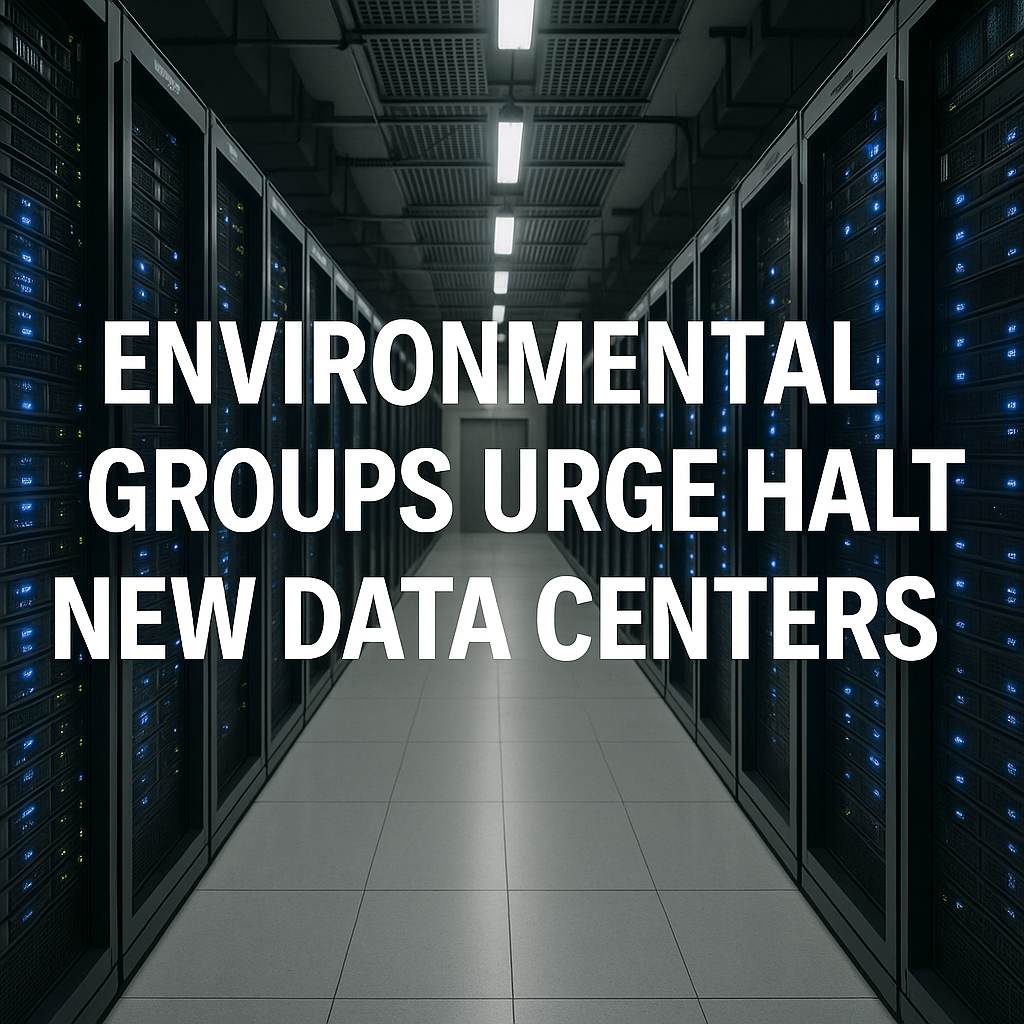
Calls for a Moratorium Grow as Compute Demand Explodes
Environmental organizations are increasingly calling for a pause on new data center construction, arguing that the rapid expansion of hyperscale facilities is straining grids, consuming scarce water supplies and undermining climate goals. In recent months local and national campaigns have gathered steam in key hubs — from Northern Virginia’s so-called “Data Center Alley” to the Dublin and Amsterdam regions — as activists demand stronger public oversight of permitting, water allocation and electricity procurement for new builds.
Why Activists Want a Pause
Groups such as Greenpeace and the Sierra Club have long criticized the tech industry’s environmental footprint. Their latest push centers on three linked concerns: electricity demand, water use for cooling, and embodied carbon from construction. According to the International Energy Agency (IEA), data centers and data transmission networks together account for roughly 1% of global electricity consumption — a share that could grow if demand from artificial intelligence (AI) training and edge computing continues to accelerate. Activists argue that without firm rules, new data centers merely shift pressure onto local utilities and water systems rather than delivering net emissions reductions.
Water stress is a focal point in some regions. Water-intensive cooling systems can draw heavily on municipal or groundwater supplies in water-scarce areas, provoking resistance from communities and environmental planners. Meanwhile, local utilities say grid upgrades — substations, transmission lines and battery storage — are necessary to integrate new load, often at public expense.
Industry Context: Efficiency Gains vs. Growing Appetite
Hyperscalers including Amazon Web Services, Microsoft Azure and Google Cloud continue to add capacity worldwide to serve cloud, AI and streaming demand. Tech giants have public sustainability pledges: Microsoft’s sustainability commitments include becoming carbon negative by 2030 and removing historic emissions by 2050; Google has committed to operating on 24/7 carbon-free energy in all regions by 2030; Amazon announced targets under The Climate Pledge and aims to reach net-zero carbon by 2040. Those commitments are real, but analysts note they mainly address emissions from operations and purchased power, not local impacts such as water stress or the carbon embedded in massive steel-and-concrete builds.
At the same time, server and cooling efficiencies have improved materially. Modern hyperscale facilities regularly report Power Usage Effectiveness (PUE) ratios nearing 1.1–1.2, compared with older facilities that were often 1.5 or worse. Liquid cooling and chassis-level innovations reduce energy per unit of compute, but the sheer scale of AI workloads — particularly large language model training and inference — is driving aggregate power needs higher.
Local Politics and Economic Tradeoffs
Municipalities face a difficult calculus. Data centers generate jobs, property taxes and infrastructure investment, and they are attractive economic-development targets. Loudoun County, Virginia, for example, became synonymous with data center clustering because of its low-cost power and connectivity, turning the county into a major U.S. hub. But officials must weigh those benefits against community concerns about water allocation, tax breaks handed to developers, and the cost of upgrading electrical infrastructure.
Expert Perspectives and Industry Reaction
Policy analysts say a temporary moratorium could force a strategic pivot: regulators could demand more rigorous environmental reviews, require proven 24/7 carbon-free sourcing, mandate recycled or reclaimed-water cooling systems, or prioritize reuse and retrofitting of brownfield sites. BloombergNEF and other energy consultancies have repeatedly noted that corporate power purchase agreements (PPAs) are a powerful tool to spur renewables, but PPAs do not directly solve local grid or water constraints.
Tech companies argue that continued growth is compatible with climate goals if paired with aggressive renewable procurement and new cooling technologies. Google’s 24/7 carbon-free energy commitment and Microsoft’s carbon-negative roadmap are frequently cited as evidence that hyperscalers can scale responsibly—if regulators and utilities cooperate on grid modernization and permitting.
Implications and Next Steps
A de facto halt on new data center construction would reverberate across the cloud ecosystem, slowing capacity buildouts for AI research, enterprise migration and content delivery. It could also accelerate alternative strategies: more efficient chip and software designs, wider deployment of liquid cooling, colocation of compute with renewable generation, and on-site recycled-water systems. Policymakers will be under pressure to craft nuanced rules that balance climate and community protections with the economic benefits of data-driven industries.
Related topics for further coverage include cloud sustainability, Power Usage Effectiveness (PUE), corporate renewable procurement (PPAs), data center cooling technologies, and the economics of hyperscale construction.
Conclusion
Environmental groups’ calls to pause new data center construction crystallize a broader tension at the intersection of digital growth and resource limits. The debate is pushing governments, utilities and hyperscalers toward more holistic planning: one that factors in grid resilience, water security and embodied carbon alongside energy procurement. Whatever the next policy steps, it’s clear that the era of unchecked data center expansion is facing tougher scrutiny — and the industry will need both technological and policy solutions to keep pace with AI-driven demand while meeting climate and community expectations.
About the Author