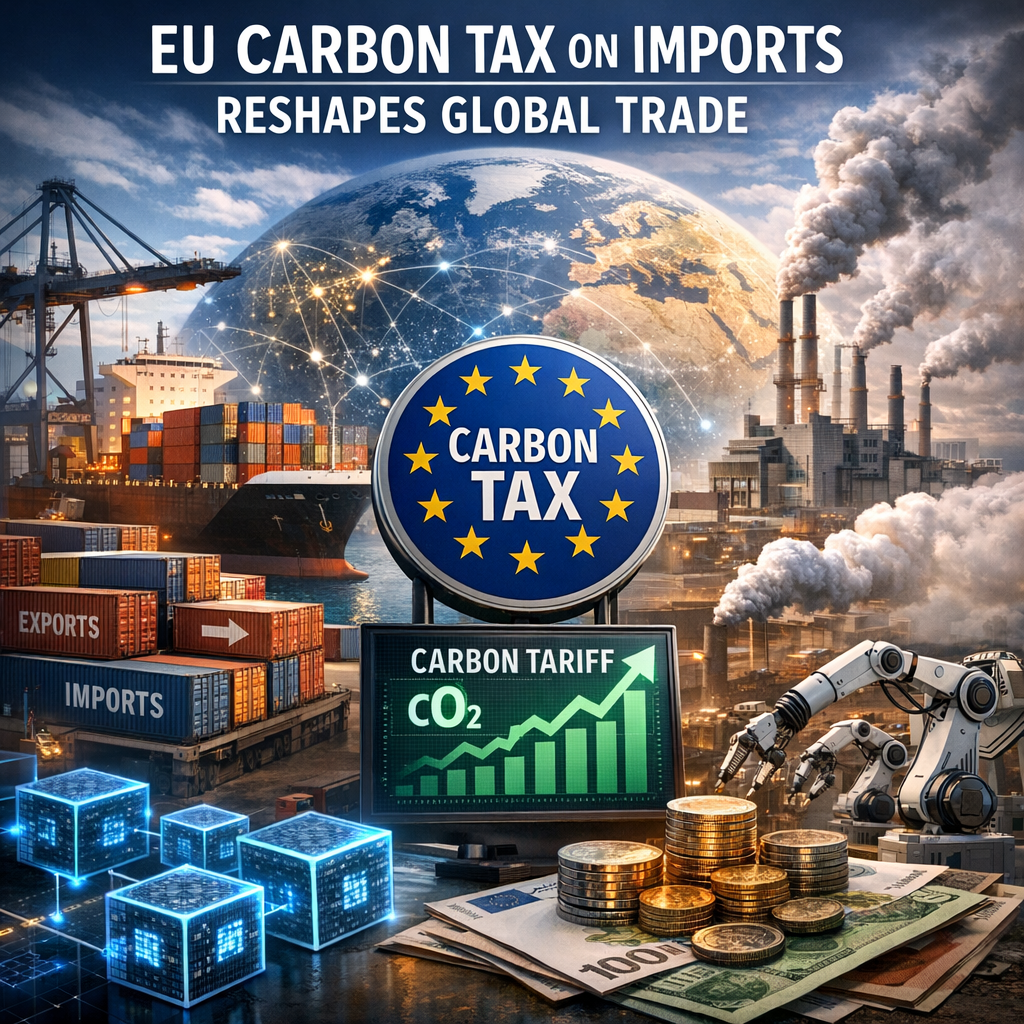
What, who, when and why: Europe puts a price on embedded carbon
On Oct. 1, 2023 the European Union entered a transitional phase of its Carbon Border Adjustment Mechanism (CBAM), a policy designed to impose a cost on the greenhouse gas emissions embedded in certain imported goods. The EU reached a political agreement on the measure in May 2023 and plans full application on Jan. 1, 2026, when importers will need to buy CBAM certificates tied to the EU Emissions Trading System (EU ETS) price. The first wave of covered goods includes cement, iron and steel, aluminum, fertilizers, electricity and hydrogen — sectors the EU says are particularly vulnerable to carbon leakage.
How the mechanism works and why it matters
Under CBAM’s transitional reporting phase, importers must report the direct and indirect emissions associated with qualifying products. From 2026, firms bringing these goods into the EU will be required to surrender certificates equivalent to the carbon emissions embedded in their imports; the certificate price will mirror the auction price of EU ETS allowances. The policy intends to level the playing field between European producers — who face rising carbon costs under the EU ETS — and foreign competitors whose production escapes similar pricing, while incentivising cleaner production abroad.
That combination of domestic carbon pricing and an import adjustment is significant: for exporting countries and multinational supply chains, CBAM is not a marginal trade policy tweak but a structural change to the economics of carbon‑intensive goods. It will affect sourcing decisions, investment in low‑carbon technologies, and the competitiveness calculus for major global manufacturers and commodity exporters.
Background and international context
The EU framed CBAM as part of the European Green Deal and its goal of reducing net greenhouse gas emissions at least 55% by 2030 compared with 1990 levels. Policy makers say the tool is intended to prevent carbon leakage — the relocation of emissions‑intensive production to jurisdictions with weaker climate rules — while preserving incentives for ambitious climate action worldwide.
Internationally, CBAM has drawn scrutiny from trading partners. Major exporters to the EU include China, Russia, Turkey and India, all of which ship large volumes of steel, aluminum and cement. Governments, industry associations and multilateral bodies have raised questions about administrative complexity, fairness to developing countries and compatibility with World Trade Organization rules. The European Commission has built in a recognition mechanism: if an exporting country’s carbon pricing or policy is judged equivalent, adjustments may be made to avoid double charging.
Business and market implications
For downstream industries and buyers inside the EU, the mechanism will change procurement pricing and contract terms. Steel buyers — from automotive manufacturers to construction firms — will begin to factor CBAM certificates into landed cost calculations. Producers in exporting countries face three broad responses: absorb the added cost and accept lower margins; pass it to buyers; or decarbonise to reduce their CBAM exposure. That dynamic makes low‑carbon investment more attractive, including electrification, fuel switching to green hydrogen, and process innovations such as steelmaking with direct reduced iron and electric arc furnaces.
Expert perspectives and industry reaction
Analysts and trade experts see CBAM as an influential precedent. Many development economists caution that without targeted support and capacity building, exporters in developing countries could be disproportionately burdened, since measuring embedded emissions requires data and verification systems that firms there may lack. Multilateral institutions including the Organisation for Economic Co‑operation and Development and the World Bank have called for coordinated approaches to avoid fragmentation in global carbon pricing.
Industry groups are adjusting. European and global trade associations have urged clear methodologies and administrative simplification to reduce compliance costs. Some large integrated producers that already face carbon pricing at home — for example in parts of Europe and North America — may be less exposed, while producers in jurisdictions with no or limited carbon controls will feel immediate pressure to adapt or face higher market access costs.
Conclusion: a model that will reshape supply chains and diplomacy
CBAM will not be the final word on trade and climate, but it is likely to accelerate decarbonisation in sectors where margins are thin and switching costs are high. The policy makes the EU a proving ground for coupling carbon markets with trade instruments. Expect redrawn trade flows, renewed investment in green industrial processes, and intensified diplomatic engagement over equivalence, capacity building and WTO compatibility. For exporters and importers alike, the message is clear: carbon accounting will soon be central to the cost of goods, and early adaptation will be a competitive advantage.
About the Author