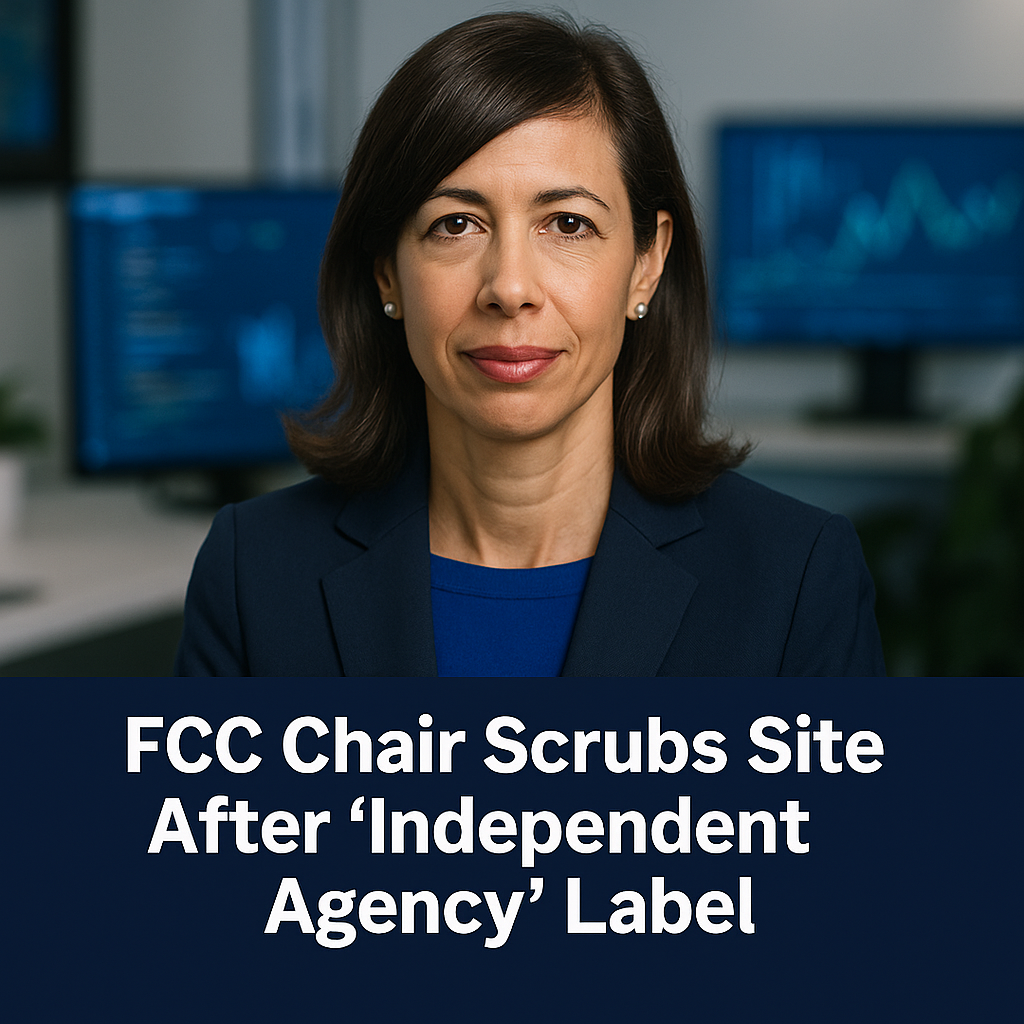
Chair Orders Edit After Website Called FCC an “Independent Agency”
The chair of the Federal Communications Commission quietly ordered the agency’s website to be edited after staff discovered a line calling the FCC an “independent agency.” The change, reported this week, removed wording from the commission’s public “About” page that characterized the FCC’s institutional status — a small edit with outsized implications for how litigants and lawmakers view the agency’s authority.
Why the Wording Matters
At first blush, the tweak looks like housekeeping. But the constitutional and statutory status of federal agencies is a hot-button legal question. The FCC was established by the Communications Act of 1934 and is composed of five commissioners nominated by the president and confirmed by the Senate; that structure has long placed it in the family of so-called “independent regulatory agencies.”
Legal precedent in recent years has made the distinction between executive and independent agencies legally consequential. The Supreme Court’s 2020 decision in Seila Law v. CFPB and its 2021 ruling in Collins v. Yellen curtailed certain protections for officers of independent agencies, scrutinizing removal protections and executive control. As industry lawyers have noted, how an agency describes itself in public materials can become evidence in litigation or congressional oversight.
Regulatory Stakes Are High
The FCC oversees a sprawling communications ecosystem: broadcast television, satellite, cable, wireline and wireless carriers, and broadband programs funded by the Infrastructure Investment and Jobs Act (IIJA). The IIJA, signed into law in November 2021, authorized programs such as the Broadband Equity, Access, and Deployment (BEAD) program, which allocates roughly $42.45 billion for broadband deployment — one of many areas where agency authority has real economic consequences.
Given the FCC’s regulatory reach — from net neutrality debates to 5G spectrum auctions and broadband subsidy rollouts — any question about the agency’s formal independence can affect litigation strategy for industry players like Verizon, Comcast, AT&T, and smaller ISPs, as well as public-interest groups pushing for tougher regulation.
Expert Perspectives
Legal analysts say the exchange about a single sentence on a website speaks to larger anxieties about administrative authority. A regulatory attorney at a Washington, D.C., law firm noted that “courts increasingly look at administrative practice and institutional design,” and that public-facing descriptions can be leveraged by challengers in separation-of-powers litigation.
Policy observers also point out the optics. One public-interest advocate told reporters that the change could be read as the commission trying to avoid a legal label that, in some recent court decisions, has invited closer judicial scrutiny of agency decision-making. Conversely, industry trade groups argue that the FCC’s practical independence — commissioners insulated by staggered terms and bipartisan membership rules — remains intact regardless of a line on the website.
Analysis: Why the Chair Might Have Acted
There are three plausible reasons the chair ordered the edit: legal caution, messaging control, or administrative housekeeping. From a legal standpoint, removing the explicit “independent agency” label could be intended to reduce the chance that litigants will use the agency’s own public materials to argue a particular institutional posture in court.
From a communications angle, leaders of federal agencies increasingly treat every public sentence as part of a strategic record that could be scrutinized by Congress, the press, and judges. Finally, it’s possible the edit reflects an internal push to standardize language across federal web properties.
Implications and What Comes Next
The edit does not change the FCC’s statutory structure: commissioners are still appointed by the president and confirmed by the Senate, and the agency continues to exercise broad regulatory authority. But the episode highlights how seemingly minor details can become fodder in larger fights over administrative power. Expect litigators and congressional staff to pore over archived copies of the site and other public statements in ongoing and future challenges to FCC rulemaking.
Related topics newsroom editors might link to include FCC rulemaking, net neutrality, BEAD broadband grants, and Supreme Court administrative law decisions (Seila Law, Collins v. Yellen).
Conclusion: Small Edit, Big Signals
A brief edit to an agency’s web copy may seem trivial, but in today’s fraught environment over administrative law, it can amplify legal and political debates. Whether the change was prudence, politics, or plain housekeeping, stakeholders across industry and advocacy groups will watch the FCC’s next public statements — and its next regulatory moves — for clearer cues about how the commission defines its own authority.
About the Author