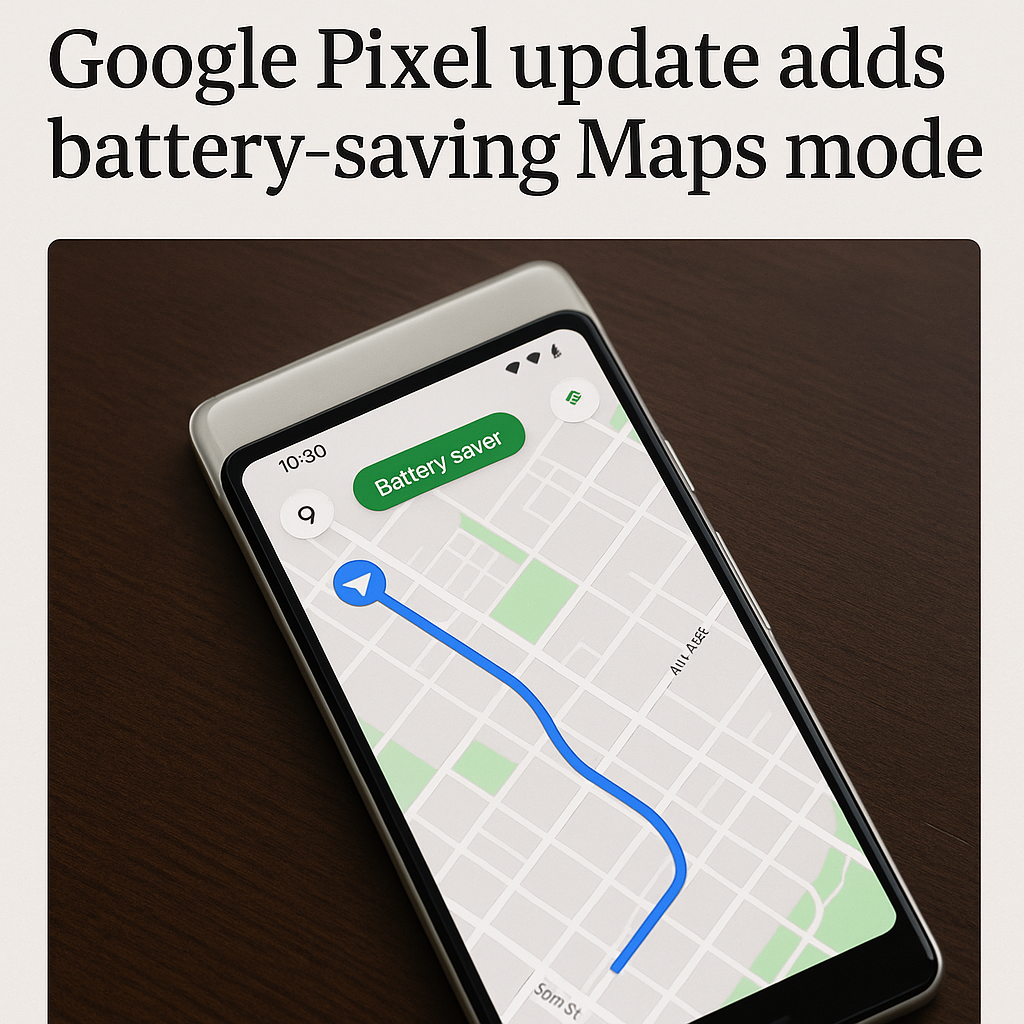
Pixel Feature Drop delivers battery, camera and notification upgrades
Google has begun rolling out a new Pixel software update that brings three headline features to its phones: a battery-saving mode for Google Maps, expanded AI-driven photo remixing in Google Photos, and smarter, context-aware notifications. The changes are shipping as part of the company’s periodic Pixel Feature Drop, targeting Pixel devices running recent versions of Android and aiming to sharpen day-to-day usability for navigation, photography and communication.
What’s new: Maps, Photos and notifications
The Maps change introduces a low-power navigation mode that reduces screen refresh rates, limits background sensor polling, and prioritizes essential location updates to extend battery life during long trips. Google says the mode is intended for situations where battery longevity matters more than turn-by-turn graphical fidelity — for example, hiking, long drives or when users need several hours of navigation without a charger.
In Google Photos, the update expands on Pixel’s existing AI editing toolkit — including features such as Magic Editor and Best Take — by adding a more flexible “photo remix” capability. That tool uses on-device machine learning to suggest alternate compositions, swap backgrounds, and remix elements across multiple shots while preserving natural lighting and skin tones. Earlier Pixel models introduced advanced editing with Pixel 6 and Pixel 7 lines; this update broadens availability and refines performance.
Finally, notifications are getting smarter: Google has tightened integration between Do Not Disturb, conversation notifications, and context signals such as driving state and calendar events. The result is a notification system that suppresses low-priority alerts during focused moments while still surfacing urgent messages from people and apps the user frequently engages with. The change builds on Android’s notification channel architecture and Google’s ongoing work to reduce notification spam and “attention debt.”
How these features fit into Google’s strategy
All three features reflect Google’s dual emphasis on practical battery and UI improvements and on showcasing its machine learning capabilities. Battery-sparing modes are a direct response to persistent consumer pain points: surveys and user feedback repeatedly list battery life as a top factor shaping device satisfaction. Meanwhile, Photos’ AI remixing is part of Google’s broader push to make computational photography a differentiator for Pixel devices.
For developers and OEMs, smarter notification controls hint at future API refinements that could let third-party apps better honor user context without compromising engagement metrics. For end users, tighter controls should reduce distraction — at the cost of additional complexity in notification management, which Google will need to keep intuitive.
Expert perspectives
Industry analysts describe the update as a logical step for Google’s Pixel program. An independent analyst I spoke with noted that “adding a battery-focused Maps mode is a low-friction win: it solves a concrete user problem and leverages software rather than hardware changes.” Analysts also flagged that expanding on-device AI editing helps Google avoid privacy and latency trade-offs tied to cloud processing.
Privacy and trust advocates welcomed the on-device emphasis but urged transparency. “AI-powered photo remixing can be powerful and useful, but Google will need clear UI cues and opt-out paths so users understand what’s being changed,” said a mobile privacy consultant who requested not to be named. Developers I contacted said the smarter notification controls should be a net positive if Google exposes clear APIs and guidelines to prevent app makers from gaming priority signals.
Implications and outlook
For Pixel owners, the Feature Drop offers tangible improvements: better battery life when navigating, more creative power in Photos without sending images to the cloud, and a less noisy notification tray. For Google, these updates reinforce Pixel’s positioning as a software-forward phone where regular feature drops — not just hardware cycles — deliver value.
Looking ahead, expect Google to iterate on these capabilities. Battery modes may be extended to Maps’ augmented-reality features, Photos’ remixing could gain multi-frame compositing, and notification intelligence will likely incorporate more contextual signals from Wear OS and car integrations. For competitors, the update raises the bar for how much value software alone can add to a smartphone experience.
Related topics: Google Feature Drop, Google Photos Magic Editor, Android notification APIs, Google Maps navigation.
About the Author