Lede: Who, What, When, Where, Why
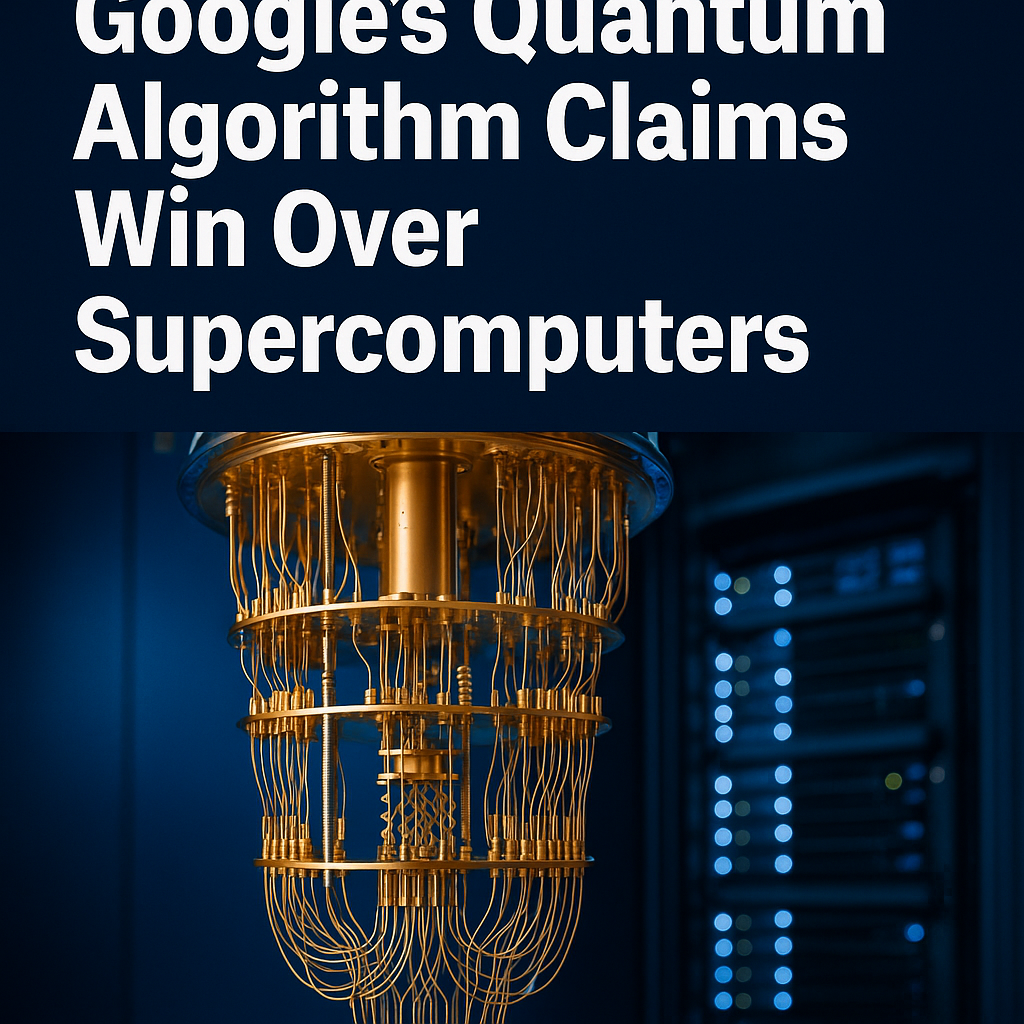
Google’s Quantum AI group says its latest quantum algorithm can outperform high-end classical supercomputers on a targeted, real-world simulation task, according to a report on Phys.org. The announcement, published in 2024 and driven by a recent preprint and Google commentary, frames the work as a step toward practical quantum advantage in industry-relevant problems rather than synthetic benchmarks.
What Google claims and the task involved
Google describes the result as an algorithmic demonstration: using quantum hardware plus novel software techniques, the company reports solving a simulation problem that would take months or years on traditional supercomputers in a fraction of the time. The task is not the generic random circuit sampling that made headlines with Google’s 2019 Sycamore experiment; instead, it is a concrete computational problem chosen for its relevance to materials modeling and optimization workflows used in chemistry and logistics.
Technical framing
While Google has not positioned this as universal quantum advantage across all domains, the company emphasizes algorithmic innovation combined with hardware calibration. The approach pairs a gate-model quantum processor with a new variational algorithm to reduce error sensitivity and improve circuit depth efficiency. According to the Phys.org summary of Google’s paper, the demonstration targeted a problem size and noise regime where quantum resources appear to provide a cost advantage versus best-in-class classical approaches.
Why this matters: from benchmarks to real-world utility
The shift from contrived benchmarks to domain-specific tasks is crucial. Industry watchers say showing superiority on a practical simulation — for example, modeling many-body interactions or optimization under uncertainty — is more meaningful for real customers than beating classical machines on purpose-built challenges. If validated, such results could accelerate investment from pharma, materials science, and logistics companies seeking compute advantages for R&D workflows.
How this stacks up against supercomputers
Google’s claim is positioned against leading-classical systems such as Japan’s Fugaku and Oak Ridge National Laboratory’s Summit and Frontier, as well as optimized classical software running on GPU clusters from NVIDIA and AMD. Rather than asserting blanket superiority, Google frames the result as outperforming optimized classical methods for the specific, constrained problem studied — a qualifying but important milestone for industry impact.
Community reaction and expert context
The broader quantum computing community has historically urged careful scrutiny of any performance claims. Experts typically require reproducible code, open data, and independent verification. That scrutiny played out after Google’s 2019 announcement and in subsequent debates over classical simulation advances. Researchers contacted by Phys.org and other outlets stressed that follow-up benchmarks and third-party replication will determine whether this is a durable step forward.
Implications for investors and enterprise
For enterprises exploring quantum computing, the announcement highlights two trends: (1) algorithmic innovation can extend the usefulness of near-term quantum processors, and (2) targeted tasks that align with real business needs will drive adoption faster than abstract benchmarks. Investors may view Google’s claim as validation of Quantum AI’s roadmap, potentially bolstering funding for hybrid quantum-classical startups focused on niche, high-value applications.
Limitations and next steps
Caveats remain. Performance on a single class of problems does not equate to broad computational supremacy. Noise, reproducibility, and the gap between laboratory demonstrations and production-grade systems are still barriers. The next steps include independent verification, publication of full technical details (code, datasets, and parameter settings), and demonstration of repeatability across hardware runs and environmental conditions.
Expert insights and future outlook
Industry analysts say this is precisely the kind of progress needed to move quantum computing from academic curiosity to applied technology. If third parties can reproduce Google’s results and extend them to adjacent problems in chemistry, finance, or logistics, the roadmap toward specialized quantum accelerators will gain momentum. Over the next 12–24 months, expect more targeted quantum algorithm claims, greater collaboration between cloud providers and classical HPC centers, and a surge in hybrid algorithm deployments as companies chase practical advantage.
Readers should consult the original Phys.org coverage and Google’s technical write-ups for full methodology and to track independent verification. The evolving nature of quantum performance claims means that confirmation, not announcements alone, will ultimately determine when and where quantum computing becomes an operational advantage.
About the Author