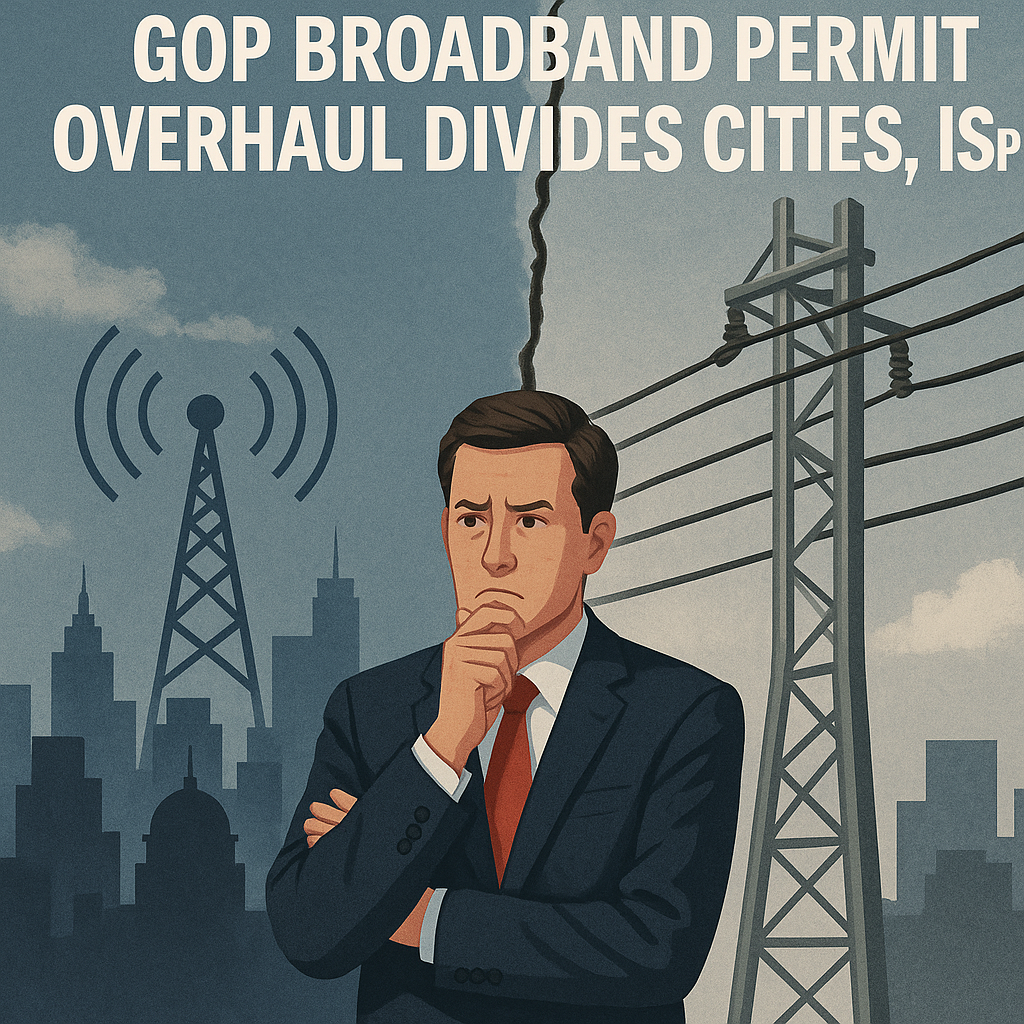
GOP push to rewrite broadband permitting: who wins and who loses
Republican lawmakers in Congress are advancing a high-profile push to streamline broadband permitting that proponents say will speed fiber and 5G deployment across the U.S., while cities and local governments warn the move would strip away local control over rights-of-way and public safety concerns. The debate lands amid the rollout of federal broadband funds from the Bipartisan Infrastructure Law (signed Nov. 15, 2021) and the NTIA’s BEAD program, which directs roughly $42.45 billion to states to expand high-speed internet.
Background: why permitting matters
Telecom carriers and cable companies say local permitting delays, pole attachment negotiations and right-of-way fees add months — and millions of dollars — to deployment timelines. The cable industry points to a mix of obstacles: lengthy municipal review periods, disparate permitting standards from town to town, and delayed access to utility poles. The result, they say, is slower fiber-to-the-premises (FTTP) and small-cell 5G rollouts, higher build costs and underused federal dollars earmarked for broadband expansion.
ISPs including Comcast, Charter, Verizon and AT&T have long lobbied for streamlined permitting and clearer pole-attachment rules; trade group NCTA (the Internet & Television Association) has repeatedly pressed federal regulators to limit what it calls “arbitrary local barriers.” The FCC’s 2018 orders to create shot clocks for small-cell siting — aimed at limiting how long localities can take to approve small-cell wireless facilities — are an antecedent to the current debate, and show how federal policy has already sought to accelerate wireless deployment.
What the GOP proposals would do
Although the text varies by bill and by sponsor, the GOP-backed measures under consideration generally would:
- Preempt or restrict certain local permitting requirements for broadband infrastructure built using federal funds or designated as priority projects.
- Create accelerated review timelines (or “shot clocks”) for fiber and small-cell siting.
- Limit or standardize fees municipalities can charge for right-of-way access and pole attachments.
- Provide dispute-resolution processes in federal or state forums to counter perceived local bottlenecks.
Supporters argue these reforms will reduce costs per home passed, stretch BEAD and other federal dollars further, and let providers like Google Fiber, Lumen, Comcast and Charter hit coverage targets faster.
Why cities say no
Local governments and municipal associations counter that permitting and right-of-way oversight are core municipal responsibilities tied to public safety, traffic impacts, historic preservation and equitable access. Groups such as the National League of Cities and many city attorneys have warned that federal preemption would erode local planning authority and fiscal stability by cutting off a revenue stream from permit and lease fees.
City officials also point to examples where rushed deployments produced utility conflicts, repeated digs, or unexpected costs for taxpayers — concerns they say are amplified when projects move at scale. Municipal broadband advocates further fear the reforms could advantage incumbent cable operators and large telcos at the expense of locally run or community-focused ISPs.
Expert perspectives and industry analysis
Industry analysts observe a split that tracks political lines: telecom analysts and investment banks generally view permitting reform as economically sensible because it lowers barriers to scale and improves return on capital. “Standardized permitting reduces execution risk — and that matters for multi-billion-dollar fiber builds,” says one broadband infrastructure analyst who follows the sector.
Conversely, public-policy experts caution that the savings touted by providers may be overstated if reforms reduce municipalities’ ability to coordinate right-of-way work or to negotiate fair pole-attachment rates. Public-interest groups warn that without careful guardrails, faster permitting could exacerbate digital redlining — where providers prioritize higher-income areas because the economics are easier — counter to the goals of BEAD and other federal programs.
Implications and the road ahead
For investors and vendors — companies such as Corning, CommScope and utility contractors — predictability in permitting would lower project timelines and logistics complexity. For cities, the tradeoffs are harder: they risk revenue losses and decreased oversight in return for faster network builds largely controlled by private firms.
Congressional action could arrive as standalone legislation or as part of broader permitting or regulatory reform packages. Any federal move will likely face legal challenges and intense lobbying: municipal groups, civil-rights organizations, and some Democrats are poised to fight blanket preemption, while cable and telco trade associations will push for broad exemptions.
Conclusion: balance between speed and stewardship
The debate encapsulates a central tension in U.S. broadband policy: how to reconcile the urgent need to get high-speed internet to homes and businesses with the longstanding local governance that shapes community planning, safety and revenue. With billions of BEAD dollars at stake and major players such as Comcast, Charter, Verizon, AT&T and Google Fiber racing to expand fiber and 5G, the outcome of the GOP permitting overhaul will determine not just who builds the nation’s networks but how those builds are regulated and paid for.
Related topics worth following: the NTIA BEAD program, FCC small-cell siting orders, state-level preemption laws and municipal broadband initiatives — all of which intersect with this unfolding policy fight.
About the Author