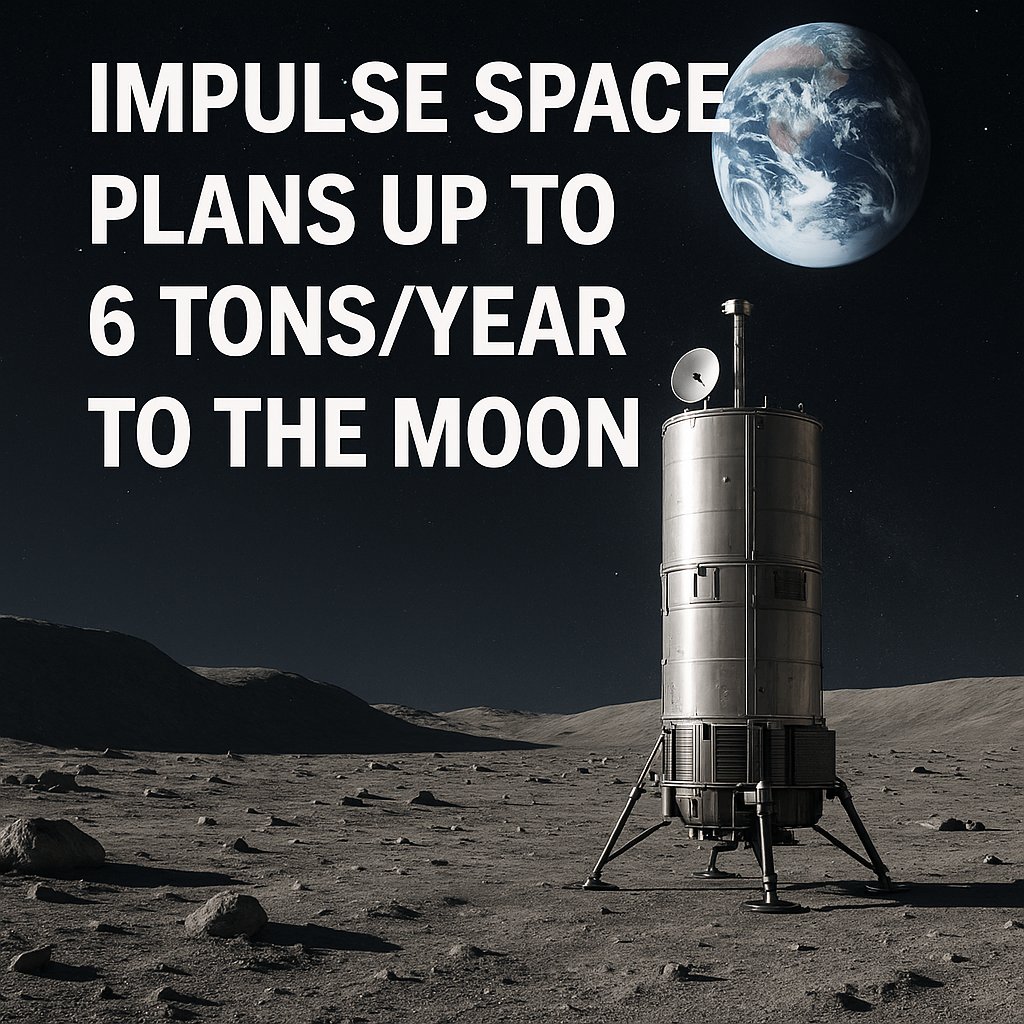
Impulse Space has released a detailed plan to deliver up to six metric tons of cargo per year to the lunar surface, positioning itself as a commercial logistics provider in the emerging lunar economy. The company’s proposal, aimed at enabling sustained scientific, commercial and infrastructure activities on the Moon, combines reusable hardware, advanced autonomy and digital supply-chain tools.
In public briefings and investor materials, Impulse Space framed the offering as a cadence-driven service: regular, repeatable payload deliveries using a family of landers and transfer stages instead of one-off demonstration missions. The company emphasizes cost reduction through hardware reusability and an operational model that mirrors maritime or air cargo logistics but applied to cislunar space.
Technology: reusable landers, autonomous operations
The technical core of Impulse Space’s plan centers on modular landers and orbital transfer vehicles. According to the company, these vehicles are designed to ferry payloads from low Earth orbit (LEO) or lunar gateways down to the surface and then return or be refurbished for subsequent flights. Key systems highlighted include precision guidance and hazard-avoidance sensors, high-thrust descent stages, and in-space refueling or staging strategies to maximize payload mass delivered per launch.
Artificial intelligence plays a prominent role in the roadmap. Impulse Space says it will deploy AI-driven navigation, landing hazard assessment and in-situ decision-making to increase landing safety and performance in unstructured lunar terrain. Autonomous operations reduce reliance on ground control and shorten operational timelines—critical for higher-frequency logistics services.
Blockchain and digital logistics
Beyond rockets and guidance software, Impulse Space is exploring digital infrastructure—specifically blockchain—to track payload provenance, custody and transactional settlement. The company frames distributed-ledger technology as a way to provide immutable records for valuable lunar cargo, verify mission milestones for customers and enable automated commercial contracts for recurring deliveries. While blockchain is not a flight system, its integration targets enterprise-grade supply-chain transparency for government and private-sector customers.
Business, funding and the startup angle
Impulse Space is one of several space startups aiming to commercialize lunar logistics. The firm pitches to both civil and commercial markets: space agencies requiring regular resupply, scientific institutions deploying instruments, and private companies building infrastructure on the Moon. The plan to deliver six tons annually is ambitious for a startup but reflects the broader market expectation that early lunar services will be niche, high-value and mission-specific.
On funding, Impulse Space has attracted venture interest typical of deep-tech space startups, using capital to accelerate development of hardware, software and operational capabilities. The company’s ability to convert investor funding into repeated missions will be critical to proving the unit economics of lunar cargo delivery.
Geopolitics and competitive landscape
Lunar logistics is increasingly geopolitical: national programs and state-backed companies are racing to secure scientific and economic footholds. Impulse Space’s commercial approach competes with both established prime contractors and foreign lunar programs. Demonstrating reliable, cost-effective deliveries will be essential to win contracts and to integrate with international architectures such as the Artemis ecosystem or partner-led initiatives.
Outlook and risks
Impulse Space’s six-ton goal reflects the next step beyond one-off lunar landers toward a logistic cadence. Realizing that target faces technical, regulatory and market risks: proving reusability in deep space, integrating autonomy on complex landers, securing launch cadence, and signing repeat customers. If successful, however, the model could unlock recurring revenue streams and help catalyze on-surface manufacturing and resource utilization.
As the commercial lunar market materializes, Impulse Space’s blend of hardware, AI autonomy and blockchain-enabled logistics offers a comprehensive vision for cargo services. The coming years will reveal whether the startup can translate that vision into a resilient delivery pipeline to the Moon.
About the Author