Lede: Who, What, When, Where, Why
ScienceDaily has highlighted emerging work in living computing: researchers are exploring how mushroom mycelium and related fungal networks can act as biodegradable, adaptive circuits for low‑power information processing. Building on unconventional computing research that dates back to experiments such as the 2000 demonstration of maze‑solving by the slime mold Physarum polycephalum, teams across Europe and North America are testing mycelium-based devices that could be embedded in sensing, wearables and architectural materials to reduce reliance on conventional silicon chips.
What is mycelium computing?
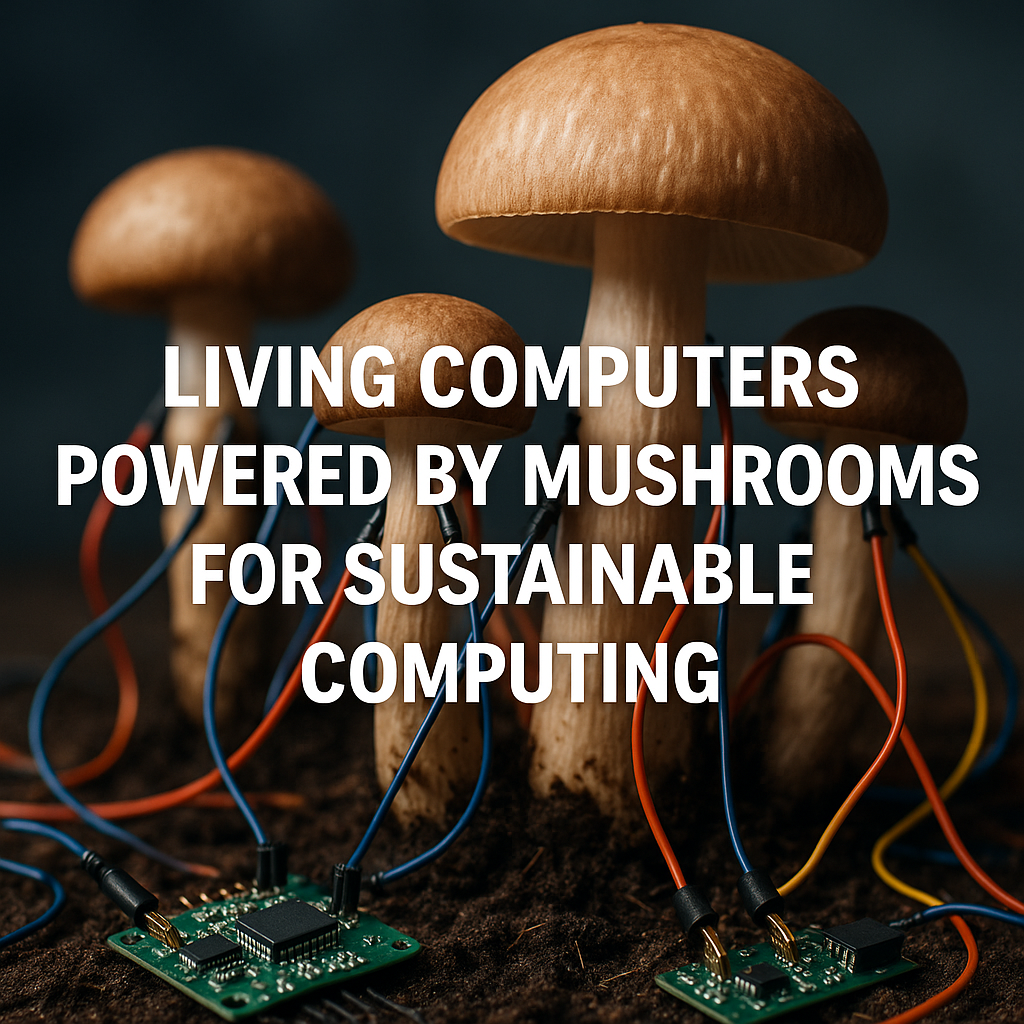
Mycelium refers to the threadlike network of hyphae beneath the fruiting bodies of fungi. Scientists studying “fungal bioelectronics” have shown that these networks can transmit ionic and electrical signals in response to stimuli such as light, humidity and chemical gradients. In practice, researchers feed substrates (wood chips, agricultural waste) to a fungal culture, allow the mycelium to colonize conductive inks or electrodes, and measure emergent voltage patterns that can be interpreted as simple logic states or analog signals. This approach is often termed “mycelium computing” or “living computers powered by mushrooms” in popular coverage.
Recent findings and proof‑of‑concepts
Recent peer‑reviewed work and press coverage summarized on ScienceDaily show several proof‑of‑concept demonstrations: fungal networks used to implement elementary logic gates, pattern recognition, and signal routing. These demonstrations are typically at the laboratory scale, focusing on reliability over milliseconds to hours rather than the gigahertz speeds of silicon. Researchers emphasize strengths such as self‑repair, low embodied energy, and integration with biodegradable substrates.
Why this matters for sustainability
The interest in fungal computing is tied to the global e‑waste challenge. According to the UN Global E‑waste Monitor 2020, only about 17.4% of electronic waste was formally recycled worldwide, a statistic that underscores the need for low‑impact alternatives. Living electronics based on mycelium could, in principle, be composted or regrown, offering a path to reduce persistent plastic and metal waste streams from single‑use sensors and transient devices.
Challenges: speed, reproducibility, and commercialization
Major obstacles remain. Mycelium systems operate at biological timescales that are orders of magnitude slower than modern microprocessors and are sensitive to humidity, temperature and nutrient availability. Standardizing growth conditions and creating reproducible fabrication methods are active research areas. Scalability and integration with existing electronics — for example, stable interfaces between fungal tissue and printed conductors — are engineering hurdles yet to be solved at commercial scale.
Context and industry reaction
Unconventional computing researchers such as Andrew Adamatzky, who has published extensively on slime molds and biological computing, have long argued that living substrates offer complementary capabilities to silicon — notably adaptability and resilience. Industry actors and materials startups are watching the space for niche applications where biodegradability and self‑repair outweigh processing speed, such as environmental sensors, agricultural monitors, and smart packaging. Venture activity remains cautious: current commercial interest prioritizes hybrid systems where living networks augment, rather than replace, conventional electronics.
Analysis: where fungal computers could fit
Mycelium devices are unlikely to displace CPUs or GPUs. Instead, the likely near‑term use cases are distributed sensing, edge devices with strict power budgets, and adaptive materials that benefit from growth and self‑healing. For example, an agricultural sensor network made with mycelium‑based transducers could degrade naturally after a season, reducing retrieval and disposal costs. That niche orientation — small, local, low‑power — aligns both with current technical limits and clear environmental benefits.
Expert insights and future outlook
Experts in biocomputing emphasize a pragmatic timeline: expect continued academic demonstrations over the next 3–7 years, with early commercial pilots in specialized markets if regulatory and reliability requirements can be met. Key research priorities include reproducible fabrication, hybrid mycelium–silicon interfaces, and life‑cycle assessments to quantify environmental benefits. While living computers powered by mushrooms are not a near‑term replacement for mainstream electronics, they represent an important strand of innovation in sustainable, embodied computing that could reshape niche applications and inform long‑term materials policy.
About the Author