Lede: Who, What, When, Where, Why
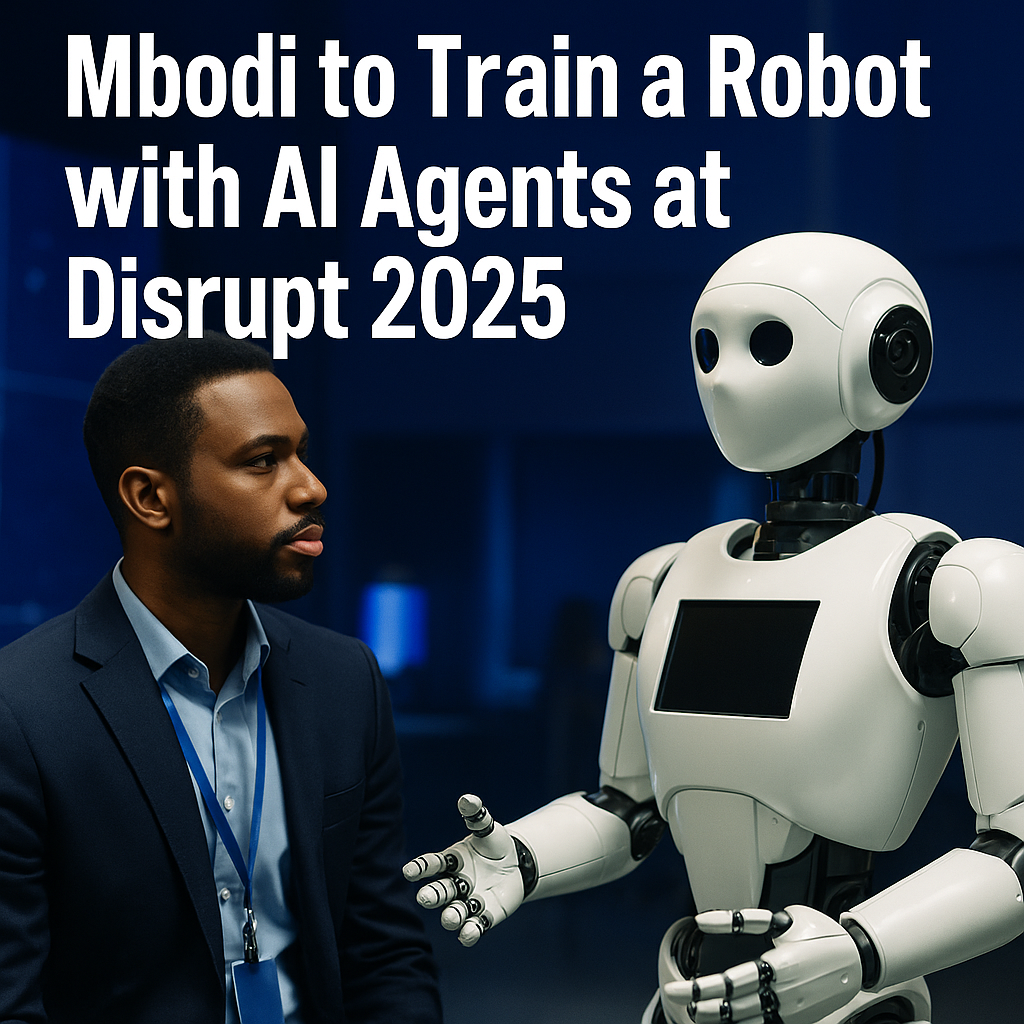
Mbodi will demonstrate how it can train a physical robot using autonomous AI agents at TechCrunch Disrupt 2025. The startup’s booth demonstration is set for the Disrupt stage during the conference in 2025, where founders and attendees will get a live look at the company’s agent-driven training pipeline and tooling aimed at lowering the bar for robot learning. The presentation is intended to show why agent orchestration—rather than hand-coded policies—can speed up task acquisition for real-world robots.
What Mbodi Is Showing
Mbodi’s demo focuses on an end-to-end workflow that pairs simulated development with real-world robot fine-tuning. The company plans to show AI agents executing trial-and-error learning loops, issuing subgoals, and coordinating sensorimotor experiments without constant human oversight. The exhibit will include a short explanation of how agents schedule training jobs, evaluate performance on objective metrics, and update control policies for hardware in the loop.
How the Technology Works
At the core of Mbodi’s approach are autonomous agents that handle exploration, data curation, and reward shaping. In simulated environments, agents generate behaviors and annotate outcomes; those behaviors are then transferred to a physical robot where further agent-guided refinement occurs. By modularizing responsibilities across a population of agents—each focused on exploration, evaluation, or safety—Mbodi aims to reduce brittle manual tuning that often limits robot learning in production settings.
Context: Why This Matters for Robotics
Training robots in the real world remains costly and slow because it requires careful experiment design, hardware cycles, and safety oversight. Agent-driven pipelines promise to shorten that loop. For companies deploying automation in logistics, retail or light manufacturing, the ability to iterate faster on physical tasks can cut development time and lower integration risk. Mbodi’s demonstration will be judged on whether it meaningfully reduces the human hours required to get a robot to a production-quality policy.
Industry Reaction and Implications
Observers will be watching for how Mbodi addresses two perennial problems: sim-to-real transfer and safety. Successful agent coordination has the potential to make on-device learning more reliable, allowing fleets of robots to personalize behavior to local conditions while adhering to global safety constraints. If effective, this could accelerate deployments in warehouses and last-mile logistics where variability and edge cases are frequent.
Market and Competitive Landscape
Mbodi’s demo arrives amid a crowded field of companies applying agents and reinforcement learning to robotics. Established players and startups alike are attempting to combine simulation scale with hardware grounding. For VCs, integrators and large manufacturers attending TechCrunch Disrupt 2025, the key questions will be repeatability, cost-per-task, and the company’s path to enterprise SLAs and support.
Analysis: Practical Challenges Ahead
Agent-based training can accelerate exploration, but it also introduces management complexity: agent orchestration, experiment traceability, and policy validation add operational overhead. Mbodi will need to demonstrate not only that agents can teach a robot a new task, but that the process produces auditable, safe models that integrate cleanly with existing robot control stacks. Success at Disrupt will hinge on measurable outcomes such as task completion rates and time-to-convergence during the demo.
Expert Insights and Future Outlook
While specific third-party endorsements are pending, the broader robotics community has signaled enthusiasm for approaches that reduce manual engineering effort. If Mbodi’s presentation at TechCrunch Disrupt 2025 demonstrates reliable sim-to-real transfer and practical governance for agent behaviors, it could influence how enterprises evaluate next-generation robot learning platforms. The coming months after Disrupt will reveal whether partner pilots and customer trials can validate the demo in production environments.
For attendees and the industry, Mbodi’s showcase is a test case: can autonomous AI agents move from research curiosities into tools that materially lower the cost and time to deploy working robots in commercial settings? TechCrunch Disrupt 2025 will be where the community begins to decide.
About the Author