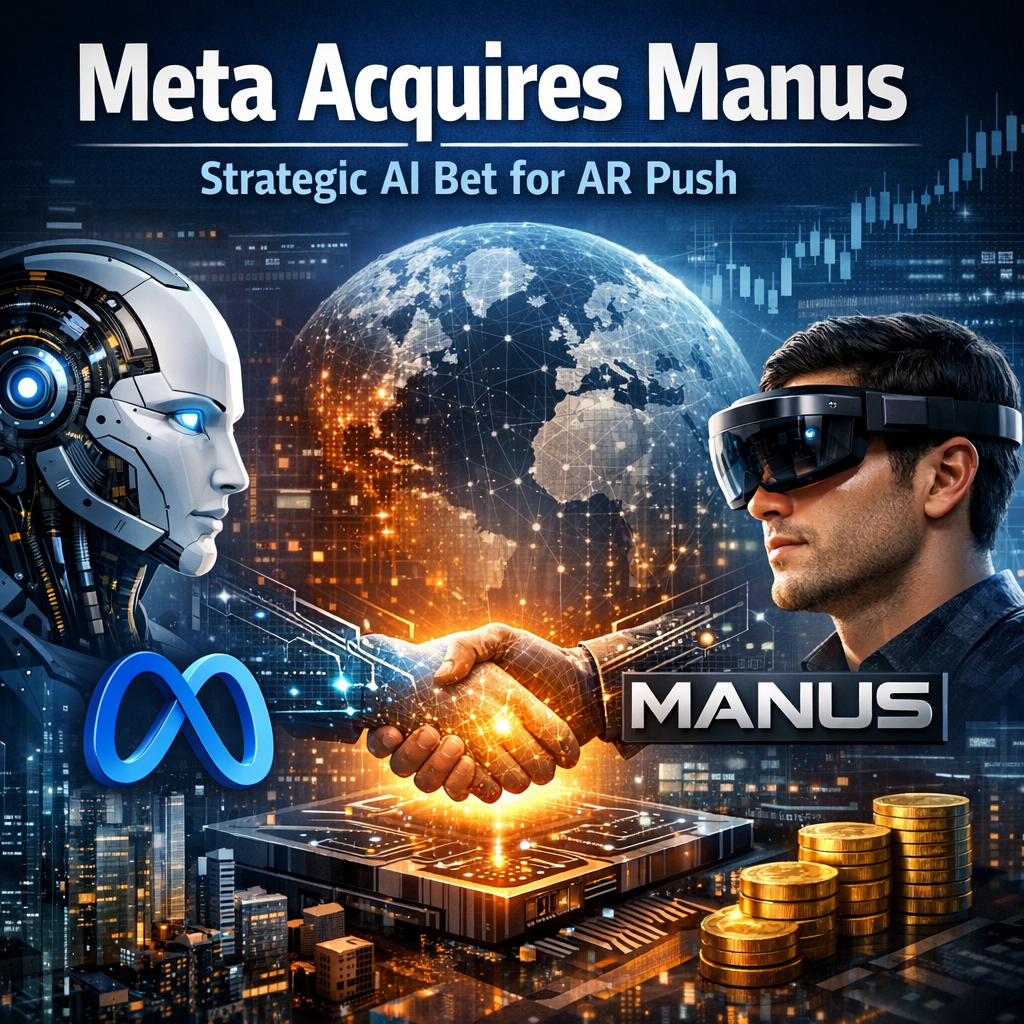
Meta buys Manus — who, what, when and why
Meta Platforms Inc. announced on Dec. 30, 2025 that it has agreed to acquire Manus, an AI startup that has become a focal point for developers and investors working on multimodal interfaces for augmented reality and wearable devices. The deal — described by both companies as a strategic acquisition to accelerate product integration — cements Meta’s push to combine advanced AI models, sensor fusion and developer tooling within its Reality Labs division.
Details, background and strategic context
Manus was founded in the late 2010s and has been widely discussed for its work on sensor-driven inference, hand- and motion-aware models, and tools that let third-party developers deploy lightweight AI on constrained devices. While neither company disclosed full financial terms at the time of the announcement, Meta framed the transaction as an effort to bring Manus’ team and intellectual property into its broader AR and mixed-reality roadmap.
The acquisition comes as Big Tech firms race to own more of the software and hardware stack for next-generation computing: generative and multimodal models, wearables and spatial computing platforms. For Meta, which has invested heavily in the Quest headset line and in foundational AI research through its Reality Labs and AI Research (FAIR) groups, Manus represents a shortcut to specialized expertise in real-time sensor processing, model compression and developer SDKs that are tailored to on-device constraints.
Product and developer implications
Developers using Manus’ toolchain — known in industry circles for efficient hand-tracking and low-latency inference pipelines — will be watching closely for how Meta integrates those SDKs into the Quest ecosystem and the company’s wider developer platform. Analysts expect Meta to fold Manus’ technology into its runtime libraries, possibly exposing new APIs for multimodal inputs that combine camera, IMU and audio signals with on-device ML. That could reduce latency for AR interactions and enable more natural interfaces across apps and experiences.
Competition and the wider market
The purchase tightens Meta’s competitive position versus rivals such as Apple, Google and Microsoft, all of which are investing in AR hardware and multimodal AI stacks. Owning Manus’ IP and talent could give Meta an edge in building lightweight models optimized for head-mounted displays and other wearables — an area where efficiency, thermal constraints and battery life are as important as raw model performance.
At the same time, the deal is likely to attract regulatory attention. Large acquisitions in adjacent hardware and AI niches have increasingly fallen under antitrust and national security review in both the U.S. and EU. Observers note that deals which consolidate control over developer platforms, SDKs and sensitive sensor-processing technology can raise competitive and privacy questions.
Expert perspectives
‘This is a classic strategic tuck-in: Manus brings narrow, high-value capabilities that accelerate Meta’s roadmap,’ said an industry analyst who follows AR and AI chip-to-cloud stacks. ‘Meta isn’t just buying code — it’s buying teams that know how to squeeze neural nets into constrained devices while preserving a developer experience.’
‘From a privacy standpoint, the integration of sensor-driven AI raises clear questions about data collection and retention,’ said a privacy expert who asked to remain anonymous. ‘Regulators will want clarity on what data is used for model training versus what stays on-device.’
Developers who spoke on condition of anonymity said they were hopeful that a Meta acquisition would lead to broader tooling and better documentation, but expressed concern about potential lock-in and shifting licensing terms if Manus’ SDKs are absorbed into Meta’s proprietary stack.
Risks, integration challenges and outlook
Integrating a small, specialized startup into a sprawling organization such as Meta is rarely seamless. Cultural fit, talent retention and product roadmap alignment will determine whether the acquisition yields returns beyond short-term headlines. There is also the risk that a more closed, Meta-owned set of tools could fragment the developer ecosystem around AR and multimodal interfaces.
Still, the strategic logic is clear: Meta needs differentiated, efficient models and real-time sensor expertise to make AR interactions feel natural and responsive. If Manus’ technology can be adapted without compromising user privacy or developer openness, the acquisition could materially accelerate features in upcoming Quest generations and other Reality Labs initiatives.
Conclusion — what to watch next
Observers should watch for three near-term signals: how Meta packages Manus’ SDKs for external developers, whether any regulatory reviews or conditions are announced, and staff retention at Manus during the integration period. Longer term, the acquisition underscores that the next wave of user interfaces will depend as much on compact, multimodal AI as on cloud-hosted generative models — and that companies are scrambling to control the software layers that translate sensor inputs into human-like interactions.
About the Author