Lede: Who, What, When, Where, Why
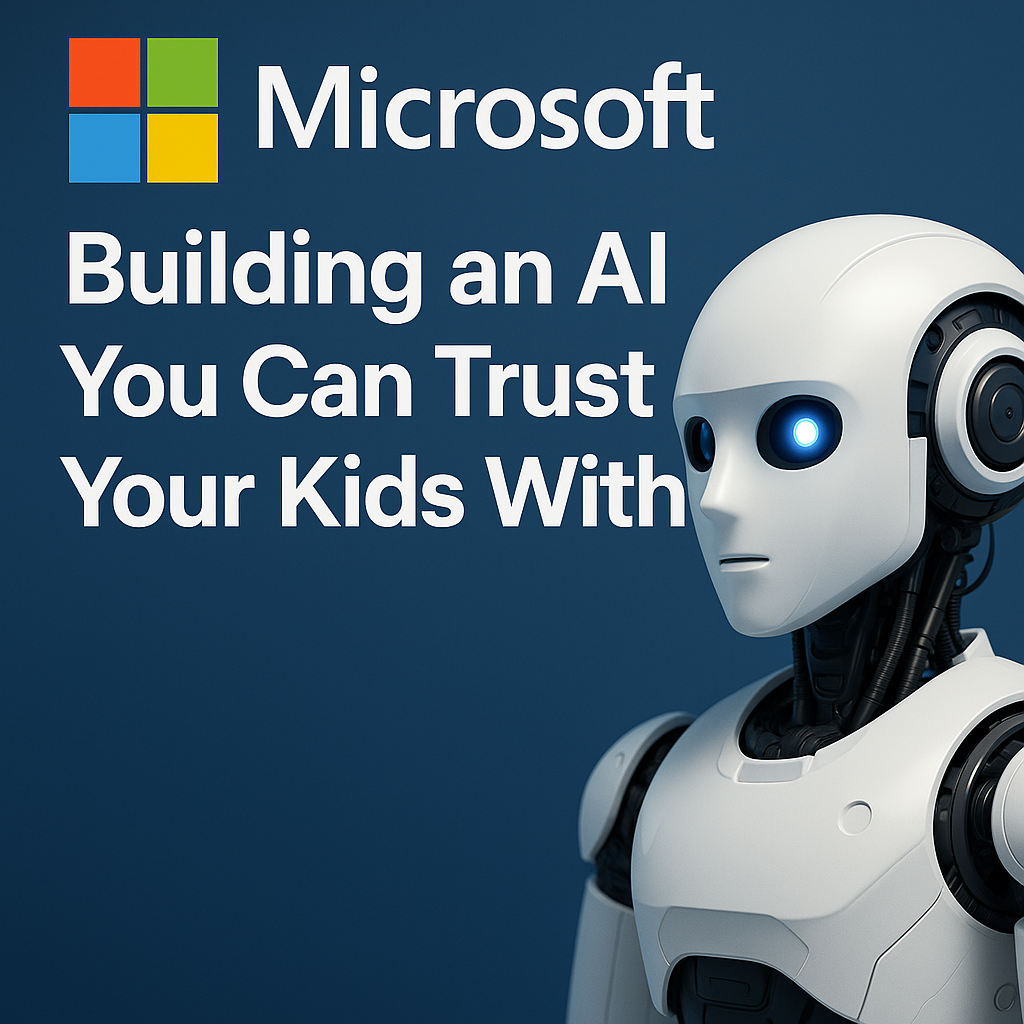
CNN has highlighted a renewed pledge from Microsoft executives that the company is developing an artificial intelligence system parents can trust their children to use. The announcement underscores Microsoft’s push to balance rapid AI feature rollouts — from Copilot to Bing chat and Azure OpenAI Service — with stronger safety and content-moderation controls aimed at younger users and classrooms.
Microsoft’s public safety push and product context
Microsoft’s AI investments have accelerated since its early partnership with OpenAI in 2019, and the company has repeatedly emphasized safety and responsible use as core priorities. Products such as Microsoft Copilot in 2023, Bing with Chat, and the Azure OpenAI Service have brought generative AI into search, productivity suites and enterprise platforms. The company now faces a central challenge: delivering powerful, useful AI while preventing exposure to harmful content, misinformation and privacy risks for minors.
What “kid-safe AI” means in practice
According to reporting, Microsoft’s roadmap for trusted AI for children includes stricter content filters, age-aware responses, classroom-ready controls for teachers and integration with family-safety tools already built into Windows and Microsoft Accounts. In practice, that could mean limiting access to adult topics, reducing hallucinations on factual queries, and adding teachers’ oversight tools for student use in hybrid and remote learning environments.
Regulatory and policy backdrop
Microsoft’s safety initiative arrives amid growing regulatory scrutiny. In Europe, the AI Act — negotiated through 2023 — targets high-risk systems and sets a precedent for mandatory safety assessments. In the United States, federal agencies such as the Federal Trade Commission have signaled increased attention to deceptive or unsafe AI practices, particularly those that could harm children. For Microsoft, aligning product design with both global regulation and parental expectations is now a commercial and legal imperative.
Why parents and educators care
Parents and educators see opportunity and risk: AI tutoring, homework help and creativity tools can expand learning access, but unchecked models can recommend inappropriate material, propagate bias or give inaccurate medical or safety advice. Schools evaluating AI tools now want clear documentation on data use, moderation standards, and teacher controls before deploying systems in classrooms. Analysts expect that product features that explicitly address these concerns will drive adoption in K–12 education.
Industry reaction and expert perspective
AI policy experts and child-safety advocates have broadly welcomed vendor commitments to safety while urging independent audits and transparency. Independent researchers have repeatedly asked for model documentation, third-party testing and clear red lines on age-restricted content. Observers note that corporate pledges must be backed by measurable safeguards, reporting and rapid update cycles as the threat landscape evolves.
Business implications and market strategy
For Microsoft, positioning an AI as suitable for children opens a large market: education technology and family-oriented applications are major growth vectors for cloud and productivity services. Demonstrable safety and compliance could become a competitive advantage against peers, including Google and OpenAI-powered services, if Microsoft can provide verifiable controls that schools and parents demand.
Analysis: risks, trade-offs and technical hurdles
Building AI that is both safe for children and functionally useful presents trade-offs: stricter safety filters can reduce helpfulness or creativity, while permissive models risk inappropriate outputs. Technical hurdles include reliably detecting user age without invasive data collection, avoiding harmful over-censorship, and maintaining accuracy. Success will require multimodal approaches — content moderation, retrieval augmentation to reduce hallucinations, and robust update pipelines.
Outlook: verification, transparency and next steps
Moving forward, independent verification will be crucial. Third-party audits, model cards and regular transparency reports will likely be demanded by regulators, educators and consumer groups. For parents and schools, the practical test will be whether Microsoft can couple robust safety controls with clear UX for guardians and teachers. If it succeeds, Microsoft could set new expectations for what a trusted, child-friendly AI looks like across education and home use.
Expert insight and closing
Industry observers view Microsoft’s pledge as a positive step but caution that public commitments alone are not enough. The most meaningful progress will be measured by demonstrable safeguards, external audits and collaboration with child-safety organizations and educators. As Microsoft refines its approach, the company’s ability to translate high-level promises into verifiable, usable protections will determine whether this AI really becomes one parents can trust their kids to use.
About the Author