Microsoft’s announcement: who, what, why
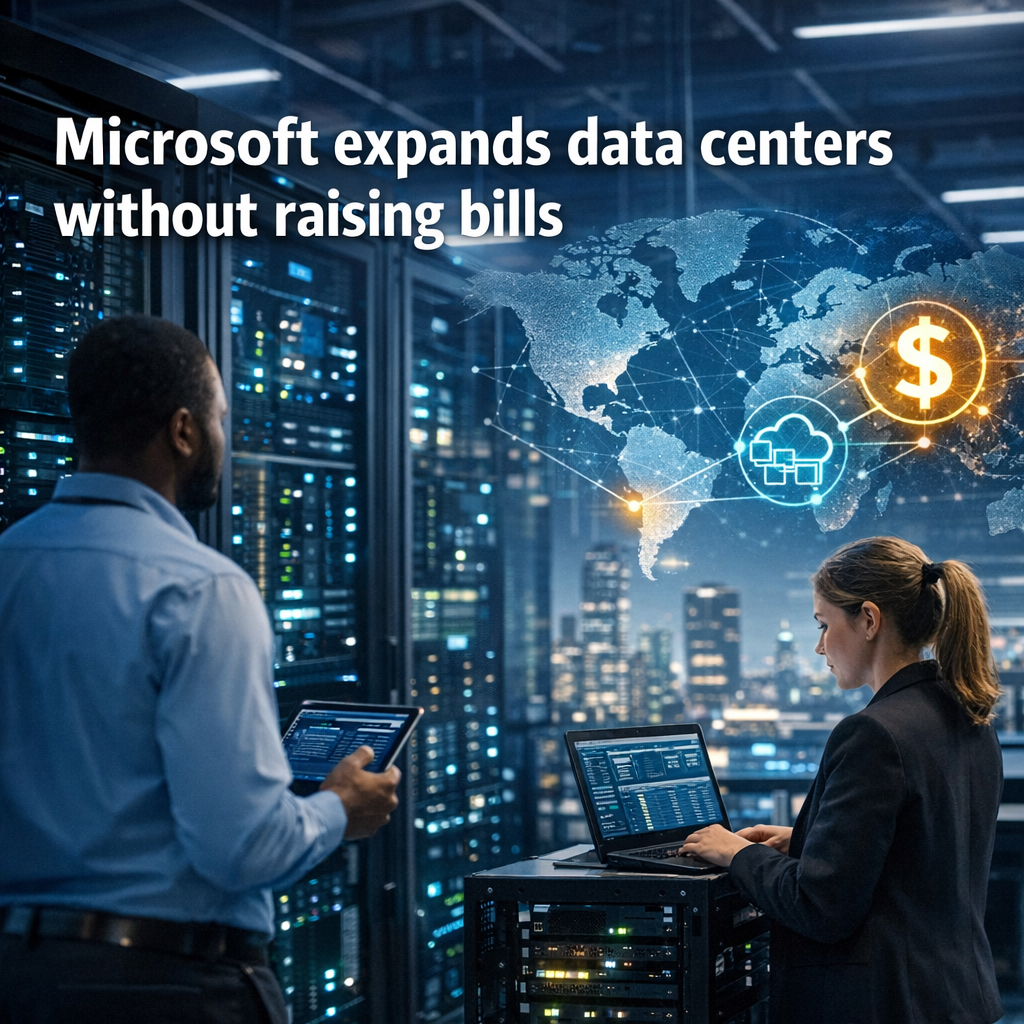
In a statement this month, Microsoft said it is moving forward with a broad expansion of new data centers in multiple regions as it seeks to meet rising demand for cloud services from Azure and Microsoft 365. The company emphasized that the expansion will not translate into higher retail electricity bills for customers, saying it “won’t let customers’ electricity bills go up” as part of the rollout. Microsoft framed the effort as a mix of capacity growth and investments in clean-energy infrastructure to serve both commercial and public-sector workloads.
Details, context and corporate strategy
Microsoft has been steadily increasing data-center capacity for years to support growth in artificial intelligence, cloud compute and enterprise SaaS. The company’s cloud platform, Azure, competes with Amazon Web Services and Google Cloud Platform for large-scale customers that demand low-latency, geographically distributed capacity. Adding data centers—whether new campuses, modular facilities, or capacity within existing regions—typically increases local power demand and can strain distribution networks unless accompanied by grid upgrades or on-site generation.
Microsoft explicitly tied the pledge not to raise customer electricity costs to a suite of measures it says the company will deploy: long-term power purchase agreements (PPAs) with renewable generators, greater use of on-site solar and battery storage at data-center campuses, and demand-management strategies that shift compute to times of lower grid stress. Those approaches align with the company’s prior sustainability commitments; in 2020 Microsoft pledged to be carbon negative by 2030 and has since increased investments in renewable energy projects and grid-friendly technologies.
How Microsoft plans to avoid higher bills
Avoiding upward pressure on retail rates while adding large new loads requires coordination with utilities and regulators. Microsoft will likely balance several levers: signing PPAs that add renewable capacity to local grids, committing capital to shared transmission or substation upgrades, and participating in demand-response programs that pay back for flexible consumption. Battery storage can shave peaks that attract costly demand charges, and shifting non-urgent workloads to off-peak hours can reduce the effective capacity footprint on the grid.
These tactics are already common in the hyperscale-cloud playbook. Microsoft and peers have historically signed long-term renewable contracts and invested in grid infrastructure to reduce both carbon and operating risk, while hoping to insulate end customers from direct utility-rate impacts.
Industry implications and regulatory angles
Even with corporate investment, the expansion raises questions for local utilities, regulators and communities. When a large customer adds capacity, utilities evaluate rate structures, cost recovery and whether upgrades should be rate-based (spread across all customers) or paid by the customer driving the load. Microsoft’s assurance not to raise consumer bills will be tested in regulatory filings: utilities and public utility commissions will decide how much of any grid upgrade cost is socialized.
There are also land-use and permitting realities. Building new data-center campuses often requires local approvals, workforce recruitment and water/energy assessments that can slow timelines. Microsoft’s public promise reduces political friction, but execution depends on many local stakeholders.
Expert perspectives and market reaction
Analysts and grid specialists say Microsoft’s approach is pragmatic but not risk-free. Expanding capacity while relying on PPAs and storage can limit short-term rate impacts, but persistent load growth across multiple hyperscalers increases pressure on transmission and distribution systems over the long term. Utilities may still seek cost recovery that ultimately influences rates if upgrades benefit broader service territories.
From a market standpoint, the move keeps Microsoft competitive in providing low-latency, AI-ready infrastructure and demonstrates another example of cloud providers internalizing energy strategy as part of product delivery. For corporate customers, the promise of expanded capacity without higher energy costs is a selling point; for communities, it is a negotiating floor for shared benefits such as local jobs and grid resiliency investments.
Conclusion: outlook and takeaways
Microsoft’s expansion plan, coupled with a pledge not to raise customer electricity bills, is a strategic attempt to balance growth, sustainability and public relations. The company’s ability to deliver on that promise will depend on contracts with renewable generators, investments in storage and grid upgrades, and decisions by utilities and regulators. If successful, the approach could become a template for other cloud providers; if not, it will highlight how rapidly growing digital loads are reshaping the economics and politics of electricity systems.
About the Author