Who, what, when — Motional’s new roadmap
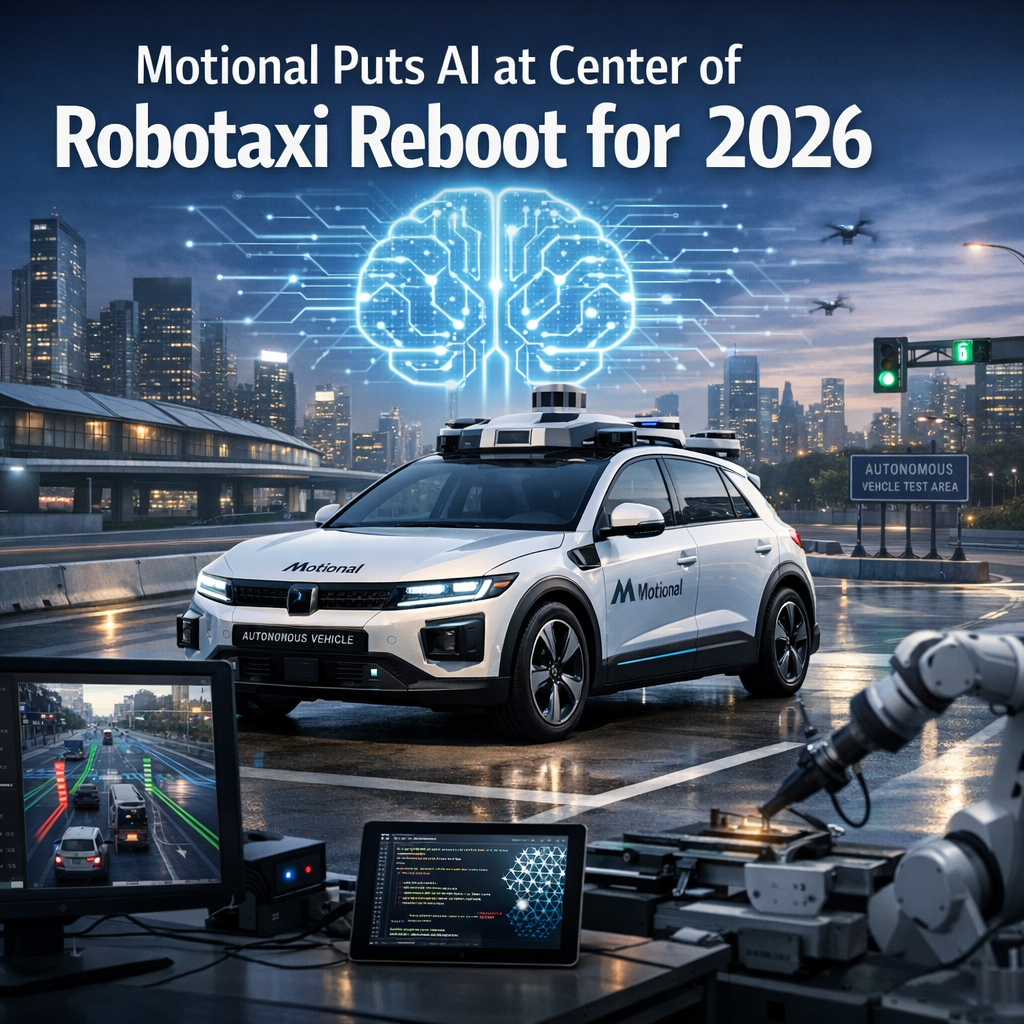
Motional, the autonomous‑vehicle joint venture formed by Aptiv and Hyundai Motor Group, announced a strategic reboot that places advanced artificial intelligence at the center of its robotaxi program as it targets 2026 to begin commercial driverless service. The move refocuses engineering, simulation and fleet operations on machine‑learning systems designed to accelerate perception, planning and validation for Level 4 autonomy.
Why AI now — technology and operational shifts
The company’s renewed emphasis on AI reflects broader industry trends: companies developing self‑driving taxis are moving from sensor‑centric incremental gains toward software architectures that rely on large‑scale data, centralized model training and higher‑fidelity simulation. For Motional that means integrating more advanced neural perception models, tighter sensor fusion pipelines, continuous learning from fleet data, and expanded virtual testing to cut reliance on time‑consuming, on‑road safety driver miles.
Concretely, Motional plans to tighten the loop between simulation and live operations, accelerate validation of edge cases through synthetic data, and deploy more capable planning stacks that can make safe, lawful maneuvers in dense urban environments. Those capabilities are critical for Level 4 driverless service, where vehicles are expected to operate without a human fallback within defined operational design domains (ODDs).
Background: where Motional sits in the AV landscape
Motional was established as a 50/50 joint venture between Aptiv and Hyundai in 2020 to commercialize autonomous mobility. The firm has spent years testing and scaling fleets and partnerships to refine hardware and software integration. Its announcement arrives at a moment of recalibration across the sector: competitors including Waymo, Cruise and others have demonstrated localized commercial services, while regulatory uncertainty, safety incidents and cost pressures have slowed broad rollouts.
The company’s 2026 goal underscores how ambitious — and how conditional — such timelines remain. Delivering driverless robotaxi service at scale requires not only software maturity but also regulatory approvals, insurance frameworks, high‑quality maps and operational partnerships with local authorities and mobility platforms.
Technical challenges and regulatory hurdles
Key technical obstacles include handling rare or ambiguous edge cases, ensuring robust perception in adverse weather, and aligning long‑horizon planning with human road users. On the regulatory side, cities and states have varied approaches to permitting driverless vehicles; companies must satisfy regulators on safety validation practices and incident response plans. Motional’s AI‑first strategy aims to shorten the validation cycle and provide reproducible evidence — through simulation and data‑driven metrics — that its vehicles can meet regulatory standards.
Expert perspectives and industry implications
Industry observers say an AI‑centric overhaul is a natural evolution for firms that have amassed large amounts of driving data but need more efficient ways to generalize learning. Analysts note that software‑driven performance gains can lower the marginal cost of scaling a fleet if models can be safely applied across cities and conditions.
However, experts caution that model improvements are necessary but not sufficient. Policy, public acceptance and commercial economics remain critical. If Motional successfully leverages AI to reduce the need for constant human supervision and cut validation timeframes, it could improve unit economics and make wider deployment commercially defensible. Conversely, a single high‑profile failure or regulatory setback could slow progress for the sector as a whole.
What this means for competitors and partners
Motional’s pivot will intensify competition with established players such as Waymo and incumbent automakers that are also investing heavily in software and simulation. It will also affect partners — ride‑hail platforms, municipalities and fleet operators — that need clearer timelines and operational guarantees to commit infrastructure or commercial arrangements. For suppliers, a software‑first approach may shift demand toward high‑performance compute, efficient data pipelines and cloud simulation services rather than incremental sensor upgrades alone.
Conclusion — outlook and takeaways
Motional’s announcement positions AI and large‑scale simulation as the linchpins for its 2026 driverless service target. That approach aligns with where many experts believe the industry must go to achieve safe, scalable robotaxi operations. Still, success will hinge on a confluence of technology maturity, regulatory approvals and commercial partnerships. Observers should watch how Motional demonstrates safety through reproducible metrics, how regulators respond, and whether the company can translate AI gains into reliable, cost‑effective service across multiple cities.
About the Author