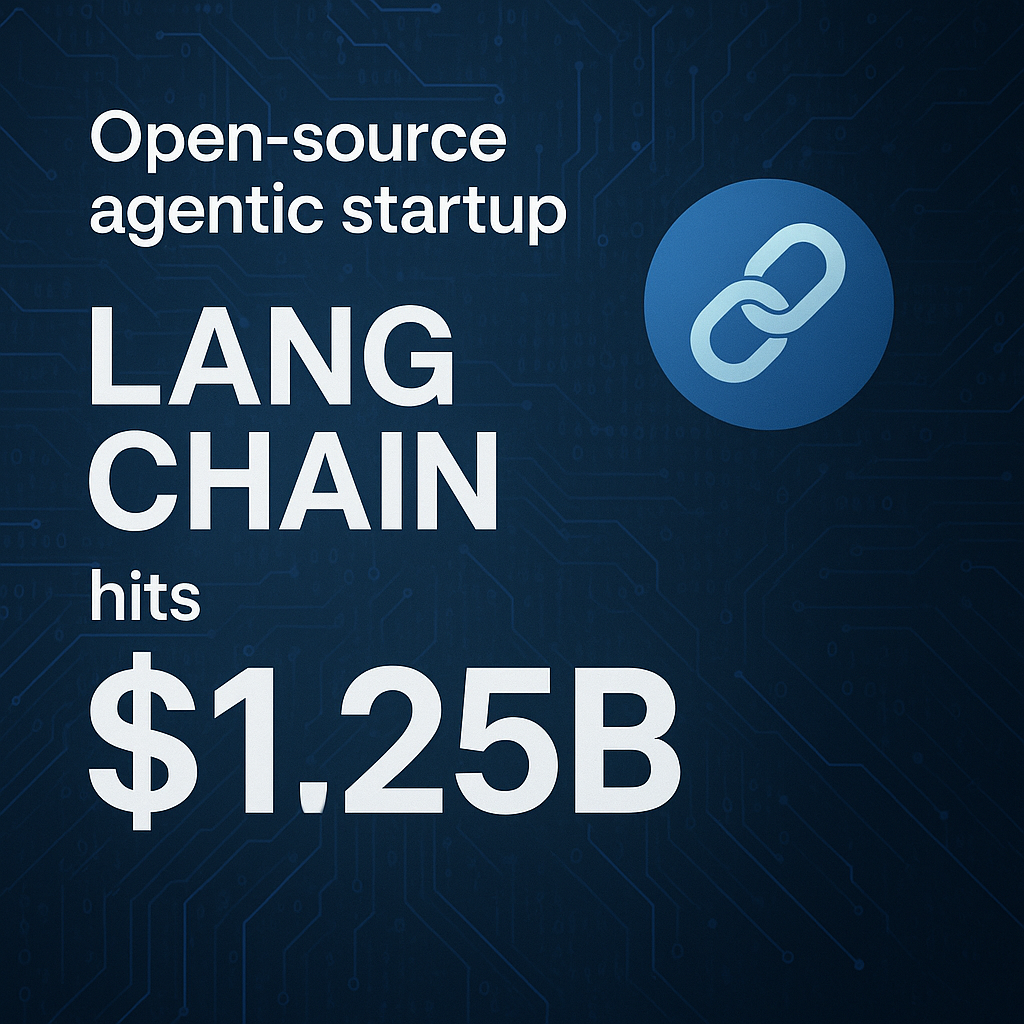
San Francisco — LangChain, the open-source developer framework for building agentic AI applications, has reached a $1.25 billion valuation, marking its entry into the unicorn ranks and underscoring investor appetite for tooling that accelerates production-grade AI.
The milestone follows surging commercial adoption of autonomous and agent-based architectures that extend large language models (LLMs) into multi-step workflows, API orchestration, and real-world automation. LangChain’s libraries and abstractions enable developers to stitch together LLMs, retrieval systems, APIs and other primitives into chains and agents — a pattern that has become central to a new wave of AI products.
Why the valuation matters
LangChain’s $1.25B valuation signals more than startup hype: it reflects the strategic value of developer-facing infrastructure in the AI stack. As enterprises race to deploy LLM-powered assistants, virtual agents and knowledge-driven apps, platforms that reduce engineering friction and standardize integrations are becoming indispensable.
Investors are betting that open-source frameworks with strong ecosystems can capture long-term enterprise spend through a combination of hosted services, premium features, partnerships and support. LangChain’s open-core model lets it balance community-driven innovation with commercial agreements for scale deployments and proprietary extensions.
Technology and product momentum
From a technical perspective, LangChain popularized patterns for chaining prompts, adding retrieval-augmented generation (RAG), and building policy-driven agents that call external tools. That modular approach helps teams build agents that interact with databases, cloud services, and even blockchains.
Blockchains and smart contracts are a natural frontier for agentic systems. Developers are experimenting with agents that sign transactions, query on-chain data, and execute cross-chain workflows via oracles — combining off-chain LLM intelligence with on-chain guarantees. LangChain’s connectors and tool abstractions make these integrations easier, but they also raise new questions about reliability, verifiability and security.
Business implications and market dynamics
For startups and incumbents, the valuation underscores the strategic race to own developer mindshare in AI. Cloud providers, LLM vendors and enterprise software companies are all eyeing similar opportunities: offering managed agent platforms, fine-tuned models, and compliance tooling. LangChain’s success may prompt larger vendors to accelerate partnerships or incorporate compatible APIs to keep developer ecosystems unified.
On the funding front, the broader AI investment climate remains active but selective. Investors favor companies with clear monetization paths, defensible technology, and growing enterprise usage. LangChain’s community, broad integrations, and role as a de facto standard for agent-based apps appear to have checked those boxes.
Geopolitics, regulation and risks
As agentic AI systems gain traction, they also draw regulatory attention. Governments are increasingly focused on AI safety, data governance, and export controls — particularly where models or tooling could enable cross-border information flows or sensitive automation. For open-source projects like LangChain, balancing transparency with compliance will be essential, especially in jurisdictions with strict data residency or AI oversight rules.
Security risks — from agents executing unintended actions to vulnerabilities in blockchain integrations — will require rigorous testing, access controls, and formal audit processes. Business customers will demand enterprise-grade SLAs and explainability as part of procurement.
Outlook
LangChain’s $1.25B valuation is a milestone for agentic AI infrastructure and highlights the commercial potential of open-source frameworks that help teams build sophisticated LLM applications faster. Moving forward, the company’s challenge will be converting community momentum into sustainable revenue while navigating regulatory, security, and geopolitical headwinds. If it does, LangChain could help define how businesses deploy autonomous AI at scale — spanning cloud services, blockchain-enabled workflows, and next-generation enterprise assistants.
Whether this valuation presages a broader consolidation of developer tooling or sparks competitive innovation from cloud and model providers, it makes clear that agent-oriented architectures are central to the next chapter of AI productization.
About the Author