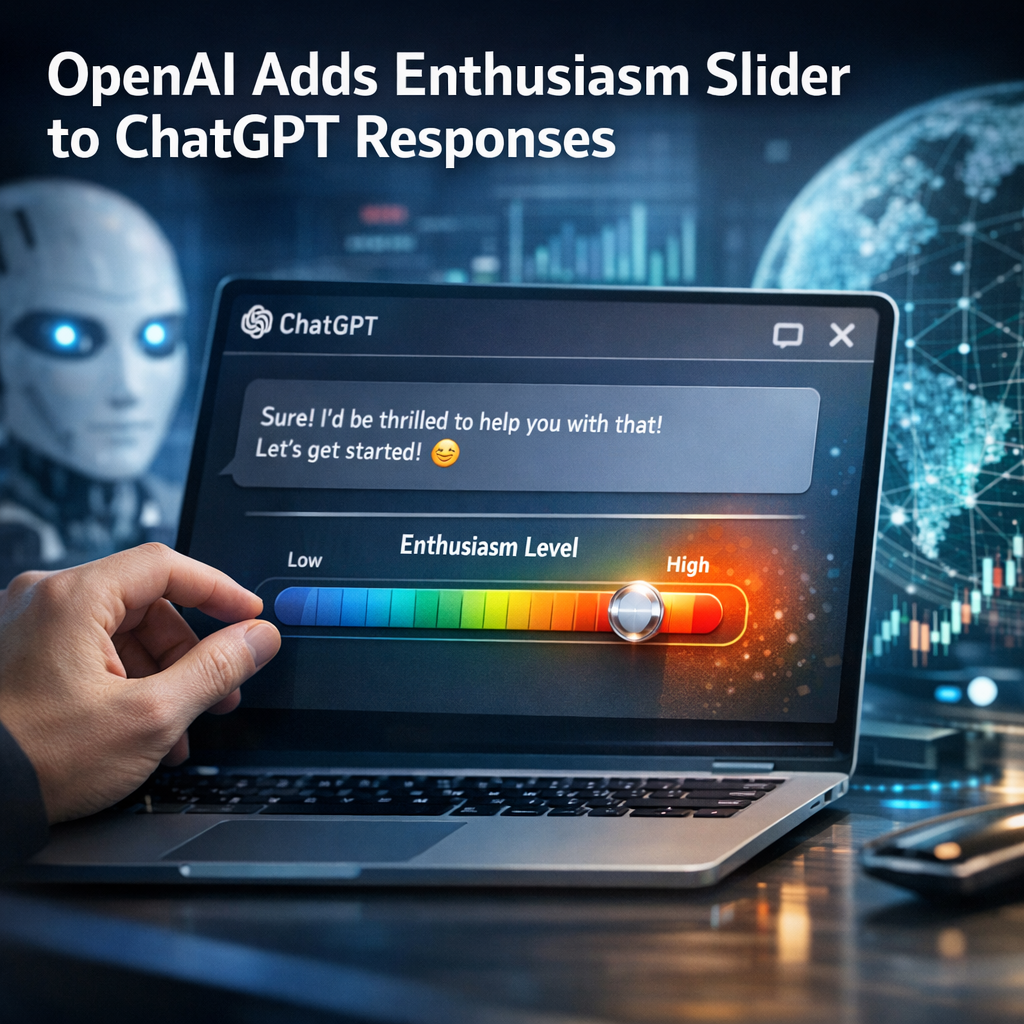
What happened: a new user control for tone
OpenAI has introduced a new control that lets users directly adjust ChatGPT’s level of ‘enthusiasm’ in responses. The change, visible in the ChatGPT interface and in developer-facing documentation, gives end users a simple way to modulate the perceived energy, excitement or cheerfulness of the model’s output without rewriting prompts or changing model selection.
How it works and where it fits
The enthusiasm control is presented as a user-facing slider (or selector) inside ChatGPT’s conversation settings and is conceptually distinct from the API ‘temperature’ parameter. Temperature, a longstanding setting in OpenAI’s API, governs randomness and diversity in token selection; enthusiasm is positioned as a higher-level tonal parameter intended to influence pacing, punctuation, emoji use and choice of words to make a reply feel more or less effusive.
This addition follows earlier personalization tools from OpenAI, including the Custom Instructions feature that launched in July 2023 and allows users to tell ChatGPT how they prefer the assistant to behave. Whereas custom instructions let users set persistent preferences on topics and style, the enthusiasm control offers an immediate, per-conversation or per-response adjustment aimed at user experience rather than model internals.
Developer and API implications
For developers building on OpenAI’s platform, the new control raises product design possibilities and integration questions. It may be exposed through the ChatGPT plugin or app configuration layers rather than as a raw API knob, although OpenAI has historically offered both GUI controls and programmatic equivalents. If surfaced in the API, enthusiasm could complement existing parameters like temperature, top_p and system prompts by providing a simpler abstraction for consumer-facing tone adjustments.
Why it matters: UX, personalization and trust
Making tone adjustments more accessible addresses a common pain point: users who want more human-sounding encouragement or a more neutral, professional tone currently must craft elaborate prompts. A dedicated enthusiasm control reduces friction for nontechnical users and unlocks new use cases — from upbeat customer-support messages to sober, concise summaries for professional workflows.
At the same time, tonal controls intersect with safety, moderation and persuasion concerns. Higher enthusiasm could make persuasive messaging feel more compelling, and could amplify harmful content if combined with prompts that generate misinformation or exploitative narratives. That tension will require product-level guardrails, moderation layers and monitoring to ensure tonal expressiveness does not degrade responsibility or user safety.
Expert perspectives and industry context
Experts in human-computer interaction and applied ethics note that tone controls are a natural evolution for consumer-facing AI. UX researchers point out that expressive controls can improve accessibility by allowing users to select communication styles that match cognitive or emotional needs. At the same time, AI safety specialists emphasize that new parameters should be evaluated for abuse vectors, including social engineering and manipulation risks.
From an industry standpoint, the move aligns OpenAI with a broader trend: platforms are shifting from purely technical knobs to higher-level, user-intelligible controls. Companies such as Google and Anthropic have also experimented with configurable assistant personalities and safety settings; enthusiasm controls are another iteration in making AI assistants feel configurable without requiring advanced prompt engineering skills.
Business and competitive implications
For OpenAI, the feature is likely part of an effort to broaden ChatGPT’s appeal among enterprise and consumer audiences by reducing friction in personalization. Enterprises that deploy generative AI for customer-facing experiences may prefer a simple tone slider to fine-tune brand voice across channels. At the same time, competitors will watch whether OpenAI offers matching programmatic access for developers and how it balances expressiveness with content controls.
Conclusion: what to watch next
The arrival of an enthusiasm control signals a maturation in how AI companies expose model behavior to end users. Expect product refinements — such as presets, contextual sensitivity and safety thresholds — along with discussions about standards for transparent tone controls. Ultimately, the feature could improve everyday usability for many ChatGPT users, but its broader impact will depend on implementation details, developer access and the regulatory and ethical frameworks governing persuasive AI.
About the Author