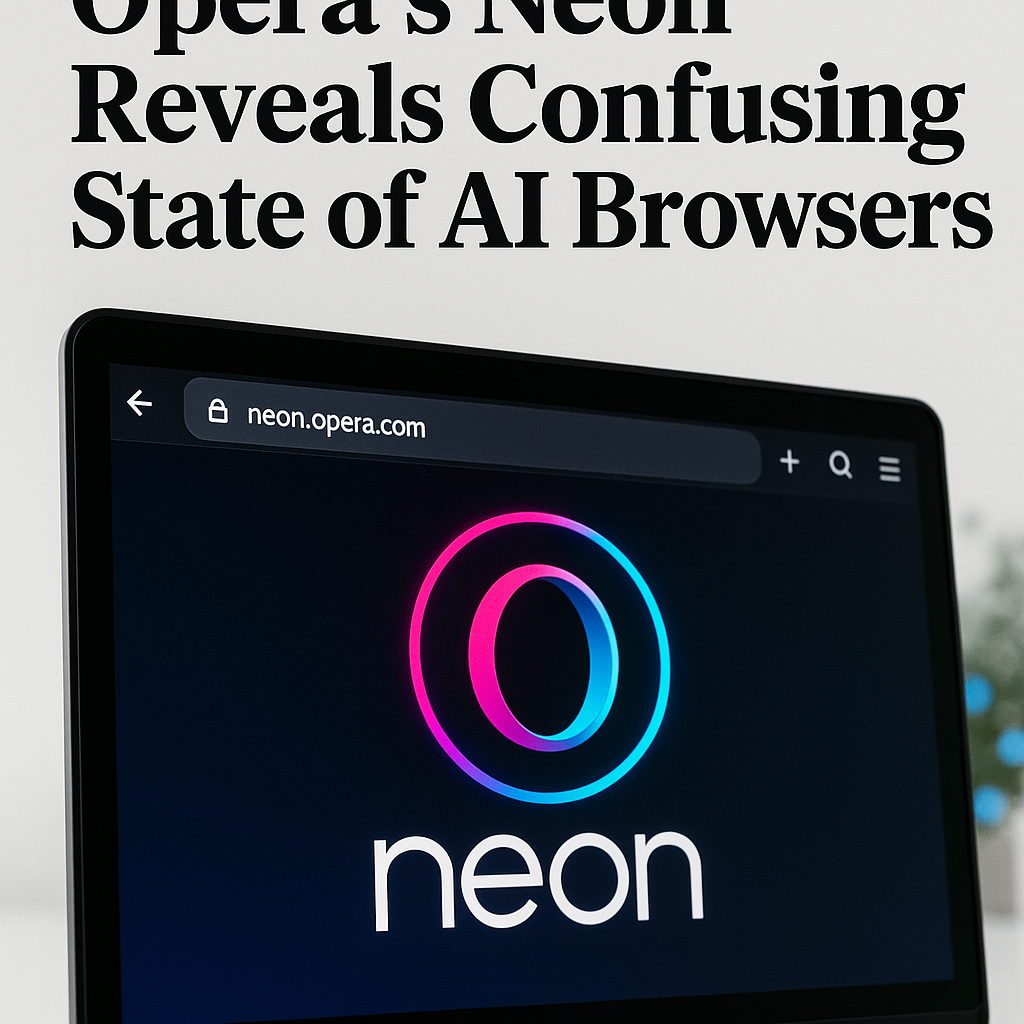
Opera’s new Neon experiment, flagged in a recent The Verge story, is the latest example showing how fragmented and confusing AI-enabled browsers remain. As legacy browser makers, startups and Web3 players rush to wrap large language models and assistant features into their products, the result is often a bewildering mix of interfaces, data flows and business incentives that leaves users — and regulators — unsure what they’re getting.
The Verge’s coverage of Neon zeroes in on a problem many observers have flagged: adding AI to the browser isn’t just a technical integration, it’s a product-design challenge that raises UX, privacy and trust questions. Opera has a long history of experimenting with alternative browsing concepts — from its early mobile footholds to crypto-focused efforts such as the Crypto Browser project — and Neon appears to be another exploratory step. But the broader pattern is clear: browsers are piling on AI features without a shared mental model for how assistants should behave inside a browsing session.
There are several tensions at work. First, the user experience: AI features can clash with established browser metaphors. Assistants that live in sidebars, overlays or omniboxes can feel redundant or intrusive if their role isn’t obvious. Second, data governance: when a browser routes queries to external LLM providers, questions arise about what data is logged, how long it’s stored, and whether it’s used to fine-tune models. Third, business models: browsers have different incentives. Google and Microsoft can embed their own AI stacks in Chrome and Edge respectively; privacy-focused browsers such as Brave must balance ad-blocking and tokenized ads with new AI revenue paths; Opera’s mix of partnerships, experimental features and Web3 work complicates its monetization roadmap.
These frictions have wider industry implications. Startups building assistant technologies are racing to sign distribution deals with browsers, and venture funding for LLMs and inference infrastructure has remained robust even as macro conditions tighten. That funding drive accelerates product launches but can also prioritize speed over clarity — resulting in features that look polished in demos but confuse users in daily use. Meanwhile, geopolitical dynamics influence architecture choices: US-based providers like OpenAI and Anthropic dominate many LLM deployments, while regional players in Europe and Asia are positioning alternatives to satisfy regulatory or sovereignty requirements.
Blockchain and Web3 further complicate the landscape. Opera was among the first mainstream vendors to experiment with built-in crypto wallets and Web3 tooling; that historic openness to decentralized primitives makes it a natural testbed for hybrid approaches that combine on-device browsing, blockchain identity and cloud-hosted AI. But blending these technologies introduces novel attack surfaces and compliance issues — from wallet phishing to cross-border data transfer rules — which startups and incumbent vendors must address if they want broad adoption.
From a business perspective, the scramble for AI-enabled differentiation is understandable. Browsers have struggled to find strong direct monetization beyond search revenue sharing and, in some cases, subscription features. Embedding AI offers potential new value propositions — search and summarization features, research assistants, transactional flows — that could justify premium tiers or new ad formats. Yet without transparent privacy practices and consistent UX conventions, adoption risks being limited to early adopters and tech-savvy users.
Opera’s Neon, as reported by The Verge, is symptomatic: interesting ideas wrapped in an interface that raises more questions than answers. The takeaway for industry watchers, regulators and investors is that AI browsers need standards — for UI behaviors, for data handling, and for model sourcing — if they are to move from experimental curiosities to mainstream tools.
Conclusion: AI in the browser is inevitable, but messy. Neon highlights the early-stage confusion: competing design paradigms, opaque data flows, and uncertain business incentives. For browsers to succeed as AI platforms, companies must prioritize clear user experiences, transparent privacy guarantees, and interoperable standards — and investors should temper the rush to deploy with attention to long-term trust and regulatory resilience.
About the Author