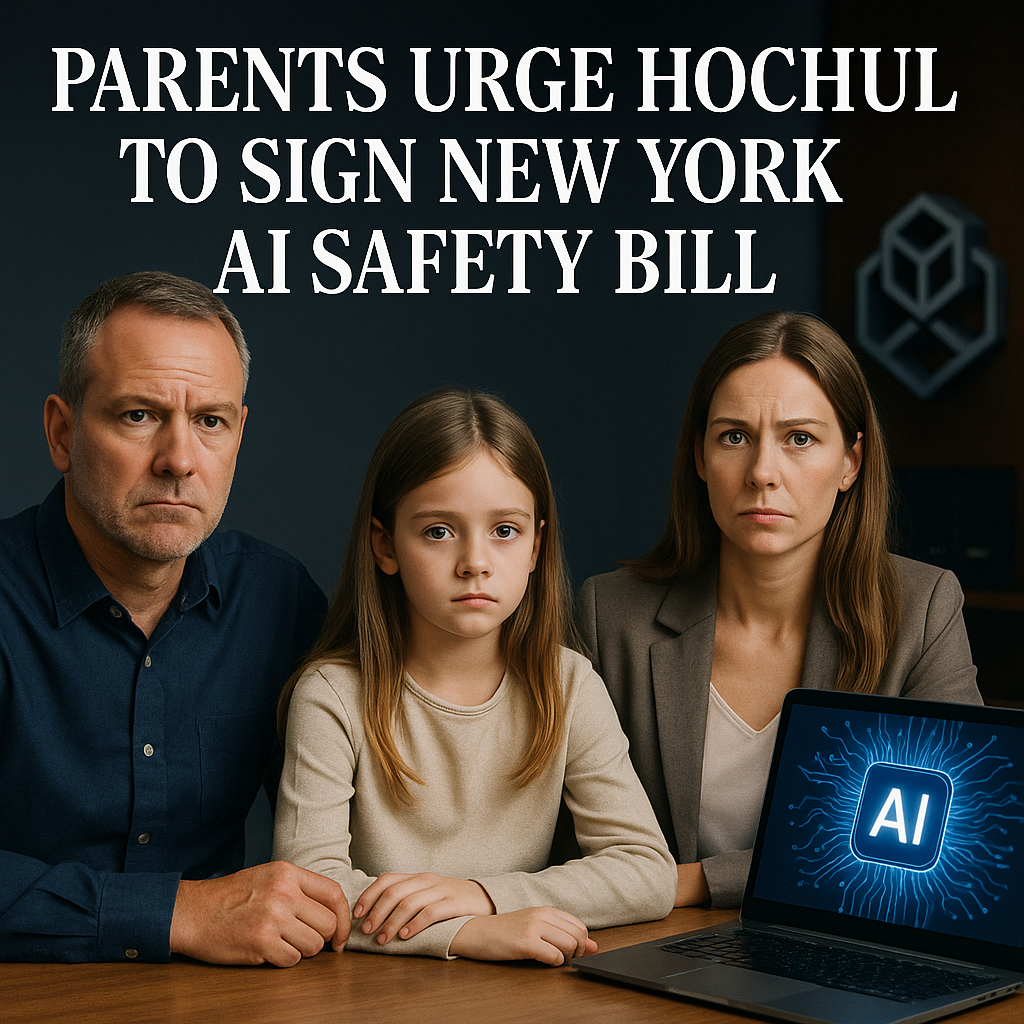
Parents press Governor to act on landmark AI safety bill
Parents and child-safety advocates gathered in Albany this week to urge New York Governor Kathy Hochul to sign a newly approved, landmark AI safety bill they say is critical to protecting children from deepfakes, targeted manipulation and opaque algorithms. The push comes as lawmakers and tech companies scramble to define rules for generative AI systems after the rapid mainstreaming of tools such as OpenAI’s ChatGPT (launched in November 2022) and Google’s Gemini.
What the bill would do and why parents are worried
The legislation, which won approval from both chambers of the state Legislature after months of hearings and amendment, would require greater transparency and safety testing for AI models deployed in New York that affect minors. Key provisions would mandate risk assessments for models that generate content, rules for labelling AI-generated imagery and audio, and requirements for companies to demonstrate mitigations for harms such as misinformation, child sexual exploitation, and targeted advertising to minors.
Parents at the rally said the change in scale — from hobbyist chatbots to large language models with billions of parameters — has left schools and families exposed. “Deepfakes and persuasive disinformation are no longer theoretical,” said one parent who attended the Albany event. Advocates point to research showing young people spend significant time with digital content — a 2022 Pew Research Center study found 95% of teens use YouTube and 67% use TikTok — and warn those platforms and AI-driven services can rapidly amplify harmful content.
Industry context: why regulators are focusing on AI now
The industry has responded to public scrutiny with voluntary measures such as “red-teaming” exercises and transparency reports. Major players — OpenAI, Google (Gemini), Meta (Llama and Meta AI), and TikTok owner ByteDance — have invested in safety teams and content-moderation tools. OpenAI, for example, reached roughly 100 million monthly users for ChatGPT in early 2023, underscoring the velocity of adoption that regulators say outpaced governance.
But parent groups and consumer-rights organizations argue voluntary steps are insufficient. They point to opaque model training practices, unchecked personalization, and adversarial misuse that can weaponize synthetic media. Proponents of the New York bill say formal, enforceable requirements will push vendors to bake safety into product design rather than bolt it on post‑release.
Analysis: implications for industry and other states
If Governor Hochul signs the bill, New York would join a handful of U.S. states taking aggressive stances on AI governance, creating a regulatory precedent that could influence federal lawmakers. Tech companies may face new compliance overhead — mandatory model documentation, third-party audits, or product changes to limit risky features for minors. That could accelerate adoption of industry best practices like model cards, data provenance tracking, and differential privacy techniques.
However, companies warn of fragmentation: state-level mandates differing from federal or international rules (such as the EU AI Act) could create complexity for platforms operating across jurisdictions. Smaller startups may be disproportionately burdened by auditing costs, while larger firms could absorb compliance work into existing trust-and-safety or safety-research teams.
Expert perspectives and advocacy views
Child-safety and consumer groups — including Common Sense Media and the Electronic Frontier Foundation — have publicly argued for stronger guardrails around AI systems that affect children, calling for transparency, clear age-appropriate defaults, and enforceable penalties for companies that fail to protect minors. Policy analysts say the bill is notable for centering children in AI governance rather than treating them as an afterthought.
Privacy and AI governance experts warn that effective implementation will hinge on technical standards and the state’s capacity to audit complex systems. The bill’s success will depend on clear definitions (what constitutes an AI “model” or a system that “affects” minors), reporting mechanisms, and whether the state hires technical staff or relies on independent auditors to validate vendor claims.
Conclusion: what comes next
With the governor’s signature pending, parents and watchdogs say they will continue monitoring implementation and enforcement. For tech companies, the law — if enacted — will be another sign that product teams must operate with safety, transparency and accountability at the center. For policymakers, New York’s move may catalyze a broader national debate about how to balance innovation with the protections children and families demand in an era of powerful, widely available generative AI.
Related topics and internal linking opportunities: AI regulation, algorithmic accountability, EU AI Act, Common Sense Media reports, OpenAI safety practices.
About the Author