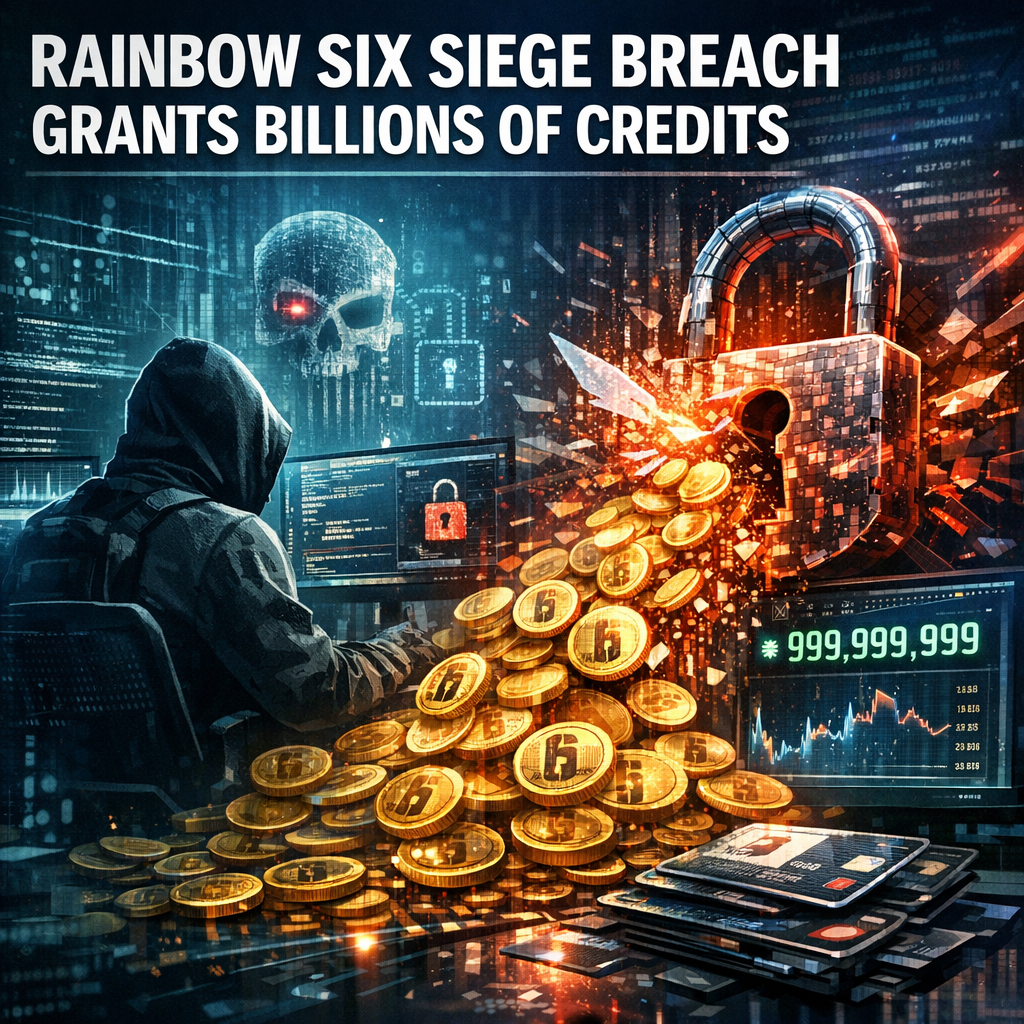
Massive breach lets players inflate in-game currency
According to reporting by BleepingComputer, an apparent breach affecting Ubisoft’s Rainbow Six Siege allowed some players to add vast sums of in-game credits to their accounts. The issue, first surfaced publicly in BleepingComputer’s coverage, reportedly resulted in billions of credits being created or credited across multiple player accounts, undermining the game’s economy and prompting urgent investigations by developers and security teams.
What happened and how it was discovered
BleepingComputer’s story states that the anomaly was discovered after large, anomalous credit balances appeared in player inventories and on community tracking sites. While Ubisoft has not published a detailed technical postmortem at the time of BleepingComputer’s report, the patterns described suggest a backend- or server-side integrity problem rather than a simple client-side cheat. In-game currencies such as Renown and R6 Credits are central to progression and monetization in Rainbow Six Siege, making any uncontrolled inflation a serious issue for both players and the publisher.
Potential mechanisms and Ubisoft response
Public reporting did not disclose the exact vector exploited. In similar incidents across live-service games, these problems have stemmed from exposed APIs, insufficient validation on transaction endpoints, admin tooling leaks, or synchronization bugs between services. Ubisoft’s standard playbook for such events has included rolling back illicit account changes, issuing bans for rule violations, and patching server-side logic; however, BleepingComputer noted that details of Ubisoft’s immediate mitigation steps were not fully clear in early reports.
Context and background: why in-game currency breaches matter
Live-service titles like Rainbow Six Siege rely on a delicate balance between free progression (Renown) and paid currency (R6 Credits). Artificial inflation of currency distorts progression, devalues paid purchases and rewards, and can catalyze fraud or chargeback disputes. Beyond direct economics, breaches erode player trust — a critical metric for long-running online games that monetize through microtransactions and battle passes.
Rainbow Six Siege, developed by Ubisoft Montreal and launched in 2015, has remained commercially significant through continuous updates, esports support and seasonal content. That longevity increases the stakes of any incident that threatens competitive integrity or perceived fairness among the player base.
Expert perspectives and analysis
Security practitioners and game-economy analysts told BleepingComputer and other outlets that incidents of this type underscore the importance of end-to-end integrity checks and robust telemetry. Observers note that server-side validation, strong authentication for administrative tools, rate-limiting of account operations, and immutable transaction ledgers are common mitigations.
Industry analysts warn that visible inflation events accelerate community scrutiny and can force heavier-handed enforcement actions. Even if developers reverse balances or claw back credits, the social impact can persist: players who spent illicit credits may resist reversions, while others worry about bans or account freezes. For publishers, balancing corrective action with customer relations becomes a complex PR and legal exercise.
Possible wider implications
If the breach reflects systemic weaknesses in Ubisoft’s backend services, it could prompt wider remediation across other live services operated by the company. Regulators and payment processors also pay attention to monetization integrity; large-scale fraud or perceived negligence can lead to chargeback volumes, merchant penalties, or increased regulatory inquiries in some jurisdictions. For competitive play and esports, organizers must decide whether to void results tied to affected accounts.
Conclusion: trust, enforcement and next steps
The BleepingComputer report highlights a reminder for live-service operators: protecting the invisible plumbing of a game’s economy is as essential as shipping content. For players, the immediate priorities are transparent communication from Ubisoft, concrete remediation steps and fair enforcement policies. For Ubisoft, the incident will likely trigger audits of transaction flows, tighter controls on admin tooling and an assessment of rollback and customer-relations strategies.
Until Ubisoft publishes a full disclosure or technical postmortem, many specifics will remain unclear. What is already evident is the reputational risk: unchecked currency inflation not only harms in-game balance but also tests the trust that long-running multiplayer titles rely on to keep communities healthy and paying.
About the Author