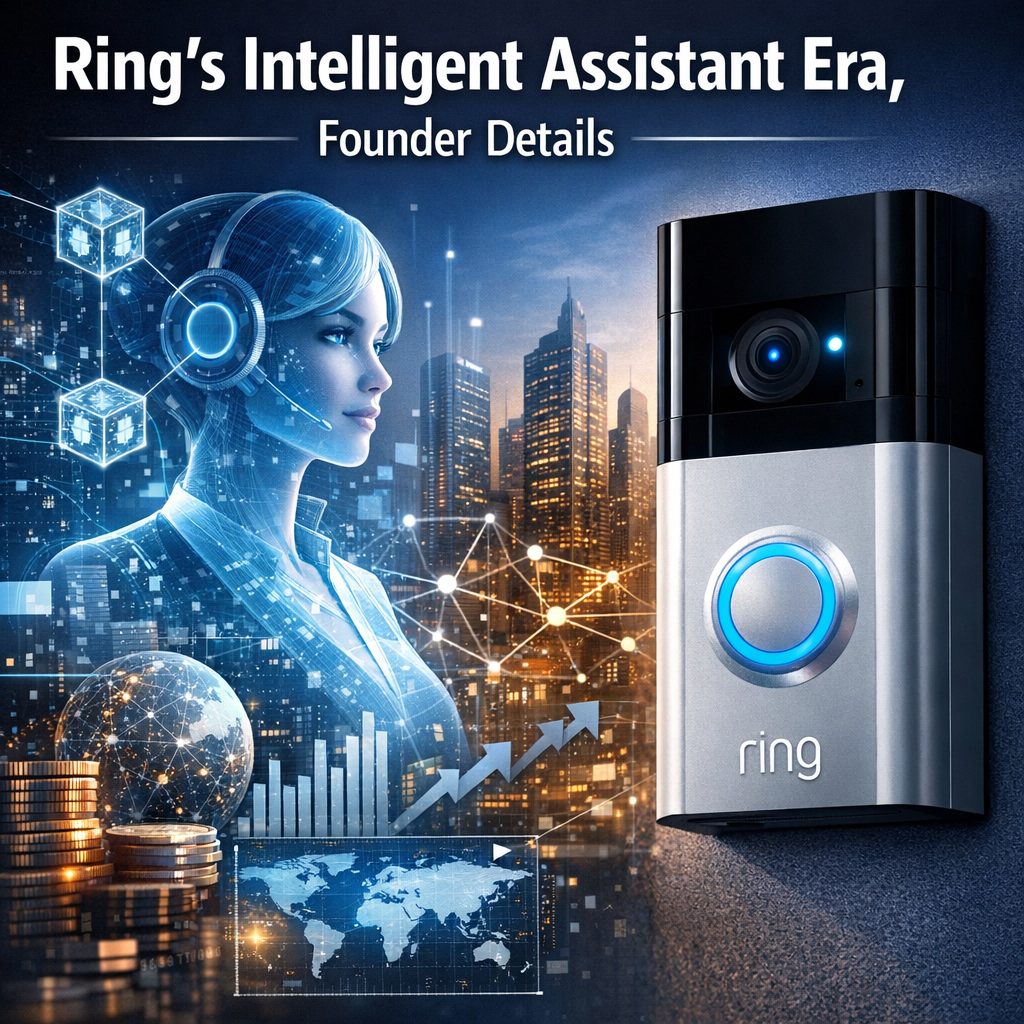
Founder outlines who, what, when and why
Jamie Siminoff, the entrepreneur who launched Doorbot in 2012 and later rebranded it as Ring, has framed the camera company’s next phase as an “intelligent assistant” era. Siminoff, Ring’s founder and its highest-profile executive since the startup’s $1 billion-plus acquisition by Amazon in 2018, has described a strategic shift away from passive video recording toward proactive, AI-driven assistance embedded in doorbells and home cameras.
The pivot — made public in Siminoff’s recent statements to trade press and stakeholders — emphasizes on-device processing, context-aware alerts and deeper integration with smart-home ecosystems such as Amazon Alexa. The change responds to both consumer demand for smarter automation and growing concerns about privacy and cloud dependency that have shadowed Ring since its rapid rise.
Products, features and technical direction
Ring’s product line — including the Ring Video Doorbell family, Ring Stick Up Cam, and the Ring Alarm ecosystem — has incrementally added machine vision features in recent years: people-only motion zones, package alerts, and differentiations between vehicles, animals and humans. Those object-detection capabilities have historically relied on cloud-based analysis, tied to the company’s Ring Protect subscription. Under the “intelligent assistant” framing, Siminoff signals a heavier push to edge computing and local inference to reduce latency, cut cloud costs and limit the amount of footage leaving the home.
That strategy mirrors broader industry trends. Competitors such as Google Nest, Arlo and budget players like Wyze are also investing in embedded AI and improved local processing. For Amazon-owned Ring, the technical choices also intersect with the parent company’s Alexa platform: tighter voice and camera integrations can turn a Ring device into a proactive household assistant, not merely a sensor.
Why this matters: privacy, monetization and trust
The move has clear commercial logic. Intelligent assistants enable upsells — advanced alerts, richer automation and subscription tiers — while making the devices more useful in daily life. Ring already monetizes through Ring Protect, which stores video in the cloud and unlocks advanced detection. Shifting some workloads on-device can reduce recurring costs and open new feature pathways that don’t require continuous cloud access.
But the technical pivot also addresses regulatory and reputational pressures. Ring’s partnerships with law enforcement and the roll-out of the Neighbors app prompted scrutiny and criticism over data sharing and surveillance starting around 2019. Reducing the volume of data transmitted off-device and providing users greater control over what is shared are practical ways to rebuild trust, even as the company deploys more sophisticated sensing.
Expert perspectives and industry reaction
Industry observers say Ring’s messaging is consistent with a market-wide recalibration. “Smart-home vendors are learning that intelligence at the edge is both a technical necessity and a privacy requirement,” said an independent analyst who follows consumer IoT. “The challenge is delivering useful predictive features without opening new vectors for misuse.”
Privacy advocates have argued that on-device AI is not a panacea: local processing reduces raw footage transmission, but smart assistants still create metadata and decision logs that can be sensitive. Policy experts caution that features which proactively alert authorities or aggregate neighborhood-level insights will require transparent controls and clear audit trails.
Implications for consumers and the market
For consumers, the immediate benefits are practical: faster alerts, fewer false positives and a smoother integration with voice assistants and home automation. For the market, a successful transition to assistant-style features could raise the bar for competing camera makers, pushing more of the industry toward edge-first architectures.
Yet the transition will not be without friction. Upgrading legacy installed bases, managing subscription economics and ensuring that new assistant features respect user consent are complex operational tasks. How Ring balances those demands will shape both its commercial trajectory and its relationship with homeowners and municipalities.
Conclusion: a cautious, pragmatic future
Jamie Siminoff’s articulation of an “intelligent assistant” era for Ring captures an inflection point for smart-home security: from passive observation to active, contextual help. The technical and commercial incentives are clear, but so are the privacy and governance challenges. If Ring succeeds, the company will have to demonstrate that smarter cameras can also be more respectful of users — and that convenience does not come at the expense of control.
About the Author