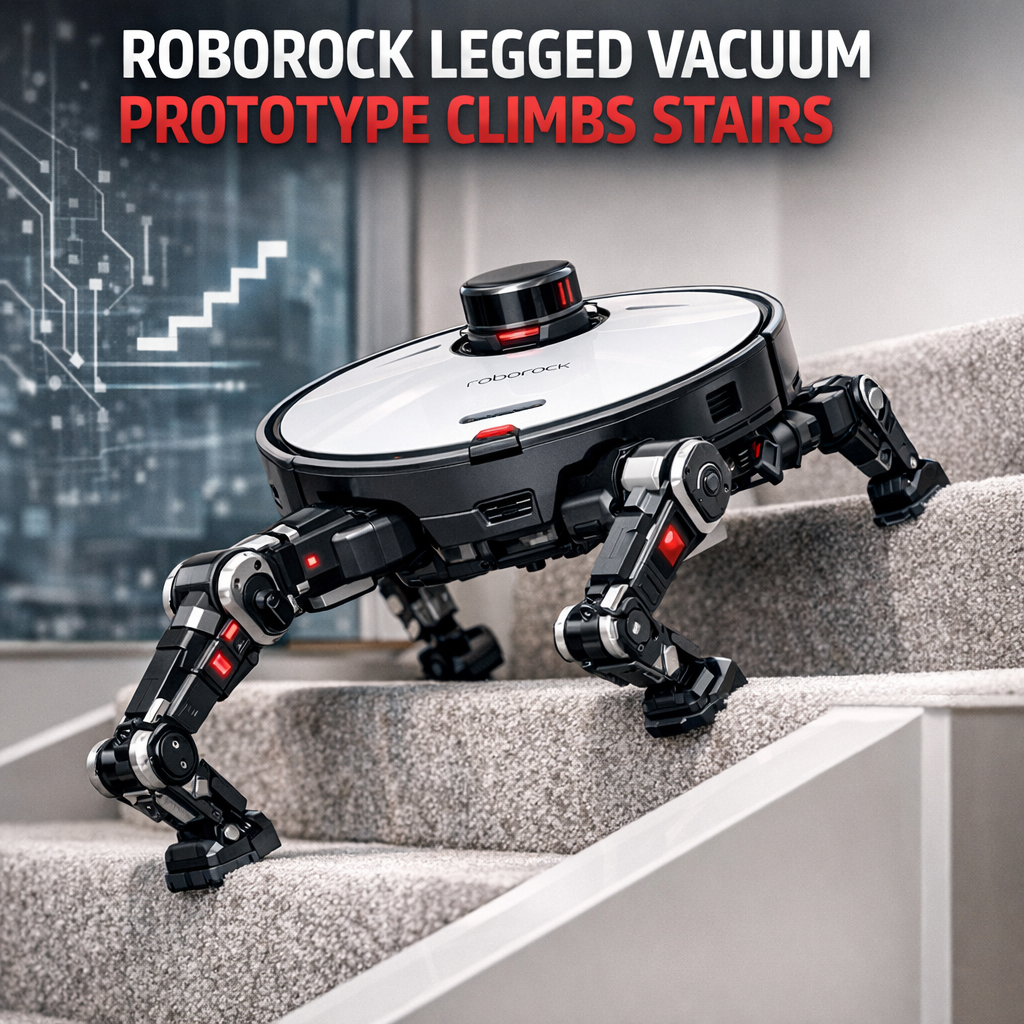
Roborock unveils stair‑climbing prototype
Chinese robot‑vacuum maker Roborock has demonstrated a prototype vacuum cleaner equipped with articulated legs capable of climbing stairs, Bloomberg reported. The device — presented as an early engineering model rather than a finished product — was shown in media coverage this week as an example of how consumer‑robot companies are exploring new form factors to tackle long‑standing limitations of wheeled vacuums.
The prototype is intended to address a practical shortcoming: conventional robot vacuums generally cannot traverse steps or move between floors without human intervention. Roborock’s legged approach would allow a single unit to clean multilevel homes without shuttle devices or owners having to carry the robot up and down stairs.
How the legged vacuum works and engineering trade‑offs
Roborock’s concept replaces or augments the robot’s wheels with articulated legs and actuators that lift and propel the unit over vertical obstacles. Though the company has released limited visuals and high‑level description through the Bloomberg reporting, the design appears to combine locomotion elements common in legged robotics — such as jointed limbs and sensors for foot placement — with Roborock’s existing vacuum and navigation stack.
Legged locomotion can extend range and mobility, but it introduces new challenges. Actuators for lifting the robot increase weight and draw significant power, which can reduce vacuum run time. Mechanical complexity raises manufacturing costs and potential points of failure. Successful deployment will require robust perception systems to map steps and detect handrails or other hazards, plus fail‑safe behaviors for uneven or fragile staircases.
Battery, sensors and mapping considerations
To operate safely on stairs, a legged vacuum needs precise sensing and fast feedback loops. Roborock has built its reputation on lidar‑based mapping and advanced path planning in its wheeled models; applying those systems to legged gaits will demand additional software development. Engineers will also have to balance suction performance, dustbin capacity and battery life against the weight and power draw of the leg mechanisms.
There are broader safety and liability questions as well. A heavier, mobile robot moving on stairs must avoid dropping or striking people and pets. Manufacturers will face regulatory scrutiny and higher testing burdens before such a device could be sold for general consumer use.
Market context and competitive landscape
The robot‑vacuum market is mature and highly competitive, with companies such as iRobot, Ecovacs and Dreame Technologies offering a wide range of mapping, suction and mopping features. For several years the product category innovated incrementally — better mapping, stronger suction, hybrid mop‑and‑vacuum units — but core capability limitations remain, especially for multilevel homes.
Roborock’s prototype, if it reaches production, would represent a noteworthy differentiation: enabling a single autonomous unit to traverse stairs could appeal to owners of two‑ or three‑story houses and to service use cases where human labor is costly. However, moving from proof‑of‑concept to viable consumer product typically takes time and additional engineering investment, and it is unclear when or whether Roborock will announce commercialization plans or pricing.
Analysis: practical promise, uncertain timing
From a product strategy perspective, the legged vacuum is a signal that makers of domestic robots are searching for visible, headline‑friendly breakthroughs to reignite growth. Robotics researchers have long demonstrated stair‑climbing machines in lab settings; translating that capability into a low‑cost, reliable consumer appliance is a separate challenge. If Roborock can balance durability, safety and cost, it could open a new subsegment within consumer robotics. If not, the prototype may join a long list of ambitious demos that never make it to market.
Industry analysts point out that commercial success will depend on factors beyond pure engineering: warranty exposure, return rates, customer education, and service networks for mechanical repairs. For high‑value purchases like advanced home robots, consumers expect reliability and predictable maintenance costs.
Outlook and implications for consumers
Roborock’s demonstration highlights how companies are continuing to push the boundaries of household robotics. For consumers, the idea of one autonomous machine handling multiple floors is appealing, but prospective buyers should temper expectations: demonstrations do not equal product launches. Roborock has not announced a release date, pricing or certification plans, and early adopters should expect a cautious, incremental rollout if the company decides to commercialize the design.
Longer term, the push toward more capable locomotion in consumer robots could spur complementary advances — lighter actuators, more efficient batteries, and improved perception software — that will benefit a range of home automation devices. For now, the legged prototype is a clear signal that makers are still experimenting with new ways to solve old household problems.
About the Author