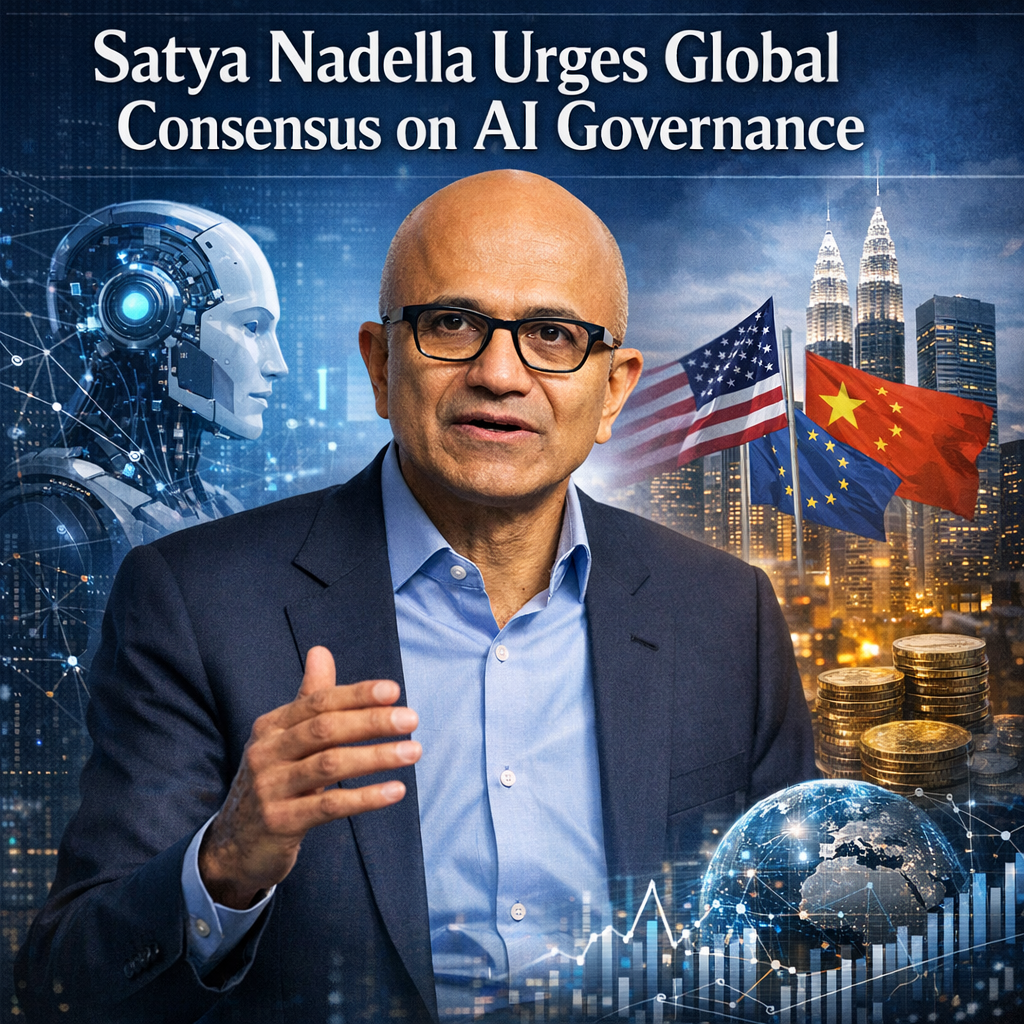
Nadella urges who/what/when/why
Microsoft chief executive Satya Nadella has urged governments, technology companies and civil society to seek a broad international consensus on the governance of artificial intelligence, arguing that coordinated rules and standards are needed to manage risk without stifling innovation. The call was reported by The Register and reflects growing pressure on major cloud and AI vendors to help shape practical regulatory frameworks as generative AI systems proliferate.
Why consensus matters now
The pace of progress in large language models and multimodal AI systems—pioneered and popularized by companies including OpenAI, Google (DeepMind), Anthropic and Microsoft—has outstripped many existing legal and regulatory frameworks. Microsoft itself has woven generative models into products and services such as the Azure OpenAI Service, GitHub Copilot and Microsoft 365 Copilot, and has been one of the most visible industry voices calling for guardrails that balance safety, competitiveness and public benefit.
Regulatory momentum is already under way. The European Union has advanced what is widely known as the AI Act—the most comprehensive bloc-level regulatory effort—while the United States issued a White House executive order on AI in October 2023 that set federal priorities around safety, innovation and public trust. Nadella’s appeal for consensus acknowledges the fragmentation risk: divergent national rules could create compliance complexity, geopolitical tensions and technical fragmentation that impede interoperability and enforcement.
Details and industry context
Microsoft’s call for consensus comes as companies and policymakers debate key regulatory questions: how to classify high-risk systems, how to require transparency and documentation (including model cards and risk assessments), responsibility for emergent harms, and how to secure data and model supply chains. Industry players favor approaches that rely on standards, certification and outcomes-based rules rather than prescriptive design limits; many governments, by contrast, want clearly enforceable obligations for safety, liability and auditing.
For Microsoft, the push for common rules is also strategic. The company is both a major cloud provider and a leading integrator of partner models, including a multi-year partnership and capital investment with OpenAI. That dual role means Microsoft has operational exposure to compliance costs, cross-border data flows and customer demand for predictable governance. A patchwork of national regimes would increase complexity for enterprise customers and cloud operators alike.
Regulatory trade-offs and technological realities
Experts say there are real trade-offs. Rapid regulation can limit capabilities or entrench incumbents if compliance is costly; weak regulation may leave users exposed to safety, privacy and misinformation risks. Technologists also warn that purely technical mitigations—watermarking outputs or red-teaming models—are necessary but insufficient without legal and institutional mechanisms to enforce standards and provide remedies.
Expert perspectives and analysis
Policy analysts and academic observers welcomed Nadella’s call for a cooperative approach but stressed that industry leadership must be complemented by independent oversight. Many commentators argue that consensus should include enforceable transparency requirements, third‑party auditing, and public-interest research funding to test real-world impacts. Civil-society groups, meanwhile, have pushed for binding rights for individuals affected by automated decisions and stronger safeguards around surveillance use cases.
Analysts also note the geopolitical dimension: any consensus will need to bridge differences between U.S., European and Asia-Pacific regulatory philosophies. Europe’s precautionary, rights-based approach contrasts with the U.S. emphasis on innovation and sectoral regulation, and China’s AI governance frameworks prioritize state control and security. Achieving operational consensus will therefore require diplomatic and multi-stakeholder mechanisms that translate high-level principles into interoperable technical and legal standards.
Practical implications for companies and users
For enterprises deploying AI, Nadella’s message signals that major cloud vendors expect clearer rules—both as a way to protect customers and reduce legal uncertainty for suppliers. That could accelerate investment in compliance tooling, model provenance systems, and auditing capabilities. For startups, faster standardization could lower market friction in the long run but may raise near-term compliance costs.
Outlook and takeaway
Nadella’s appeal for consensus is emblematic of a broader industry pivot from rapid capability deployment toward institutionalizing safeguards and accountability. The next 12–24 months are likely to be decisive: negotiators will flesh out the details of the EU AI Act, national regulators will issue guidance implementing the U.S. executive order, and standards organizations will try to translate policy signals into technical interoperability. Whether those efforts produce a coherent international architecture will determine if the benefits of generative AI can be realized while managing its systemic risks.
About the Author